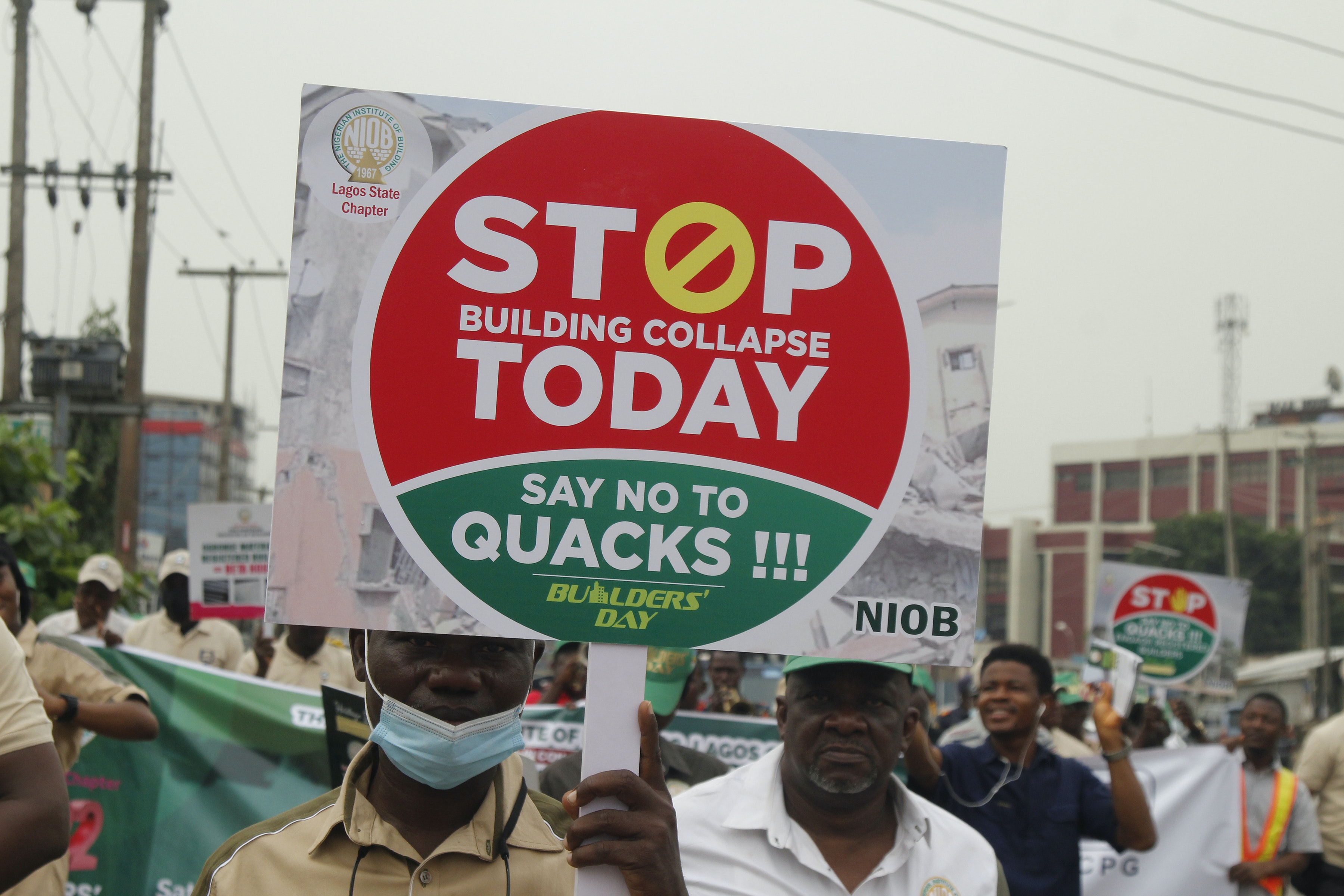
Buildings in Lagos state, Nigeria’s economic hub, have in recent years been collapsing in greater numbers than ever. Between 2000 and 2021 the city experienced 167 reported cases, with significant human and economic losses.
The latest data from Lagos State Emergency Management Agency showed that between January and July 2022, Lagos recorded 24 cases of total building collapse, six of partial collapse and one of impending collapse. Eighty-four Lagosians have been killed in building collapse incidents in the last two years.
Ghana’s capital, Accra, in contrast, had only eight building collapses between April 2000 and February 2016.
This grim Nigerian data reflects the failure of the Lagos state government to protect its citizens.
Drawing from my previous research, I have identified that high-rise residential buildings make up most of the collapses in Lagos. The reasons include the use of substandard materials and unqualified or unskilled builders.
Other factors include non-adherence to the National Building Code, illegal conversion of existing structures and ineffective monitoring by regulatory agencies.
The recent spate of building collapse in Lagos presents an opportunity for the government to get tough on the construction industry and prevent future incidents. Citizens also have a part to play.
In this article I set out five critical issues I consider indispensable for building safety, stability and sustainability. They are all germane, given the disastrous state of building development in Lagos in the past four years.
1. Test the integrity of all high-rise buildings
The starting point is to recognise that high-rise structures are at the highest risk of collapse. This is due to structural inadequacies and professional ineptitude on the part of the developers.
Previous studies suggested that government didn’t implement the recommendations from past integrity tests of buildings in Lagos. This was likely due to a lack of political will to ensure fundamental standards were maintained. It suggests the government might only be paying lip service to building safety.
Urgent and frequent integrity tests of all high-rise buildings in Lagos are needed. Those built more than five years ago are in particular need of testing. A structural integrity test confirms the stability of buildings and determines whether they are fit for people to live in.
Government must also ensure that buildings that are not structurally habitable are either strengthened or demolished immediately.
2. Identify and prosecute offenders
Government must identify and prosecute landowners, investors, consultants, architects, quantity surveyors and engineers involved in previous cases. It must also publish all permits received during those projects and all documents related to safety testing.
This will show its commitment to putting an end to the loss of lives and property. It will also enable a thorough investigation into the causes of building collapses and ensure there are consequences for failures.
It will encourage more responsible practices in the construction industry.
3. Overhaul and restructure agencies and ministries
The recent resignation of the Lagos State Physical Planning and Urban Development commissioner was a step in the right direction. Nevertheless, the agencies and ministries responsible for monitoring the construction process appear overwhelmed and handicapped in enforcing building regulations. This is due to ineffective monitoring, lack of human resources and corruption among officials in charge of building approval.
There is also a serious governance issue that must be addressed. Building control should be a local government responsibility. In Nigeria, however, it falls under the state government. Nigeria currently runs a three-tier federal system comprising federal, state and local governments.
As a result of the constitutional reforms made between the 1970s and 1990s some of these tiers of responsibility were arbitrarily altered. The building control function was transferred from local to state governments.
Thus, a total overhaul and restructuring of all the agencies and ministries responsible for monitoring the construction process is urgently required. This could be done by prosecuting complicit government officials involved in the approval of previous collapsed buildings.
Improved tactics and logistics in monitoring construction could also be deployed.
Building control must be returned to the local governments and they must ensure that they have enough qualified, quality personnel.
4. Integrate governance of the construction industry
Governments, professional bodies and citizens all have essential roles to play in preventing building collapse in Lagos. The starting point is the sensitisation of citizens and building developers by the emergency management agencies and professional bodies. They should focus on the need to obtain planning permission, engage professionals in the construction of their buildings and report cases of illegal construction activities in their community.
Government must also collaborate with professional bodies and make sure that individuals or building developers consult certified professionals like engineers.
5. Enforce laws and policies
A review of enforcement and building control regulations in Lagos state shows the problem is not inadequacy of relevant laws and monitoring agencies. Rather it’s a lack of proper enforcement of building regulations.
The state government must quickly take decisive steps to implement existing building control regulations and measures for transparency and accountability in its processes. Simple but important things like information display boards at construction sites should be enforced. There is also an urgent need for public awareness of the regulatory requirements for buildings. The public should demand transparency from developers and landlords.


