Five things South Africa must get right for tech in schools to work:
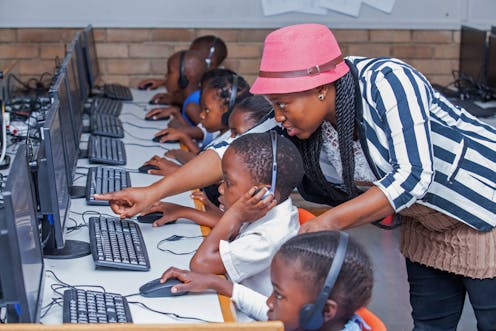
South Africa says it is pushing ahead to grasp the many opportunities presented by the fourth industrial revolution. President Cyril Ramaphosa has appointed a commission of experts to explore what this fusing of the physical, digital and biological worlds, driven by technology, will mean for the country.
One of the areas in which technology is already playing a major role is the school system with some South African schools having already embraced it. President Ramaphosa announced in his 2019 state of the nation address that tablets would be rolled out to all South African schools. There’s also been extensive research in recent years into the potential role of electronic and mobile learning in the country’s schools.
And there have been other initiatives such as introducing robotics education in primary schools as well as ensuring the provision of digitising learning resources.
But are all South Africa’s public schools ready for this shift? As an academic whose research focuses on educational technology, I would suggest that five important factors must be considered before the answer is a resounding yes.
Read more: Marrying technology and home language boosts maths and science learning
Of course, schools in the country are not homogeneous. But, broadly speaking, infrastructure, ongoing teacher training and support, appropriate localised content, technical support and safety and security must all be prioritised so that educational technology actually does what it’s supposed to: enhances teaching and learning.
Focus areas
The first important area is infrastructure.
Schools need technical infrastructure to support both online and offline access to digital resources. That physical infrastructure needs to managed and properly maintained. For this, proper planning is needed: hardware tends to be the last priority for schools when they have many other financial needs. A sustainable financial plan for hardware maintenance is crucial in the introduction of any technology in schools.
Data costs are another major concern. Software, related applications and learning content need to be available offline so that pupils can keep working beyond the school premises.
The second area that needs attention is teacher training and support. This is not a once off process – it must be continuous. But as it stands, many of the teachers in the education system received very few or no technology infused learning experiences while they were studying.
And, crucially, introducing more educational technology is about more than the addition of a piece of hardware or some software. It also means introducing novel approaches to teaching and learning. Universities that train teachers need to be cognisant of this.
In my own work with the Peo Ya Phetogo Foundation, a non profit organisation aimed at empowering teachers with computer and digital literacy skills, my colleagues and I have learned that teachers need local communities of practice where people work together and learn from each other. This can support their journey of transition from older teaching materials to modern technology. There is also extensive South African research which reflects this issue.
Then there’s localised content. There’s already a lot of local learning software in South Africa but a lot of this is in English. Most South African pupils don’t speak English as their first language, and have to battle with translating difficult concepts into their native language to try and understand what’s being taught. This is made even tougher when they are also learning new platforms and methods, like digital education tools.
Content and education technology developers need to provide adaptable systems which consider the context of use, the culture of use as well as language of use. The design process needs to follow a co-design process which also involves teachers. After all, a potential mobile learning user in South Africa can be some non-English speaker, accessing the mobile learning content in a cattle kraal in a village.
More support and security
The fourth area is technical support. Technology introduction in schools needs ongoing “help desk” support. This task is often left to Computer Applications Technology or Computing subject teachers. These teachers become burdened: they are seen as the the all round computing experts, expected to always be able to handle help desk questions.
My colleagues and I have heard this often in our teacher workshops – these teachers’ colleagues also expect them to keep and remember their passwords on their behalf. Schools in urban, peri-urban and rural schools will need dedicated technical support services which teachers will be able to rely on when facing any technical difficulties.
Finally, there’s safety and security. The use of high-end technology within and beyond schools not only affects teachers and learners but also the affects communities in which the schools are based. In a highly unequal society, crime becomes a challenge for schools, teachers and learners who have to make use of such technologies. Any introduction of technology must be accompanied by a sustainable security plan.
Policy review
This is not to say that technology doesn’t belong in schools. On the contrary, the renewed focus on introducing technology to schools should be celebrated. But it also requires a review of South Africa’s existing technology in education policies and a sustainable plan to ensure that no child is deprived of a skill that is no longer a luxury.

Mmaki Jantjies receives funding from The South African National Research Foundation. She is affiliated with PYP Foundation.
Source: The Conversation – Articles (AFRICA)
Read more on The Conversation.
Join the fun: Add Your event | Submit a Press Release | Add your listing.


