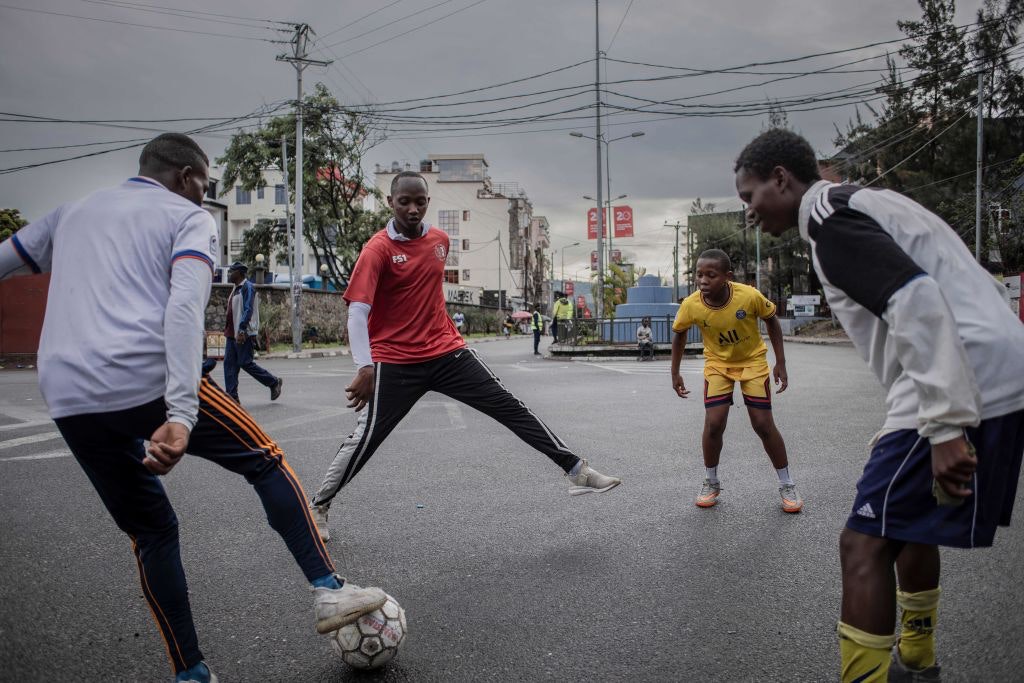
Football in the Democratic Republic of Congo (DRC) – as in much of the world – is intertwined with politics.
In the central African country, football clubs have long been a way for the regime in power to build political capital. Many politicians involve themselves with clubs to bolster their image. On the other hand, football is also a space for political opposition.
In our recent paper, we show how politics and football come together in a number of ways in Kinshasa, the country’s capital city.
Football was particularly important for Joseph Kabila’s regime, from 2001 to 2019. His was a contested and repressive regime. Throughout his tenure as president, Kabila and his party members looked for ways to improve their reputation to gain votes. One way was by financially supporting football clubs. This worked because these clubs don’t have structural or sufficient commercial or state support.
But our study finds that football politics can also work against a regime. During the Kabila years, football stadiums and supporter crowds offered a relatively safe place to protest the repressive regime. Anti-Kabila songs, for example, were often heard at matches.
Football and power
Our interviews with supporters, regime figures and others found that during the Kabila years, supporters and club officials made a distinction between regime figures supporting the club, and the regime. A common statement we heard was:
supporters still appreciated Kabila-associated politicians as long as they were able to provide financial support.
Gabriel Amisi (commonly known as Tango Four), for example, was a close ally of Kabila’s and currently serves as an army general and inspector general of the Congolese army. Amisi has been accused of a wide range of human rights abuses during his time as a rebel commander and an army commander. One press article describes him as “the butcher of Eastern Congo”.
Between 2007 and 2020, Amisi was president of the AS Vita Club, one of the biggest clubs in Kinshasa. Before 2007, the team was performing poorly. Under Amisi’s leadership, the team won three national titles and excelled internationally. Players remember his leadership as providing financial stability, with regular and good salaries, and material supplies.
This made him very popular. When Amisi tried to resign in 2012 after AS Vita Club’s elimination from the national league, the team’s management and club supporters didn’t accept his submission. When protests began against the Kabila regime in 2016 in Kinshasa, AS Vita supporters protected Amisi’s house.
Human Rights Watch has documented how Amisi (and other elite figures) used youth league members of football clubs to infiltrate protests against the Kabila regime “and incite protesters to loot and commit violence”.
An association with regime figures gives football clubs advantages, such as protection from prosecution if supporters are caught up in stadium violence. This makes it unattractive for clubs to associate with opposition figures, who generally have less money to invest and less political power.
In this way, Congolese football isn’t very different from football elsewhere in the world. It has been shown how worldwide – not only on the African continent, but in a variety of places such as Turkey, Indonesia and Malta – football helps regimes to reproduce their hegemony, particularly by creating political capital.
Football and protest
But the opposite has also been shown. Football has played an important role in contesting power. It has, for example, played a role in decolonising struggles in Zimbabwe, Zanzibar and Congo-Brazzaville; and in the Arab spring in the 2010s.
These dynamics also played out in Kinshasa, where football supporters participated in decolonisation struggles. On 16 June 1957, a match between Kinshasa’s FC Leopoldville and Belgium’s Union Saint Gilloise de Bruxelles led to the first riots leading up to independence. A year and a half later, AS Vita Club supporters played an important role in decisive riots against colonial authorities. In 1960, the DRC got its independence from Belgium.
In the postcolonial period, football has also played a role in challenging power. During the Kabila regime, as political repression escalated in almost every other space, the football stadium became an important venue for political protest.
In the words of a soccer fan in our study:
Since we’re in the stadium, we won’t be arrested. The police knows this: they won’t try anything because we’re way more numerous than them.
The lyrics of protest songs and slogans – referred to as “hymns of the oppressed” – included: “God is doing everything so that Kabila dies!” and “Eeeh, we refuse (to be) the voting machine”.
During the “slippage” period from 2015 onwards – when Kabila went beyond the formal limits of his mandate – anti-Kabila slogans became even more popular.
The engagement of regime figures with soccer clubs didn’t overcome hostile feelings about the regime.
Regime controls
The impact of these confrontations of regime power was limited, though.
For example, during the Kabila regime, radio and TV stations would cut their broadcasting when political songs were sung during games involving the national team. And in late 2016, the minister of sports temporarily suspended the national football competition. The official reason for this was “excessive violence in the stadiums”. But it was widely understood as a political measure by the regime, fearing protests by supporters in reaction to the end of Kabila’s official mandate during this period. The former minister confirmed this to us during interviews.
In sum, football in Kinshasa is politics – but primarily regime politics. Even though political opposition can be expressed through football, it is questionable how much potential for change this carries.
During the authoritarian Kabila regime, the protest role of football was confined. It’s similar under the current Felix Tshisekedi regime, which uses football as a political tool. Kinshasa’s main clubs (Daring Club Motema Pembe and AS Vita), for example, have club presidents who are close allies of Tshisekedi.


