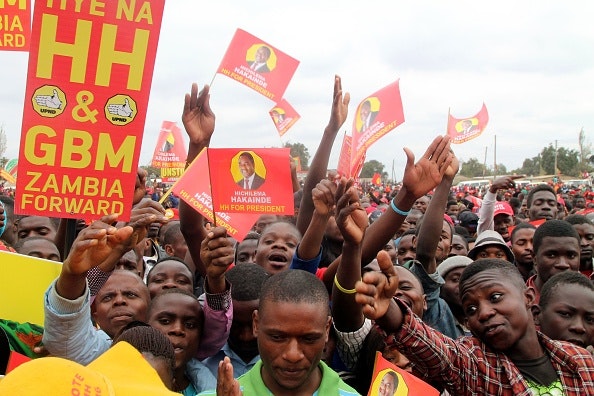
Whoever wins Zambia’s 2021 general elections will face two key challenges: reviving the country’s democratic credentials and stimulating the economy. To achieve this, the new administration must have at least four priorities. These are regaining credibility with the international financiers, fighting corruption, curtailing the dominance of the executive branch of government, and ending the reign of terror by political party vigilantes, known as “cadres”.
On 12 August, Zambians will elect the president, 156 members of parliament and 117 district council leaders. The elections take place in an increasingly contentious environment.
Edgar Lungu, who has been president since 2015 after his predecessor Michael Sata died in office, has shown increasingly autocratic tendencies. He is running for a controversial third term that opponents argue is unconstitutional since he already has been elected twice, in the 2015 and 2016 general elections. The Constitutional Court dismissed the claim since Lungu’s first term was only one year.
The run-up to the polls has been characterised by accusations that the voters’ register has been manipulated to disadvantage strongholds of the main opposition party, the United Party for National Development (UPND), led by veteran politician Hakainde Hichilema. He lost in 2016 by only just over 100,000 votes in an election deemed unfair by international observers.
The military has been deployed on the streets due to excessive pre-election violence that underscores how competitive the election is.
Following a tactic used by Sata in the 2011 elections, Hichilema has mobilised 20,000 election agents from his party to assist a parallel vote tabulation process to help monitor fraud. Such a tabulation is a common methodology based on observing a random sample of polling stations to independently verify election results.
Meanwhile, a recently passed Cyber Security and Cyber Crimes Bill is making citizens wary of how internet and digital communications could be interrupted as election results roll in.
A repeat of the aftermath of the 2016 elections could occur. Specifically, if Lungu claims an outright victory – passing the 50% threshold, thus avoiding the need for a second round of voting – Hichilema will likely contest the elections in the courts. This may result in clashes in the cities.
Whoever wins the elections will face two key challenges: reviving the country’s democratic credentials and stimulating the economy. This will require the new administration to focus on four priorities.
Regaining trust of financiers
Economic debt is Zambia’s biggest challenge. Under Lungu, the debt ballooned from 36% to 110% of GDP. Zambia defaulted on repaying $42.5 million in interest on a Eurobond in November 2020.
Read more: African governments have developed a taste for Eurobonds: why it’s dangerous
The negative impacts of debt servicing have been deeply felt across Zambian households. Multiple factors contributed to the rising debt – including volatile copper prices, drought in 2019, and COVID-19.
The shift by the government towards sovereign financing and Chinese loans since 2012 severely compounded the debt crisis. There has been a lack of transparency about the Chinese loans. This has been made worse by concerns about corruption in the use of Eurobond funding for large-scale infrastructure projects. These two factors have undermined efforts by the IMF to negotiate debt relief on behalf of commercial creditors.
Fighting corruption
Regaining trust, especially with Western donors, requires fighting corruption that has become endemic under Lungu.
In 2017, it was uncovered that the government procured 42 fire trucks for US$42 million. In the same year, the country’s Financial Intelligence Centre revealed that billions of Zambian kwacha had been laundered through high level corruption and tax evasion. In 2018, several bilateral donors halted US$34 million in funding for education and social welfare programmes due to mismanagement.
And, in the midst of the COVID-19 pandemic, US$17 million in procurement irregularities by the Ministry of Health were uncovered.
Curbing executive dominance
Lungu’s government attempted to remove legislative oversight over contracting public debt via a failed constitutional reform known as Bill Number 10.
First introduced in mid-2019, the bill’s other provisions included reducing the National Assembly’s powers to impeach the president. It also allowed for judges to be removed through a tribunal appointed by the president, rather than through the extant Judicial Complaints Commission. Established in 2006, the commission receives complaints against judicial officers and submits recommendation for action to the independent Director of Public Prosecutions.
Civil society organisations and legal experts opposed the attempt to create a “constitutional dictatorship”.
In October 2020, UPND members of parliament walked out of the National Assembly to prevent the bill from being passed. But Lungu’s party has vowed to reintroduce the bill after the elections.
Other forms of executive interference include using the Independent Broadcasting Authority to shut down privately owned news outlets that are critical of the government. This contributes to an already biased media environment.
Tackling party cadres
Finally, there is mounting disenchantment with the Patriotic Front in the party’s traditional strongholds of Lusaka and cities in the Copperbelt Province.
This is due to the party having alienated the urban youth and middle classes because of its repression of civil society, and surveillance on the University of Zambia campus. But the Patriotic Front’s cadres – typically unemployed men hired to extort money, provide informal security for party elites, and disrupt opposition events – are a particular nuisance for urban market traders, minibus and taxi operators.
For instance, they charge extra fees to allow minibuses to pick up customers in particular areas, or threaten violence against traders who refuse to pay them illegal fees to sell from market stalls.
Although they have existed for decades in Zambia, cadres have become increasingly violent and extortionary under the Patriotic Front.
The extortion deprives the city councils of revenue from the markets and bus stations. It has generated a culture of fear and frustration among the urban poor.
But the opposition United Party for National Development has its own cadres who are equally violent. If elected, Hichilema should enable the police to better regulate the cadres. He must also hold councillors elected on his party ticket accountable if they condone cadre activity.
Back to the future or a new beginning?
These four priorities are not new. In 2001, Zambia was massively indebted, politically polarised, and led by a deeply corrupt president – Frederick Chiluba. He tried (and failed) to change the constitution to run for a third term as leader of the Movement for Multiparty Democracy.
Chiluba’s successor, Levy Mwanawasa, also from the Movement for Multiparty Democracy, reversed Zambia’s decline. From 2001 until 2008, the country enjoyed a period of economic growth. This was mostly due to good macroeconomic management that involved fighting corruption. But, when Mwanawasa died in 2008, his successor, Rupiah Banda, created a more restrictive political environment. This contributed to the popularity of the Patriotic Front.
If this year’s election results in a new leader, the onus will be on Hichilema to do a better job than his predecessors at stopping the cycle from repeating itself.


