Frederick Douglass as a young man: 1838 ca.
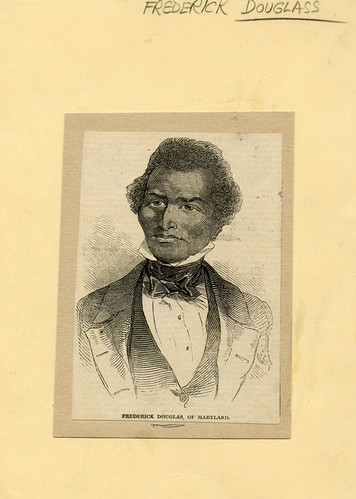
Image by Washington Area Spark
Frederick Douglass, the pre-eminent African American abolitionist prior to and during the Civil War, is shown in an illustration depicting him as a young man about the age shortly after he escaped bondage in Maryland in 1838.
Frederick Augustus Washington Bailey was born into slavery on the Eastern Shore of the Chesapeake Bay in Talbot County, Maryland in 1818. The plantation was between Hillsboro and Cordova; his birthplace was likely his grandmother’s shack east of Tappers Corner, (38.8845°N 75.958°W) and west of Tuckahoe Creek.
The exact date of his birth is unknown, and he later chose to celebrate his birthday on February 14. In his first autobiography, Douglass stated: "I have no accurate knowledge of my age, never having seen any authentic record containing it." Upon gaining freedom, he adopted the name Douglass.
In his autobiography, Douglass related how he learned to read from white children in the neighborhood, and by observing the writings of the men with whom he worked.
Douglass credited The Columbian Orator, an anthology that he discovered at about age twelve, with clarifying and defining his views on freedom and human rights. The book, first published in 1797, is a classroom reader, containing essays, speeches and dialogues, to assist students in learning reading and grammar.
After several failed escape attempts, Douglass boarded a train in Baltimore disguised as a sailor and made the trip to New York City, aided by money and documents provided by his fiancé, Anna Murray who was a free black woman living in Baltimore.
There Douglass went on to become a social reformer, abolitionist, orator, writer, and statesman. He became a national leader of the abolitionist movement in Massachusetts and New York, gaining note for his dazzling oratory[5] and incisive antislavery writings.
During the Civil War, he urged President Abraham Lincoln to utilize African American soldiers. In the 1864 election, he supported John C. Fremont against Lincoln because the President would not commit to voting rights for African Americans.
After the war, he enthusiastically supported President Ulysses S. Grant’s armed suppression of the White Leagues and Red Shirts that were paramilitary arms of the Democratic Party in the South attempting to overthrow elected governments.
In a speech delivered on November 15, 1867, Douglass said: "A man’s rights rest in three boxes. The ballot box, jury box and the cartridge box. Let no man be kept from the ballot box because of his color. Let no woman be kept from the ballot box because of her sex."
Douglass re-located to Washington, D.C. to publish The New National Era, a newspaper designed to cover Reconstruction, the Republican Party and African American Washington, D.C.
Douglass briefly served in the upper house of Washington’s form of self-government before resigning and clearing the way for his son Lewis to serve.
He served briefly as President of the insolvent Freedman’s Savings Bank and was confirmed by the Senate as the city’s United States Marshal during the administration of Rutherford B. Hayes.
He worked as Recorder of Deeds in the District of Columbia for five years and in 1889 was appointed Minister to Haiti.
During this period these jobs helped bring in income, but Douglass stayed true to his calling of being the premier spokesperson for African Americans.
He weighed in on the lack of suffrage in the District saying, “What have the people of the District done that they should be excluded from the privileges of the ballot box? Where, when and how did they incur the penalty of taxation without representation?”
Douglass’ home Cedar Hill in Anacostia often served as a meeting place for both city residents and national social justice advocates.
Douglass died February 20, 1895 after he attended a meeting of the National Council of Women in Washington, D.C. where he received a standing ovation. Shortly after he returned home, Frederick Douglass died of a massive heart attack or stroke. He was 77.
Upon hearing of his death, suffragist leader Elizabeth Cady Stanton wrote the following words that were read at Douglass’s funeral by Susan B. Anthony:
“Taking up the morning Tribune, the first words that caught my eye thrilled my very soul. ‘Frederick Douglass is dead!’’ What vivid memories thick and fast flashed through my mind and held me spellbound in contemplation of the long years since first we met.”
“Trained in the severe school of slavery, I saw him first before a Boston audience, fresh from the land of bondage. He stood there like an African prince, conscious of his dignity and power, grand in his physical proportions, majestic in his wrath, as with keen wit, satire and indignation he portrayed the bitterness of slavery, the humiliation of subjection to those who in all human virtues and capacities were inferior to himself. His denunciation of our national crime, of the wild and guilty fantasy that men could hold property in man, poured like a torrent that fairly made his hearers tremble….”
For more information and related images, see flic.kr/s/aHskXCMjzg
The illustrator is unknown. The image was a Culver Pictures photograph obtained via an Internet auction.
This Free State South Africa image was automatically curated and published with WP Robot plugin – CLICK HERE to learn more about WP Robot for WordPress – a massive time and money saver.
Visit the MyPE YouTube Channel.


