From medicine to nanotechnology: how gold quietly shapes our world:
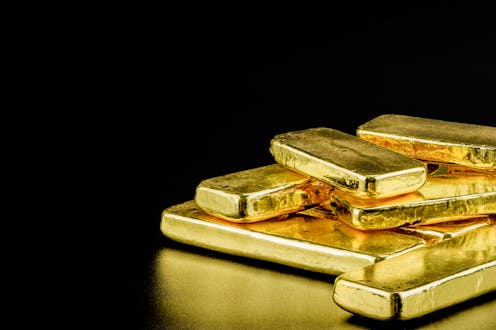
The periodic table of chemical elements turns 150 this year. The anniversary is a chance to shine a light on particular elements – some of which seem ubiquitous but which ordinary people beyond the world of chemistry probably don’t know much about.
One of these is gold, which was the subject of my postgraduate degrees in chemistry, and which I have been studying for almost 30 years. In chemistry, gold can be considered a late starter when compared to most other metals. It was always considered to be chemically “inert” – but in recent decades it has flourished and a variety of interesting applications have emerged.
A long, curious history
Gold takes its name from the Latin word aurum (“yellow”). It’s an element with a long but rather mysterious history. For instance, it’s one of 12 confirmed elements on the periodic table whose discoverer is unknown. The others are carbon, sulfur, copper, silver, iron, tin, antimony, mercury, lead, zinc and bismuth.
Though we’re not sure who discovered it, there’s evidence to suggest it was known to the ancient Egyptians as far back as 3000 BC. Historically, its primary use was for jewellery; this is still the case today, it’s also used in mint coins. Gold is also found in ancient and modern art: it’s used to prepare ruby or purple pigment, or as gold leaf.
South Africa was once the top gold-producing country by far: it mined over 1,000 tonnes in 1970 alone. Its annual output has steadily fallen since then – the top three gold producing countries in 2017 were China, Australia and Russia, with a combined output of almost 1000 tonnes. South Africa has dropped to 8th position, even surpassed by Peru and Indonesia.
But gold’s uses and its chemical properties extend into many other areas beyond jewels and minted coins. From pharmaceutical research to nanotechnology, this ancient element is being used to drive new technologies that are pushing the world into the future.
Why and how it’s useful
Of the 118 confirmed elements in the periodic table, nine are naturally occurring elements with radioactive isotopes that are used in so-called nuclear medicine. Gold is not radioactive, but is nevertheless very useful in medicine in the form of gold-containing drugs.
There are two classes of gold drugs used to treat rheumatoid arthritis. One is injectable gold thiolates – molecules with a sulfur atom at one end, and a chemical chain of virtually any description attached to them – found in drugs such as Myocrisin, Solganol and Allocrysin. The other is an oral complex called Auranofin.
Gold is also increasingly being used in nanotechnology. A nanomaterial is generally considered a material where any of its three dimensions is 100 nanometres (nm) or less. Nanotechnology is useful because it is not restricted to a particular material – any material could in principle be made into a nanomaterial – but rather a particular property: the property of size.
For example, gold in its bulk form has a distinct yellow colour. But as it is broken up into very small pieces it starts to change colour, through a range of red and purple, depending on the relative size of the gold nanoparticles. Such nanoparticles could be used in a variety of applications, for example in the biomedical or optical-electronic fields.
Another exciting advancement for gold in nanotechnology was the discovery in 1983 that a clean gold surface dipped into a solution containing a thiolate could form self-assembled monolayers. These monolayers modify the surface of gold in very innovative ways. Research into surface modification is important because the surface of anything can show very different properties than the bulk (that is, the inside) of the same material.
More to come
Gold nanoparticles have also proven to be an effective catalyst. A catalyst is a material that increases the rate of a chemical reaction and so reduces the amount of energy required without itself undergoing any permanent chemical change. This is important because catalysis lies at the heart of many manufactured goods we use today. For example, a catalyst turns propylene into propylene oxide, which is the first step in making antifreeze.
Two discoveries in the 1980s made scientists look at gold catalysis differently. Masatake Haruta, in Osaka, Japan, made mixed oxides containing gold – and discovered the material was remarkably active to catalyse the oxidation of toxic carbon monoxide into carbon dioxide. Today, this catalyst is found in vehicle exhausts.
At the same time Graham Hutchings, who was working in industry in Johannesburg, South Africa, discovered a gold catalyst that would work best for acetylene hydrochlorination. This process is central to PVC plastic, which is used in virtually all plumbing production. Until then, the industrial catalyst for this process was using environmentally unfriendly mercuric chloride material.
Many applications
In my opinion, gold has many more uses that haven’t yet been discovered. There is much more to come in the world of gold research.
There will, in the next few years, be new developments in how the element is used in, amongst others, medicine, nanotechnology and catalysis. It will also find new applications in relativistic quantum chemistry (combining relativistic mechanics with quantum chemistry), surface science (the physics and chemistry of surfaces and how they interact), luminescence and photophysics – and more.

Werner van Zyl does not work for, consult, own shares in or receive funding from any company or organization that would benefit from this article, and has disclosed no relevant affiliations beyond their academic appointment.
Source: The Conversation – Articles (AFRICA)
Read more on The Conversation.
Join the fun: Add Your event | Submit a Press Release | Add your listing.


