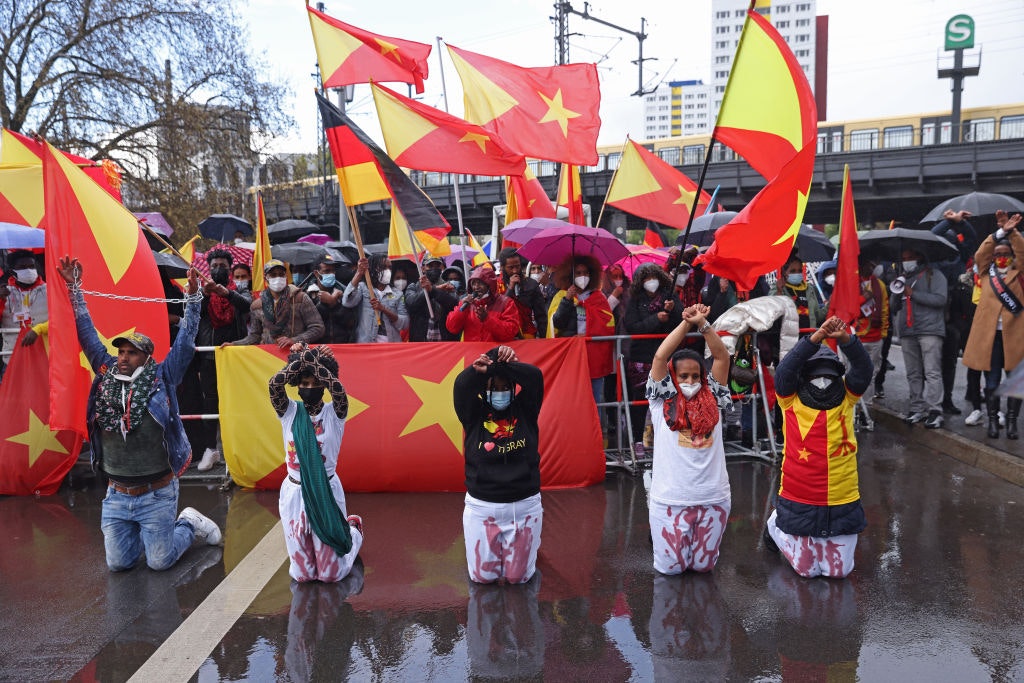
The head of Ethiopia’s Orthodox Church, Abune Mathias, recently condemned the ongoing armed conflict in Ethiopia’s Tigray region and the suffering it’s causing the civilian population. In a video message he was seen saying “genocide is being committed now”.
Abune Mathias may be the highest-profile figure to label the alleged criminal acts against Tigrayans as genocide, but he’s not the first. In January, the leader of the Tigray People’s Liberation Front and former president of Tigray – Debretsion Gebremichael – accused the Ethiopian and Eritrean forces of waging a “devastating and genocidal war” in Tigray. Tigrayans around the world have echoed the same message on social media and at protest rallies.
In addition to this, there have been numerous reports by media agencies and rights groups that corroborate the targeting of civilians.
But what exactly constitutes a genocide?
According to the United Nations, genocide is when certain acts are committed with the intention of destroying, in whole or in part, a national, ethnic, racial or religious group. These acts are:
-
Killing members of the group;
-
Causing serious bodily or mental harm to members of the group;
-
Deliberately inflicting conditions of life calculated to bring about a group’s physical destruction in whole or in part;
-
Imposing measures intended to prevent births within the group;
-
Forcibly transferring children of the group to another group.
The major difference between other grave international crimes – such as crimes against humanity and war crimes – and genocide is that genocidaires have two intentions: the intent to commit crimes against a group and the intent to destroy the group in whole or in part.
I’m an international law expert and have extensively studied cases of past genocide in Ethiopia. Establishing whether a genocide is happening in the country requires an independent and objective investigation. This should, preferably, be carried out by a United Nations (UN) mandated commission of inquiry. Such investigations form the basis of whether the case should be referred to the International Criminal Court (ICC) by the UN Security Council.
In Ethiopia, this investigation needs to cover all major incidents against the country’s Tigrayan population since the start of the conflict.
The challenge is that various actors are involved in the war in Tigray. These include Ethiopia’s national army, the Amhara region’s militia and para-military forces and Eritrea. Not all have the same objective. Any credible investigation needs to separately examine the role played by each to determine whether they harboured a genocidal intent.
No government will announce its genocidal intentions to the world and only a credible investigation can get to the bottom of the allegations.
Genocide trials
Raphael Lemkin, a Polish lawyer, coined the word “genocide”
in 1944 partly in response to the systematic murder of Jewish people by the Nazis. It was also a response to previous actions that targeted groups, such as the Armenians in Turkey and the Herero by the Germans in Namibia.
Genocide was codified into international law in 1948 via the UN Convention on the Prevention and Punishment of the Crime of Genocide. This treaty is ratified by 152 countries. In Ethiopia, the Ethiopian Criminal Code criminalises genocide, though it goes beyond the Genocide Convention by adding political groups to the protected groups.
Prior to the establishment of the ICC, the international community relied on ad hoc tribunals, such as the Nuremberg and Tokyo Tribunals, and more recently the UN tribunals for former Yugoslavia and Rwanda. Only 123 countries are party to the ICC, and Ethiopia is not one of those.
Typically, even for members of the ICC, local courts have the primary responsibility to prosecute genocide. But whether local courts are willing and able to do the task is a different matter.
Ethiopia has a history of prosecuting genocide crimes. In 2007, after a 12-year trial, Ethiopia’s former leader Mengistu Haile Mariam was found guilty of genocide in absentia. The investigation and prosecution was carried out by Ethiopia’s office for the special prosecutor. Regular courts handled the trials. Senior members of Mengistu’s military regime were convicted for carrying out the criminal acts with a view to destroying political opponents.
But prosecuting an overthrown regime is not the same thing as prosecuting an incumbent.
Crimes in Tigray
At the national level, Ethiopia’s Federal Attorney-General is responsible for investigating atrocities. And this office has already begun to look into allegations of crimes committed in Tigray.
One of these was conducted in the historic town of Axum. There are reports that, in November 2020, Ethiopian and Eritrean forces indiscriminately attacked the town, killing and wounding civilians. This continued after they had control of the town. There are allegations that several hundred residents were executed by Eritrean forces.
Ethiopia’s attorney general’s office released its findings. It stated that most of those killed were fighters who died in clashes with Eritrean troops, and not civilians.
I believe it’s unlikely that this was an independent or comprehensive investigation. It probably won’t lead to the prosecution of suspects implicated in the crimes.
Unfortunately, it’s unlikely that the Ethiopian authorities can conduct credible investigation into events in Tigray. Only a UN mandated commission of inquiry can make a finding of whether the matter should be referred to the ICC for further investigation and prosecution of suspects.
Because Ethiopia isn’t party to the ICC, the case would need to be referred by the United Nations Security Council. But China and Russia are two permanent members of the Security Council that typically oppose external investigations into what they regard as “internal affairs”.
Another option is that, as a non-ICC member, Ethiopia could refer itself. But, as Lemkin once stated, genocide by its very nature “is committed by the state or by powerful groups with the backing of the state. A state would never prosecute a crime instigated or backed by itself.”
I believe it’s unlikely that the Ethiopian government would refer itself or carry out a credible investigation.


