Genocide negotiations between Germany and Namibia hit stumbling blocks:
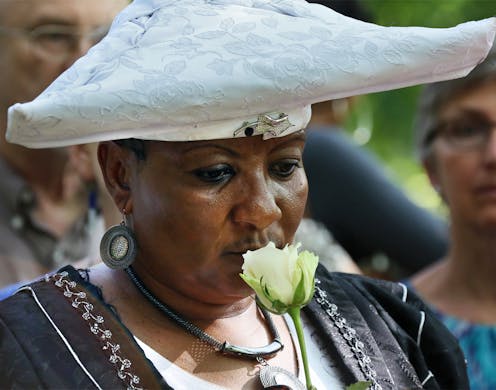
Namibian-German negotiations about the genocide perpetrated in the former German colony South West Africa in 1904-1908 have just entered their third year.
The start of the negotiations in late 2015 marked a turning point after more than a century of German denialism. But now tangible progress seems elusive, and a crisis may be imminent, delaying justice for the Ovaherero and Nama descendants of the main victim groups.
There’s always been unity in Namibia about the broad demands towards Germany – recognition of the genocide, an apology and reparations. This has been true even though there’s been considerable controversy about the issue of representation at the negotiations, with the feud between groups representing the victims and the Namibian government turning bitter at times.
Each of the three issues is throwing up fresh challenges in the negotiations. Hopes that were placed in the shift of German official language in mid-2015 have evaporated. According to the latest indicators, Namibian negotiators are quite doubtful about an outcome of the government negotiations.
The question of genocide
In January 1904 Ovaherero communities in the central parts of the territory resisted the settler-colonial invasion by attacking German farmers. Imperial Germany reacted with military actions seeking to destroy the “savages”.
The genocidal warfare and its aftermath condemned tens of thousands of Ovaherero to death by thirst and hunger in the Omaheke steppe. Witnessing the brute force unfolding, Nama communities in the south took up arms too and entered a drawn-out guerrilla warfare.
Thousands of Ovaherero and Nama, confined to concentration camps died of hunger and malnutrition, harsh weather conditions and the consequences of forced hard labour. According to estimates half to two thirds of the Ovaherero and a third of the Nama did not survive what they call the Namibian War.
Provisions under the so-called Native Ordinances included the sweeping expropriation of African land and the confinement to Native Reserves. They prohibited livestock. For nomadic cattle-breeders this was tantamount to denying their cultural identity.
Groups of Nama were even deported to the German colonies in West Africa. Exposed to forced labour under climatic conditions they weren’t used to, only a few survivors were repatriated towards the end of German colonial rule.
All these events fall under the defined act of genocide in terms of the UN Convention for the Prevention and Punishment of the Crime of Genocide.
The facts are hardly in question – words are.
In mid-2015 the German Foreign Office after decades of denial seemingly acceded, in a very informal way, to labelling what had happened as genocide. The two governments subsequently appointed special envoys to resume negotiations.
But from mid-2017 matters began to deteriorate. Beginning with the German Ambassador in Namibia, German officialdom retracted from using the term genocide. Instead, references were made to “atrocities”.
An apology, and reparations
Two other central issues that have emerged is the apology to be tendered by Germany, and the question of reparations.
In transitional justice, a “deep apology”, rendered by the sovereign of the offending state, is considered a central prerequisite of reconciliation. But German diplomacy seeks to avoid the risk inherent in an apology for mass, including state, crimes. Any apology is offered with the possibility that it can be declined.
And German diplomacy seems to be bent on further goals.
The government negotiations are meant to be confidential. But some points have transpired. The German side has consistently underlined that – from their point of view – reparations are out of the question. But it indicated willingness to consider substantial payments to improve the position of the victim groups in particular.
In this way, any legal obligation was denied. This shifted the meaning of material redress. It replaced a right for compensation of the damages with a German government grant. To Namibian ears at least, this hardly conveyed the genuine remorse that would have to constitute the grounds of a serious apology.
A step back?
German diplomacy appears to be driven by legal considerations more than by anything else. Conceivably, such legal concerns have been enhanced by the legal steps taken by victim groups who have filed a class action complaint with a US District Court in New York. The German side considers such action not valid on account of state immunity and refused to accept the claim.
This argues that states cannot be sued for criminal offences in other states. However, this principle does not apply in cases of genocide. This might explain why the German Foreign Office has backpedalled on its terminology.
Moreover, should an agreement be reached, it is unlikely that it will enjoy the consent and acceptance by the victim groups. But this would be indispensable to gain any legitimacy. Otherwise, any arrangement will not contribute towards reconciliation and closure.
Against this sobering perspective, one will have to look at the perseverance of the victim groups in Namibia. They have demanded recognition, apology and reparation from Germany for the better part of two decades.
Their campaign has developed strong and trustful links with German counterparts. These are the Left Party, sections of the Greens and Social Democrats, and particularly groups of civil society actors, including Afro-German and postcolonial initiatives.
Many thought their aim near at hand. In the meantime, colonial-apologetic roll back – combined with white supremacy and racism – has entered the public sphere and German politics with new force. It will take much stamina in the months if not years to come yet to change the tide by those seeking redress for historical injustices.

Henning Melber is a member of SWAPO since 1974.
Previous research on Namibian-German memory politics has been carried out under the auspices of Arnold-Bergstraesser-Institut, Freiburg, using a grant from the funding initiative 'Knowledge for Tomorrow' of the Volkswagen Foundation.
Source: The Conversation – Articles (AFRICA)
Read more on The Conversation.
Join the fun: Add Your event | Submit a Press Release | Add your listing.


