In the early years of African independence, hydroelectricity offered the promise of modernity and development. For then President Kwame Nkrumah of Ghana, the Akosombo Dam in Ghana (completed in 1965), in conjunction with the Aswan High Dam in Egypt (completed in 1970), would lead to the electrification of the continent. And it would help transform Ghana’s economy and boost development.
But by the 1970s and 1980s, the negative social and environmental
consequences of large-scale dams were becoming more obvious. These crystallised around the construction of the Sardar Sarovar Dam in the Indian state of Gujarat, which displaced over 200,000 people.
The pendulum began to swing away from support to opposition. This stimulated the creation of both local opponents of dam building and transnational anti-dam organisations. The most important became International Rivers, whose campaign director, Patrick McCully, attacked dams on a range of environmental and social grounds.
In 1997 International Rivers and other anti-dam organisations were able to pressure the World Bank, the major funder of large-scale dam-building projects, and the World Conservation Union to establish the World Commission on Dams to review the development effectiveness of dams.
Dam builders thought that the commission would legitimise dam construction. Instead, a report it produced in 2000 presented a negative picture of the role of reservoirs.
But the impact of opposition to dams was short-lived. A dramatic increase in urban populations created a demand for electricity that far outstripped supply.
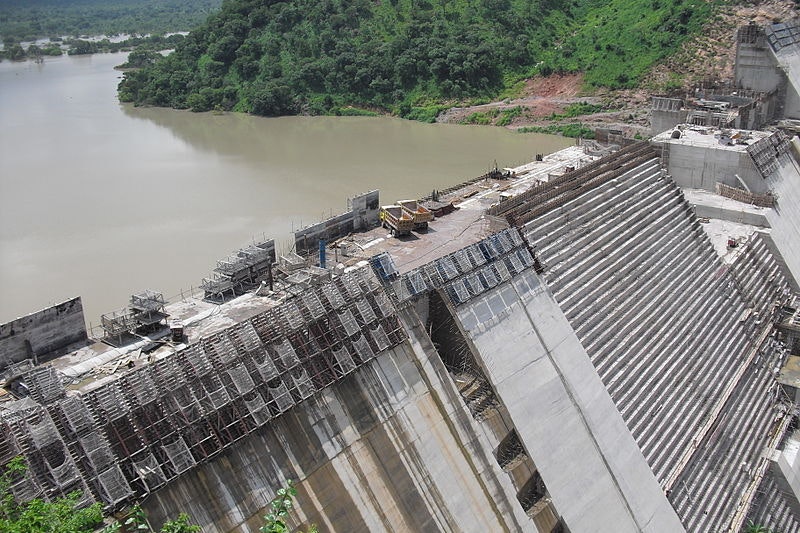
Against this background I reviewed the buildup to the construction of Ghana’s third hydroelectric dam, the Bui Dam. The idea for the dam was first mooted in 1925. But it wasn’t until the beginning of this century that there was any traction. In 2006 the Chinese government loaned money for its construction and it was finally opened in 2013. It was built to generate power and provide water for irrigation.
My paper traces how Chinese companies with similar funding have contributed to a second era of major dam building on the continent, although there still remains considerable contestation.
The return of big dams
In the 1990s Ghana had turned to thermal power plants to meet its needs.
They were relatively cheap to build, but the price of their fuel, mostly oil, was even more unpredictable than river flows, and inevitably increased costs. In general hydro electricity became an attractive option once again. African countries had tapped into less than 5% of the continent’s massive hydroelectric potential. Only a few countries had fossil fuel resources but many more had numerous river basins suitable for hydroelectric facilities.
In the early decades, Western countries monopolised the funding of these large projects. But soon after the turn of the century other capital-rich nations like India, Brazil and especially China emerged as major backers. They had the money and they had the expertise to construct large scale hydro electric
projects. They were also less constrained by anti-dam NGOs.
The first major indication of this new funding reality came in 2004 with the construction of the 1,250 MW Merowe High Dam on the Nile River in the Sudan. Most of the funding came from Arab states awash in petrodollars. The construction company was the Chinese firm China International Water and Electric Corporation.
Two years later the Chinese government agreed to provide loans for the construction of the 400 MW Bui Dam on the Black Volta River. The construction company was the Sinohydro Corporation, one of the largest hydro power construction firms in China.
China has funded other large dam projects on the continent.
The opposition
Anti-dam opponents have not stopped their campaigns against hydro electricity. They maintain that these facilities, especially in the tropics, are significant emitters of greenhouse gases. They submitted a manifesto to this effect to the 2015 UN Climate Conference in Paris. This outlined ten reasons why climate initiatives should not include large hydro electricity projects.
However, the issue that continues to generate the most criticism has been the
inadequacy of the compensation given to people affected by the construction of dams. This has been the Achilles heel of all dam-building projects.
Only 1,216 people needed to be resettled for the Bui Dam in contrast to the over 80,000 for the country’s two previous hydro electric projects. The compensation for those displaced by the Bui Dam construction was far more generous. It consisted of new housing, community facilities and short-term income support.
Nevertheless, providing new livelihoods for people who were subsistence farmers and fished with dugout canoes in the Black Volta River and had minimal education has been a major challenge. It has been outsiders with appropriate skills and resources, such as more seaworthy boats and outboard motors, who have been able to benefit most from the new economic opportunities that the dam has provided.
The new era
The new era of dam building led to major projects, most notably the Grand Ethiopian Renaissance Dam. However, most of the new construction has begun to focus on much smaller hydro electric dams similar in size to the Bui Dam.
Compensating those affected will be an ongoing challenge. Some academics and policy makers have suggested that this should be permanent with a percentage of the hydro power revenue paid to affected communities. This was tried in 2009 in Burkina Faso with the construction of the Bagre Dam. But the plan caused tensions between local councils.
Another more radical, but more equitable, solution would be to impose a surcharge on all electricity users in the country which would then be directed to those most affected by displacements.


