Ghana’s construction industry is lively but needs regulation:
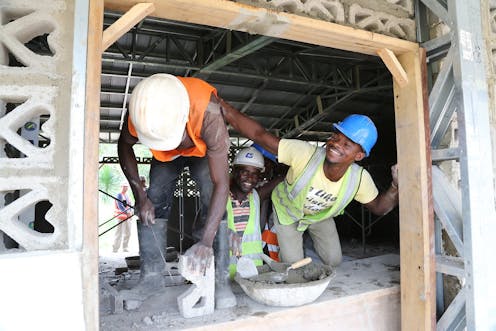
Over the past two decades, Ghana’s construction sector has both contributed to and benefited from a rapidly growing economy. The government is investing in rail, road and property projects across the country amid strong demand created by an expanding urban service economy. This is reflected in the increased spend in the 2019 budget.
In 2016 and 2017, construction contributed 13.7% to GDP. It remains among the fastest growing of the 21 sub-sectors of the economy, according to Ghana Statistical Service data and it employs at least 3% of the labour force.
Ghana has joined the group of frontier emerging markets. It is moving towards becoming an advanced economy characterised by political stability, rapid economic growth and industrialisation. But rapid urbanisation could also create slums if infrastructure does not keep pace.
My research looked into whether the construction industry has the policies and strategies it needs in place to continue supporting Ghana’s economic growth. I found that it needs to be structured and regulated to be more competitive.
This is not happening as fast as it should.
Construction and economic growth
Frontier emerging economies are characterised by relatively low per capita income, high unemployment and low activity in business and industry. Though Ghana has created a structural and economic environment that inspires some confidence in attracting global investments, much still needs to be done and the political dispensation needs to remain stable.
One theory is that construction industry activities are critical in driving faster development towards emerging economy status. Known as the Bon Curve, it suggests that, as a nation migrates from developing country status to an emerging economy, it must be fully prepared to tap into the increasing volumes of construction activities that are critical in driving the accelerated development expected.
A construction sector index developed by the academic Victor Osei shows that the industry in Ghana has improved significantly over the last two decades. Osei also demonstrated that there has always been a positive relationship between construction activities and growth of the wider economy.
In theory, the Ghanaian construction industry should be at the point of being able to propel that economic growth. It employs over 320,000 people and more than 2% of young people, as well as providing more training and apprenticeship opportunities to young people than any other sector. This can only happen if appropriate strategic action plans are put in place. These include efforts to integrate the informal sector.
Industry players have called for an industry development agenda which would provide an overall structure and direction. Efforts have been made towards drafting a construction industry development authority bill.
Progress however has been slow. One reason is the lack of a unified construction industry body to lobby the government to pass the bill. Attempts to bring various professional bodies together have been met with apathy. Civil engineers, planners, architects, surveyors involved in the sector are instead on entrenching their positions within the sector.
The industry bodies are also generally uncompetitive. This is because they have remained traditional. They have failed to transform current economic demand into an opportunity to compete with international players and to access new markets in, for instance, the sub-region.
Informal and wasteful
This is consequent on the lack of deliberate policy direction in raising first-class contractors to be global competitors. Because of the transient nature of activities in the sector and its ability to absorb relatively large numbers of unskilled workers, the sector is also heavily informal.
Above all, it appears that the political elite are using the industry to consume wealth. This happens when projects are discontinued upon a change of government or completely abandoned. This leads to locked-up capital in several abandoned projects.
Even though the constitution of Ghana mandates succeeding governments to continue projects started by their predecessors, it rarely happens. Completed projects that have turned into white elephants are constantly in the news and the political class plays the blame game.
There are lessons to be learnt from emerging economies such as China, Brazil, South Africa and India, whose contractors are beginning to influence the international market. They all have an apex body regulating and providing a deliberate construction industry development agenda. They have taken steps to enhance productivity and efficiency; set performance standards and integrate new technologies for efficiency. They have also improved occupational safety, health and environmental practices. They encourage technology transfer including export of construction products.
The global construction space is becoming more technologically advanced. Ghana cannot afford to remain stagnant and uncompetitive. There have been several calls for government policies to support better project management practices.
The starting point would be to pass the construction bill into law. That would provide space to pursue the construction industry developmental agenda, in tandem with Ghana’s quest to become a firmly rooted middle income economy.

Divine Kwaku Ahadzie does not work for, consult, own shares in or receive funding from any company or organisation that would benefit from this article, and has disclosed no relevant affiliations beyond their academic appointment.
Source: The Conversation – Articles (AFRICA)
Read more on The Conversation.
Join the fun: Add Your event | Submit a Press Release | Add your listing.


