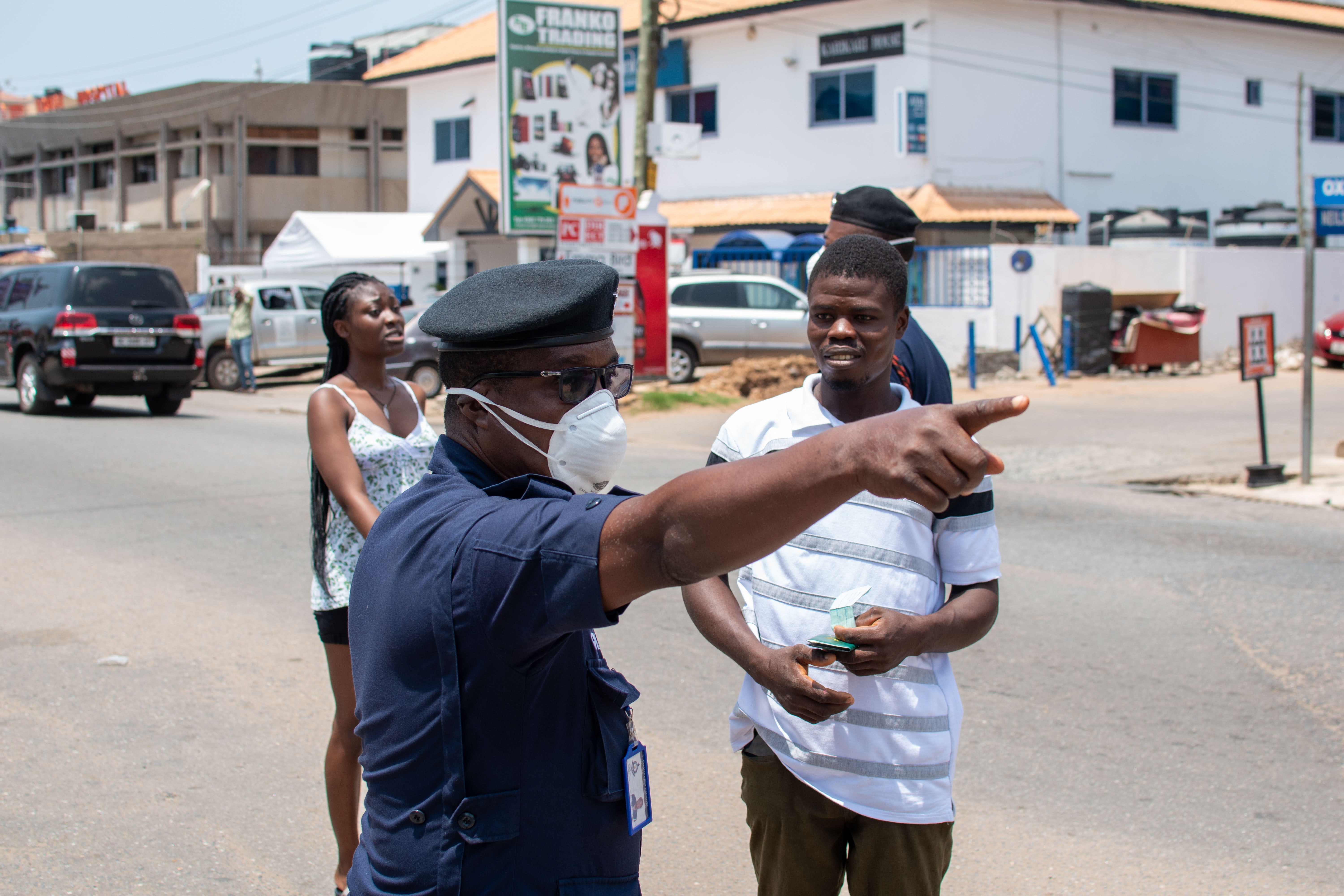
Ghana confirmed its first 2 cases of COVID-19 infections on March 12, 2020 which increased to 152 with 5 deaths by March 30. Sensing that the virus may spread and overload the healthcare systems, the President imposed a three-week lockdown in the communities considered as infection hotspots. These included Accra, the capital and Kumasi, the second biggest city and their environs.
Many people disregarded the lockdown and went about their daily lives. One state media, Graphic Online, ran the headline:
Public defy lockdown directive in Accra, Kumasi.
Traffic remained at a standstill in the cities as the police sought to check hundreds of vehicles with the view to enforcing the lockdown directive. Some commuters tried to outwit law enforcement officials by faking identity cards designed for people exempted from the restrictions. Others tried to avoid security officials at checkpoints by trekking long distances or boarding ‘Okadas’ (motorbikes) that used narrow walkways and bushes to beat the police and transport people to various destinations.
The media, police, politicians and social commentators and other powerful actors and institutions in the country blamed the mass-defiance on indiscipline. This narrative echoed the rather deep-seated view that the intractable social problems in the country are primarily due to bad attitudes–Ghanaians penchant for breaking laws and disregarding cherished values.
But criminological and sociological research has shown that people’s personal characteristics or morality offer severely limited explanatory weight for deviant behaviours.
We, therefore, set out to explore what really lay behind the failure of people to adhere to the lockdown.
We argue that most Ghanaians could not lockdown because they are trapped in precarious jobs, and in poorly serviced overcrowded neighbourhoods. And that any analysis of the lockdown defiance – and urban social problems generally – must move beyond the simplistic notion of indiscipline. Instead, they must dissect how deliberate bias against the needs of the majority operates, and is institutionalised in ways that undermine people’s commitment to rules and regulations.
We believe that our findings provide useful lessons on how Ghana’s cities could be managed better.
The drivers of mass defiance, and the reaction
Most Ghanaians – some reports estimate 80% of the workforce – work in the informal sector. Most informal jobs aren’t digitised which means that people have to rely on regular social interaction in close proximity to others.
Second, the formal housing market benefits a privileged few. The result is increased use of inadequate and insecure structures as housing in slums and other poorly serviced areas in the cities. These include kiosks and containers.
The provisional results of the 2021 Population and Housing Census issued by the Ghana Statistical Service suggest that 6 out of every 10 of the 10.7 million structures in the country are used for residential purposes. Of these, 20% are containers, kiosks, and wooden structures.
Trapped in precarious low-income jobs, and in poorly serviced overcrowded neighbourhoods, the majority of the population could not lockdown, resulting in mass-defiance.
Stressed by the mass-defiance, the police threatened that
some Ghanaians have decided to take the Police for granted and are flouting the President’s lockdown directive with impunity. The Police will no longer tolerate this kind of attitude again.
Soon security personnel were captured on tape brutalising unarmed civilians who supposedly had breached the lockdown rules.
The extralegal punishments ranged from the mildly humiliating to the downright violent. There was footage of drivers being made to crawl on their knees, young men forced to do squats and women forced to hop to their homes. A 60-year old woman was seen weeping on camera, like a child, after being lashed by the police for going to the market.
The violence meted out to alleged violators of the restrictions echoes the ‘war against indiscipline’; ‘slum clearance’, ‘decongestion exercises’, ‘demolition of illegal structures’ and other aggressive, strategies the authorities frequently invoke in dealing with the urban working class.
The challenge for the authorities during the enforcement of the COVID-19 lockdown, however, was that, this time around, they were facing the workers collectively as the marginalised class that they are. As a result, even as the brutalities continued, an even greater number of them kept on defying the restrictions.
This, in turn, drove law enforcement officials to behave even more savagely.
As footage of more brutalities and stand-offs kept surfacing, it became apparent to the government that the lockdown was losing its moral authority, compelling the President to lift it.
Governing cities better
Our paper sheds light on the inadequacy of law enforcement violence as a tool for addressing crime and other problems often associated with the precarious existence of informal workers in cities in Ghana.
Multiple studies have shown that the activities of informal workers in the cities reflect continuing state failure to prioritise investments that support the life chances of the majority of the urban population.
This suggests that Ghanaian authorities could elicit more cooperation from the people in governing the cities by creating conditions that give the majority a chance to have a shot at decent life. A starting point could be prioritising investments that create more decent and secure jobs, and expand adequate serviced housing.
Informal workers will remain an integral part of Ghana’s urban economy for the foreseeable future. This requires the country to explore better strategies to elicit their cooperation in governing cities.
Samuel Ametepey and Savior Kusi contributed to this and the original article.


