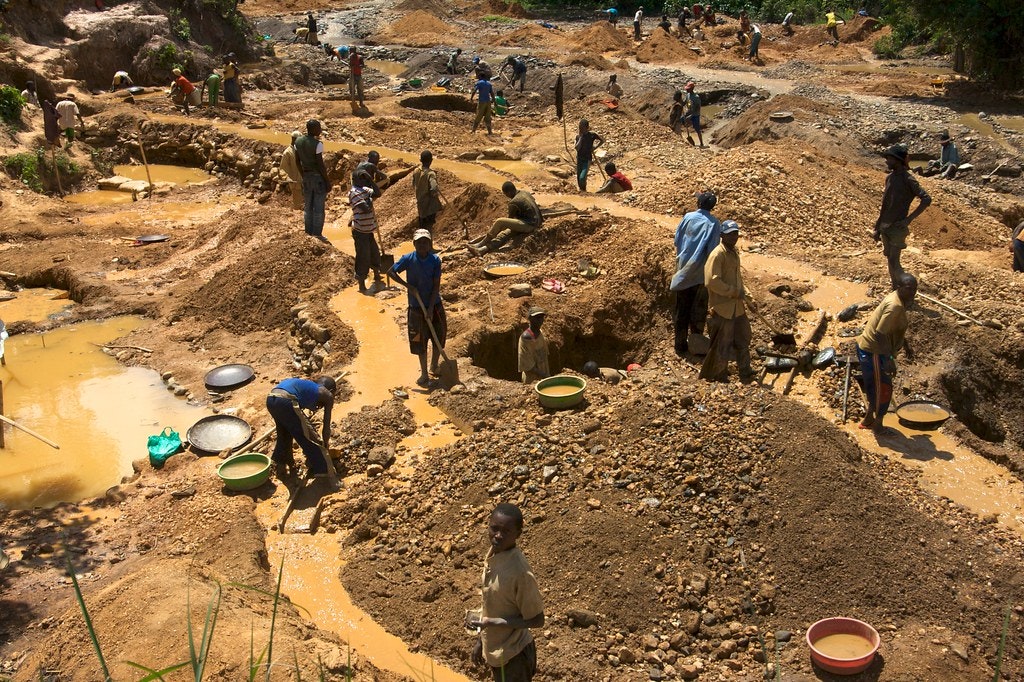
Artisanal and small-scale mining – a low-tech, indigenous mining subsector – is taking on increasing economic importance in many developing countries. Over 150 million people worldwide are estimated to derive their livelihoods from this activity indirectly. In Ghana, it supports millions and contributes up to 43% of the nation’s total gold production.
The sector employs over 1 million rural Ghanaians directly, while the upstream and downstream industries employ 4.5 million people, accounting for 60% of the country’s mining workforce. But artisanal and small-scale mining is also responsible for complex environmental challenges: destruction of land and vegetation and chemical contamination of water.
Ghana is one of the first countries in Africa to promulgate a small-scale mining law. Ghanaian mining codes not only recognise artisanal and small-scale mining as a legitimate livelihood source but also establish a framework aimed at formalising it.
So far, though, the regulation of artisanal and small scale mining in Ghana has been mostly unsuccessful. More than 85% of small-scale mining operations still occur in the informal and illegal sector of the economy and remain largely unregulated.
As part of my PhD research I explored the reasons for this persistent illegality, from the point of view of licensed and illegal miners. The study identified two key related factors that drive illegal mining in Ghana. First, the mines are transient but getting a mining licence is time-consuming. Second, the regulatory framework doesn’t take into account the diverse reality of operations. It is difficult for people to comply with rules that do not adapt to their conditions: they will seem irrelevant to them.
To effectively manage and control the activities of artisanal and small-scale mining, these factors must be considered.
Disconnect between rules and reality
I carried out fieldwork between December 2020 and May 2021 in three mining communities in Ghana: Wassa Akropong, Bogoso and Gbane. I conducted interviews with illegal miners and gold dealers, licensed miners, local land owners, government officials, NGOs and others.
The first finding was that informal local mines were transient and often operated on a subsistence basis. The miners lacked adequate capital and geo-prospecting knowledge.
According to local informants, the productive lifespan of most of these kinds of mines was 6 to 18 months. But the formal procedure to get a small-scale mining licence in Ghana can take up to three years. According to the Minerals Commission, this process should normally take three to four months. A major reason why many locals don’t apply for a licence is this disconnect. As one illegal miner puts it:
to me, it doesn’t make sense to wait for three years for a licence to undertake a six-month project. I will rather hide and do my galamsey (illegal mining).
The second problem is another kind of disconnect. The miners in this research were of diverse kinds but the rules are supposed to apply to all equally. The operators ranged from alluvial miners removing stream bed deposits to those mining hard rock for gold near the surface. They used a wide range of techniques, practices and forms of knowledge to extract and process minerals. Different miners therefore had different perceptions about the formal licensing requirements. For example, some did not think they required a licence to operate because their activities caused no destruction to water bodies.
Ghana’s key legal and regulatory instruments for small scale mining show that the sector is poorly defined and classified. Poor rural people panning for shallow alluvial gold with rudimentary tools are subject to the same permit procedures as operators with more sophisticated tools.
This generic regulatory framework fails to link the diverse types of the sector’s operations to appropriate levels and forms of control. Some of the sector’s most vulnerable operators can’t comply.
Reforming Ghana’s mining regulations
It is important to create a regulatory framework that makes all miners accountable and also enables them to formalise their operations.
The burdensome, costly and overly time-consuming licensing process needs reform.
This could mean devolving more small-scale mining decisions to local governmental agencies and different local stakeholders. Kenya has recently set an example: counties and municipal authorities are empowered to issue mining licences through consultation with different local interest groups.
The reason local miners move their operations frequently lies in poverty and lack of education. So the regulatory frameworks should set up support for miners, including education and training, technical and financial support. This would enable miners to make investments to prolong the economic lifespan of local mines.
Policy reforms also need to reclassify Ghana’s artisanal and small-scale mining sector. This would result in more effective control and accountability measures. “Small-scale” and “artisanal” mining aren’t necessarily the same thing, so they may require different rules. In the DRC, for instance, artisanal mining is seen as an indigenous livelihood source where operators only require “exploitation cards.” Cameroon also distinguishes between “small mines” based on proven ore deposits and “artisanal mines” worked with specified levels of technology.
Ghana’s framework should consider these differences if the fight against illegal mining is to be successful.


