Coronavirus lockdowns brought the world to a standstill. Rules on hygiene and social distancing have reshaped daily life, schools and businesses had been closed, and gatherings banned. Almost 2.7 billion workers, representing around 81% the world’s workforce, have been affected by partial or full lockdown regulations.
We looked at how the lockdown strategies in Ghana affected the labour market in the country. The aim was to identify lessons that could be learnt from Ghana’s policy response to the pandemic. And to glean insights that could be useful for the design of future policies in Ghana as well as other countries in the region.
Ghana’s experience illustrates the difficult balance between protecting lives and livelihoods. It also highlights the challenge of designing targeted policies that ensure the most vulnerable are not being left behind.
Ghana was one of the first African countries to enact stringent policies to slow the spread of the virus. The urban centres of Accra and Kumasi – which emerged as transmission “hotspots” – were under lockdown from 30 March to 19 April 2020.
The partial lockdown did not last long enough to flatten the pandemic curve. But our paper outlines how it had a large economic impact, triggering job losses and business closures. Many Ghanaians have been able to resume work since the most rigid regulations were relaxed. Nevertheless the labour market recovery has remained partial and uneven, and the economic burden of the pandemic continues to fall on the most vulnerable.
Impact on workers
In our research, we talked to more than 600 workers in different cities throughout Ghana to assess how their livelihoods were affected by the pandemic.
Three main findings emerged.
Firstly, the lockdown had an immediate impact on the labour market, as illustrated in the left hand graph.
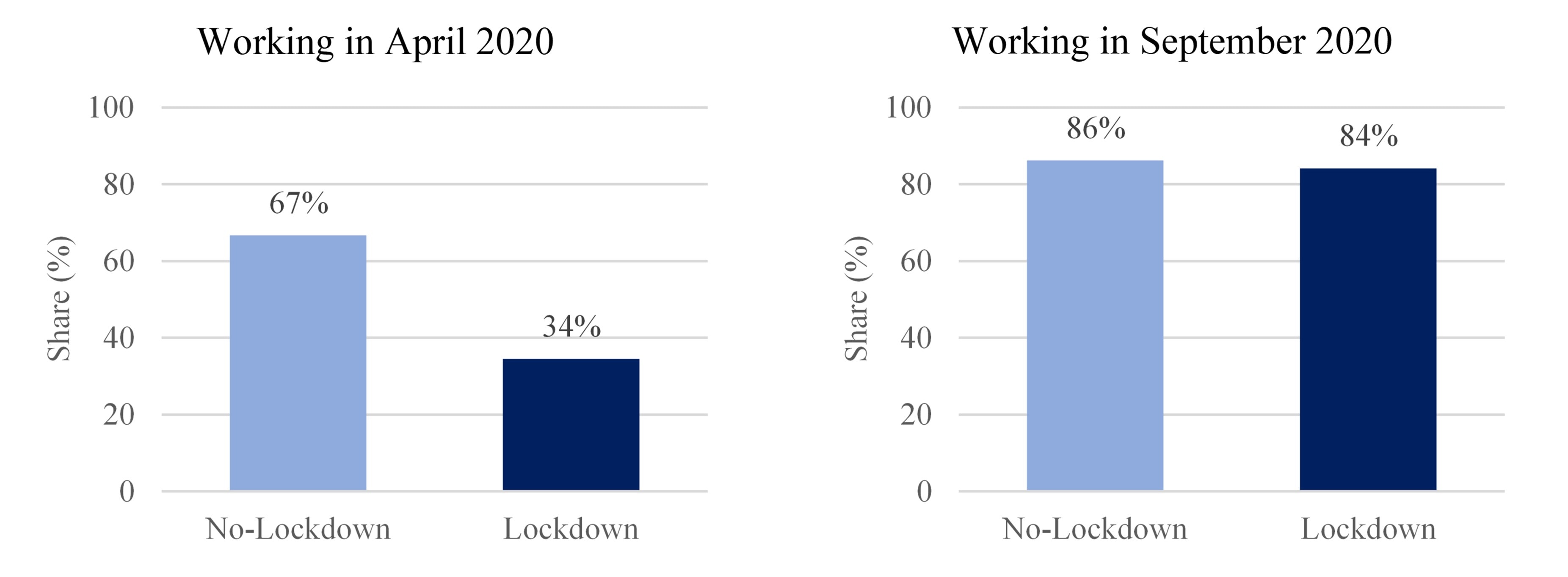
Workers in districts affected by the lockdown were more than twice as likely to drop out of work in the early phases of the pandemic. And only one out of three workers in lockdown districts continued working throughout April 2020, compared to two out of three in districts that had no lockdown.
In both cases, the vast majority reported workplace and business closures due to government regulations as the main reason for this break in economic activity.
Secondly, the gap in employment levels between locations subject to different lockdown policies had closed four months after the measures were relaxed. Despite this remarkable recovery in employment, as illustrated in the right-hand graph, the pandemic had a persistent nationwide effect on the labour market. We estimated that by September 2020 employment was still 12 percentage points lower compared to February that year. And average weekly earnings remained substantially below the pre-COVID-19 levels. This was even after accounting for differences in the compositions of the workforce.
Thirdly, the pandemic’s shock to the labour market did not affect all workers equally. Rather, it exposed and exacerbated pre-existing vulnerabilities.
The graph below exemplifies this unequal impact.
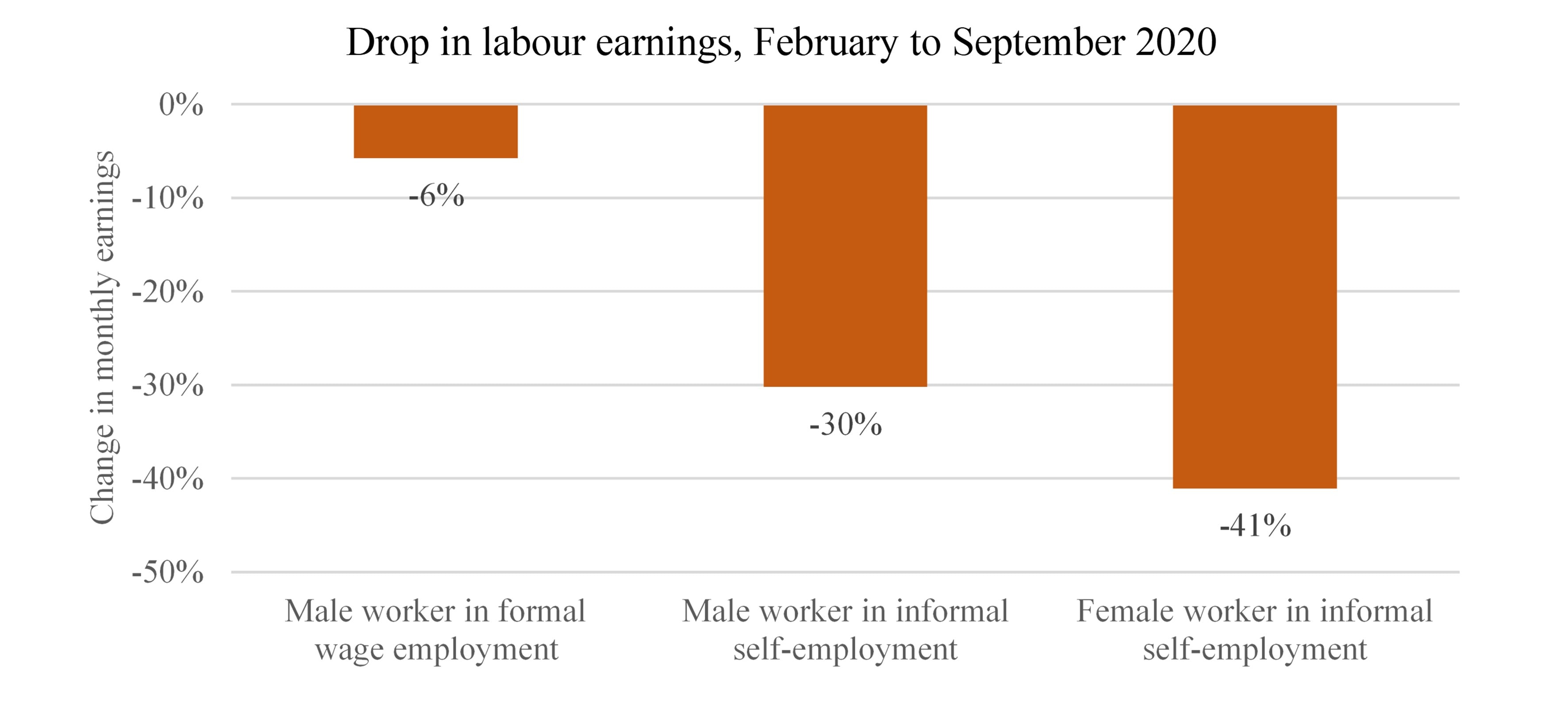
Business owners in the informal economy most often had to stop their activities in the early phases of the pandemic and saw a slower near-term recovery in terms of both employment and earnings. This means that people in contact intensive environments such as restaurants, tourism businesses, small retail shops, and street vending were the most affected.
Most were low-income earners with no or small savings, who needed to earn a living on a daily basis and were at high risk of being left destitute without targeted assistance.
In Ghana, females make up the majority of the vulnerable self-employed, and our research shows that women remain disproportionally affected by the pandemic in terms of both employment and earnings.
The Ghanaian government rolled out measures to support the poor and vulnerable as well as businesses. These interventions which were covered under the coronavirus alleviation programme seek to mitigate the disruption in economic activities, the hardship of the people and also to rescue and revitalise micro, small and medium scale businesses. For instance, under the coronavirus alleviation programme business support scheme, the National Board for Small Scale Industries disbursed soft loans to micro, small and medium scale businesses operating in agribusinesses, manufacturing, water and sanitation, tourism and hospitality, education, food and beverages, technology, transportation, commerce and trade, healthcare and pharmaceuticals, and textiles and garments.
Making sure no one is left behind
For policymakers around the world, navigating the response to the COVID-19 pandemic has been a difficult balancing act between protecting public health and the economy. As COVID-19 cases surge again, how should Ghana reconcile health and economic risks? And how can the country prevent a backsliding in progress on reducing poverty and mitigate further pressures to inequality?
Our research shows that future containment policies will need to be coupled with protective measures that prevent the most vulnerable workers from being left behind in the crisis.
In this case, containment measures must be complemented by adequate relief to the poor and vulnerable in a quick, safe, and effective manner. In order to restore income and preserve livelihoods, income support in the form of direct cash payments to those in need are crucial.
There are a few green shoots in the labour market, given that many Ghanaians have been able to start working again. We argue that these can be attributed to the policies adopted by the Ghanaian government such as the timely lifting of the partial lockdown and the swift support to households and businesses.
But more needs to be done to mitigate the impact of the pandemic on informal workers, particularly women. It is important for countries to develop measures to support workers in this segment of employment. Ghana rather seems to be doing better compared to other developing countries. These interventions should be aimed at addressing the hardship of households as well as the disruption in their economic activities. Particularly, governments can develop safety nets to support informal workers until they are able to return to work.


