Girls thrive with women teachers: a study in Francophone Africa:
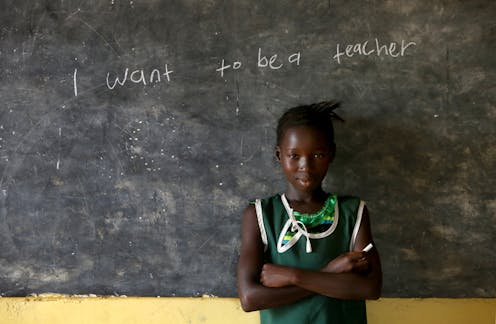
Over the past few decades most advanced countries have witnessed two striking reversals of the gender gap. First, teaching has become a profession dominated by women. This is particularly true at primary school level, where 84.5% of teachers across all countries classified as “developed” by UNESCO are women.
The second reversal has been among pupils. Girls now outperform boys in almost every educational outcome across the board – they do better in terms of enrolment, achievement and graduation rate.
These changes have been achieved in several ways. When a country is in the early stages of development, there tends to be a gender gap in educational investment that favours boys. And the teaching profession in such countries is usually dominated by men. But as countries develop and incomes rise, spending becomes more balanced and girls are able to close to even entirely reverse the gender gaps in schooling and teaching.
Such shifts are starting to occur in many developing countries. But sub-Saharan Africa, particularly in its western and central regions, is lagging behind. Women teachers are still in the minority in countries like Benin, Burkina Faso, Burundi, Cameroon, Chad, Congo, Ivory Coast, Niger, Senegal and Togo.
And, we discovered, this has implications for how teachers’ gender influences student learning performance.
Our study found that girls in the sixth grade – so on average around 13 years old – performed better on standardised tests in reading and maths when they are taught by women than when they are taught by men. This also has implications for how girls perform at school compared to boys. Girls outperformed boys on the subjects under women teachers.
We found no evidence that boys’ performance changed in maths whether their teachers were men or women. And in reading, boys performed a little better under female teachers than they did with male teachers.
These findings echo similar studies elsewhere in the world. They suggest that female teachers can act as role models who enhance girls’ motivation and learning outcomes. The countries in our study – and others – should work harder to ensure gender parity when hiring teachers. This can empower girls and improve their results.
Measuring performance
We analysed the standardised test scores of more than 31,000 primary school pupils in 1,800 primary schools in the Francophone nations of Benin, Burkina Faso, Burundi, Cameroon, Chad, Congo, Ivory Coast, Niger, Senegal and Togo. In 2015, only 36.9% of primary teachers in these countries were female.
We decided to focus on test scores, which are graded by external evaluators, as they’re an objective measure of achievement. This means they provide the best evidence of how teachers’ gender affects – or doesn’t – pupils’ results.
In addition to the data analysis, we asked pupils to report back about whether they enjoyed a subject more or less when it was taught by a teacher of the same gender. So, for instance, did girls enjoy maths more with a woman teacher? The answer was “yes”. Girls preferred being taught by women and their results reflected this.
Role models
Teachers are important figures when it comes to students’ gender-related attitudes towards different school subjects. Along with parents, teachers determine the extent to which traditional academic stereotypes such as “boys are good at maths and girls are good at reading” are passed on to future generations.
Our research found that such stereotypes remain widespread in Francophone Africa – even among teachers themselves. Teachers’ perceptions of the relative average performance of girls versus boys in their classes often differed entirely from the reality. In particular, both male and female teachers frequently overestimate boys’ maths performance.
But these perceptions don’t hold girls back from outperforming boys in maths. This suggests that female teachers’ presence – and the roles they model simply by being maths teachers – inspires girls, makes them more motivated to do well and improves their results.
Based on our findings, we’d suggest that policies should be developed specifically to improve gender balance in teaching in the countries we studied. Hiring more female teachers can contribute to closing educational gender gaps without hurting boys’ performance.
Author’s note: The research on which this article is based was conducted with Professor Dong-Eun Rhee, Division of International Studies, Korea University and Professor Robert Rudolf, Division of International Studies, Korea University.

Jieun Lee does not work for, consult, own shares in or receive funding from any company or organization that would benefit from this article, and has disclosed no relevant affiliations beyond their academic appointment.
Source: The Conversation – Articles (AFRICA)
Read more on The Conversation.
Join the fun: Add Your event | Submit a Press Release | Add your listing.


