Graveyards can be a reservoir for antibiotic resistant bacteria:
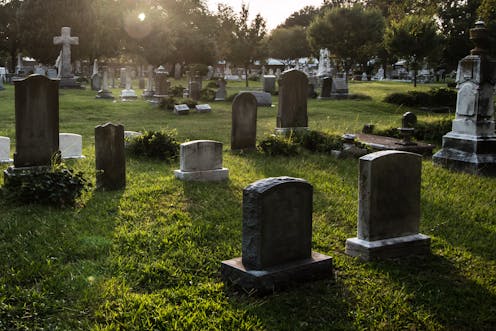
We may not like to think about it, but after we die many of us will end up in cemeteries. Burial grounds play an important role in society, functioning as spaces where people can mourn their loved ones.
And generally, cemeteries are places where corpses can decompose without posing a danger to public health. But sometimes – especially when sanitation and waste management services are poor – they can become environmental reservoirs of pollutants arising from human activities.
Among these pollutants are bacterial pathogens. These bacteria can be transported into groundwater when people live near a graveyard. The same communities – and visitors to a graveyard – can then be exposed to the pathogens via groundwater or surface water.
Decomposing bodies can add bacteria to the soil, but most importantly, they provide nutrients to the bacteria already present in the environment.
Escherichia coli (E. coli) is a microorganism that is commonly used to indicate the level of pollution in an environment, especially aquatic ones. This organism can be found in many places, including soil, water, food, and the intestines of humans and animals.
The presence of E. coli in the environment in large numbers can indicate faecal pollution. Some strains of this organism can also cause diseases such as diarrhoea, urinary tract infections and meningitis in newborn babies. The bacterium can also cause infection in other animals such as birds. Some strains have also been linked to disease outbreaks in developed and developing countries.
Many E. coli strains are resistant to antibiotics used to treat human diseases.
We wanted to find out whether cemeteries could harbour these resistant bacteria – a question that had not previously been answered.
In places with shallow water tables, the bacteria, together with other toxic biological waste arising from decomposing bodies, can contaminate water sources in nearby communities, representing a public health concern.
Pollution in graveyards
Rapid urbanisation in many developing countries has meant that informal settlements have begun to sprout near cemeteries. Since many of these settlements lack basic sanitation facilities like toilets, surface runoff from informal pit latrines can make its way into graveyards. Sometimes, people also dump waste at cemeteries because there are no waste management services and many cemeteries are not fenced or have no access control preventing unwanted entry from the public.
As a result, many cemetery sites have become polluted with human waste, including bacteria like E. coli. Also, because cemeteries themselves are typically not inhabited, many animals find a niche in them. These animals also carry E. coli in their gut and further contaminate the area with their faeces, although to a lesser extent. Decomposing bodies can also be a source of food for the E. coli and other bacteria in these environments.
We carried out research in South Africa to explore whether cemeteries could act as reservoirs of human pathogens that are resistant to numerous antibiotics, using E. coli as the indicator organism.
The study was carried out in three graveyards (Maitland, Delft and Welmoed cemeteries) in the Cape Flats area of Cape Town. These suffered from encroachments of informal settlements with poor infrastructure, lack of waste management and vandalisation of the cemetery walls allowing unauthorised access. This area has a high water table, with the Maitland Cemetery having water at less than two metres below ground level (the same depth as coffins). The area is also affected by seawater intrusion, especially when sea levels rise. A wet environment like this supports E. coli.
We isolated E. coli in water samples collected from boreholes and surface water in these cemeteries and checked whether these E. coli strains had the potential to cause disease in humans. We also checked whether they were resistant to antibiotics commonly used to treat human infections.
In some cases, we found as many as over 2,400 E. coli cells in 100ml water samples, especially in the surface water samples. Water meant for drinking should contain zero E. coli in 100ml. The number of E. coli should not be more than 575 cells in 100ml of water for partial body contact or 235 in 100ml of water for full-body contact activities. E. coli was also isolated in some of the borehole water samples, although at lower concentrations.
We found that 42% of the E. coli obtained in this study had genes that could allow them to cause infection in humans.
And 87% of the E. coli isolated were resistant to at least one of the antibiotics tested, with 72% being resistant to more than three antibiotics. Four isolates were resistant to all the eight antibiotics tested.
In other words, many of the bacteria we found in the cemetery water could cause human diseases and were resistant to antibiotics.
Making cemeteries safer for the living
To control the spread of antibiotic-resistant infections, the World Health Organisation recommends a One Health approach that takes into account humans, animals and the environment. Our study shows that cemeteries are a notable part of the environment in this regard.
If informal settlements near cemeteries depend on boreholes for their water supply, they could be infected with contaminated water.
Grave diggers could be affected, too, especially if they sustain cuts at work.
Municipalities must consider the type of soil and the water table when selecting areas to use as cemeteries. Ideally, settlements should not be built close to cemeteries and residents should be provided with waste management service and safe water. But if settlements do exist they should be discouraged from using borehole water.

Akebe Luther King Abia is affiliated to the Aspen Institute through the Aspen New Voices Fellowship. He is also a member of the Antimicrobial Research Unit, University of KwaZulu-Natal. This work was funded by the Water Research Commission of South Africa. The research in this piece was conducted together with Eunice Ubomba-Jaswa, Chantelle Schmidt, Matthys A. Dippenaar.
Source: The Conversation – Articles (AFRICA)
Read more on The Conversation.
Join the fun: Add Your event | Submit a Press Release | Add your listing.


