Growing Western Cape protests show citizens expect greater accountability:

The Western Cape, the second wealthiest province in South Africa after Gauteng, is the only one governed by the opposition Democratic Alliance (DA). The party won control of the province in 2009, under the leadership of its then leader Helen Zille. It has been in charge of the City of Cape Town since 2006.
In its competition with the African National Congress (ANC), which governs the country and the eight other provinces, the DA has often used the province and the city as examples of the kind of good governance that it can bring to the rest of the country. The Western Cape outshone the eight other provinces on clean audits in the most recent local government audit reports.
The DA also claims to have made much greater progress than the ANC on a range of fronts, including land reform. But, significant challenges remain in the province, as shown by the upsurge in protests in recent weeks.
The protests were reportedly prompted by unhappiness over access to land, low-cost housing and the provision of basic household services such as water and sanitation. The spate of protests has taken place despite various efforts and the recent implementation of a plan aimed at reversing the legacy of apartheid spatial planning and improving service delivery.
We examined data from the South African Social Attitudes Survey, conducted by the Human Sciences Research Council annually since 2003. It shows that there has been a decline in public confidence in local governance in the Western Cape over the past 12 months. In addition, there’s been growing dissatisfaction with the delivery of certain key services. The most marked changes are over people’s satisfaction with housing provision, water and sanitation and land reform.
Satisfaction levels on the decline
The data shows that there’s been a demonstrable decline in the number of people satisfied with the provision of low-cost housing in the province since the start of Zille’s second term as premier in 2014. While half the province’s population was satisfied with the provision of low-cost housing four years ago, only a third were satisfied by late 2017 (Fig. 1).
There have been similar dips in service delivery performance ratings in the Western Cape in the last year. For instance, approval of water and sanitation delivery fell from 86% in 2016 to 61% in 2017. Satisfaction with land reform declined from 46% in 2016 to 29% in 2017.

Confidence in local government has fared somewhat better, varying between 36% and 45% during Zille’s first term of office (2009-2014), and increasing during the first couple of years of her second term (from 38% in 2013 to 57% by 2016). But, there was a distinct decline in confidence in local government in the Western Cape between 2016 and 2017, falling from 57% to 44%.
These declines in public confidence are not necessarily due to provincial performance alone. It is more likely that these trends reflect a growing dissatisfaction with democracy and governance in South African society more broadly. For example, only 6% of Western Cape residents were satisfied with the general economic situation in 2017, and a sobering 20% expressed satisfaction with the way democracy is working.
These critical evaluations speak to a fundamental shift in the political mood in the province against which new developments, such as protest action, should to be contextualised.
The protest vote
The recent protests that occurred within the province are clearly at odds with the typical view of Western Cape residents towards mass action. This tends to be characterised by strong disapproval of any form of disruptive and violent action, as shown by the 2016 survey results (Fig. 2).
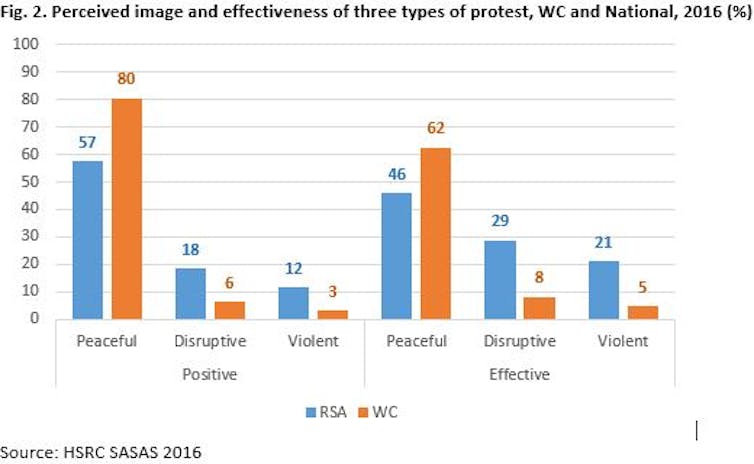
By contrast, peaceful protest is seen in a favourable light (80% positive) and regarded by many (62%) as effective.
The fact that the protests have continued despite this prevailing view speaks to a sense of frustration and desperation in certain communities, particularly those that are poorer and more vulnerable.
Responding to public needs
Governing parties and officials need to take note of the frustration being expressed by ordinary South Africans, particularly given that the country goes to the polls next year in national elections.
The response to protests shouldn’t be heavy-handed policing. Instead, what’s needed is for governments – local, provincial and national – to understand the basis for protests and then to ensure a swift resolution of public concerns. Regular public engagement is needed, by municipalities in particular, and the use of innovative approaches (including social media) must be made a priority for communicating with communities.
A failure to do so is likely to reinforce a sense that the country is becoming less democratic and that the social distance between the elected and the electorate is widening.
Samela Mtyingizane, a Master’s Research Intern at the HSRC, was part of the research team. Readers requiring the detailed data from the survey should please contact the HSRC at datahelp@hsrc.ac.za.

Benjamin Roberts receives general financial support from various government and non-governmental agencies in securing the costs associated with the annual fielding of the South African Social Attitudes Survey (SASAS). This funding has no bearing on the scope and interpretation of the survey analysis.
Jare Struwig receives general financial support from various government and non-governmental agencies in securing the costs associated with the annual fielding of the South African Social Attitudes Survey (SASAS). This funding has no bearing on the scope and interpretation of the survey analysis.
Narnia Bohler-Muller receives research funding from various government and non-government sponsors as part of competitive tender-based processes.
Steven Gordon receives funding from DST-NRF Centre of Excellence in Human Development. He is affiliated with Human Sciences Research Council.
Yul Derek Davids receives general financial support from various government and non-governmental agencies in securing funding for project related work at the Human Sciences Research Council (HSRC). The funding has no bearing on the scope and interpretation of the analysis of survey data and project related information.
Source: The Conversation – Articles (AFRICA)
Read more on The Conversation.
Join the fun: Add Your event | Submit a Press Release | Add your listing.


