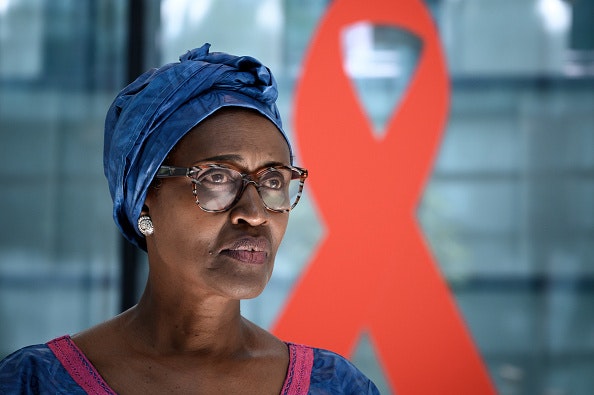
The COVID-19 pandemic has deepened global inequities. The world’s poor have bore the brunt of national lockdowns and will struggle to recover and poorer countries have been unable to rollout comprehensive vaccination campaigns because of a grossly unequal distribution of vaccines. On top of this COVID-19 has also derailed progress against diseases that affect poor people. Imraan Valodia sat down for a conversation with Winnie Byanyima, the Executive Director of UNAIDS.
Imraan Valodia: What impact has COVID-19 had on the fight against HIV in countries, particularly those in the global South, carrying the biggest burden of the disease and with significantly weaker healthcare systems?
Winnie Byanyima: Firstly, we must recognise the successes of the AIDS response. We have achieved what many once said was impossible. Of the 38 million people living with HIV, 27.5 million are accessing lifesaving antiretroviral therapy. We have cut the rate of new HIV infections by more than half and averted 16.6 million deaths.
But let us be clear: fighting a pandemic with no cure and no vaccine is hard.
Hundreds of thousands are still dying of AIDS and 1.5 million people were newly infected last year. AIDS remains a crisis and COVID-19 is making it worse.
Even before COVID-19, we were off track in meeting the global AIDS targets and the COVID-19 pandemic has pushed us back even further. COVID-19 related restrictions have hurt the most vulnerable, including marginalised and stigmatised communities and has disrupted access to HIV services.
Since COVID-19 hit, the Global Fund to Fight AIDS, TB and Malaria estimate that the number of mothers receiving prevention of mother to child transmission services dropped by 4.5%, people reached with HIV prevention programmes declined by 11%, HIV testing declined by 22% and medical male circumcision to prevent HIV dropped by 27%.
In very high prevalence settings in Africa, it is estimated that the effects of COVID-19 could contribute to a 10% increase in HIV deaths over five years.
Amid unprecedented global disruptions, we must act urgently to prevent a resurgent global AIDS pandemic and to quickly recover our progress toward ending AIDS. To get fully back on track on HIV we absolutely have to get on top of COVID-19.
Imraan Valodia: COVID-19, like HIV, has deepened inequalities in society and disproportionately affected women while widening the long-existing gender pay gap. How do we begin to address this gender economic and inequality pandemic?
Winnie Byanyima: Both COVID-19 and HIV are feeding off inequalities: women whose rights are not respected; women who do not have economic security or access to the most basic health or education services. These are the people that pay the heaviest price of our inaction on inequality. They pay the price in insecurity, in poverty, in sickness, and too often in death.
Five in six African adolescents newly acquiring HIV are girls. The reason is power. Research shows that completion of secondary education reduces a girl’s risk of acquiring HIV by up to half, and by even more if this is complemented by a package of rights and services. Yet as countries struggle with the current fiscal challenges, education and girls’ empowerment are among sectors that are suffering the biggest budget cuts.
Governments also have a responsibility to shift the burden of care away from women’s invisible unpaid labour. Affirmative action is essential to counteract the legacy of discrimination against women.
Economic interventions are needed to overturn the gross imbalance of wealth. But ending the age of inequality requires the strengthening of emancipatory social and cultural forces to overturn the gross imbalance of power in all its interconnecting forms.
Imraan Valodia: You say that extreme inequality is not inevitable – it’s a policy choice – explain what you mean by this? What roles can individuals, communities, and nations play to end it?
Winnie Byanyima: There is a pandemic of inequality – between men and women, between the South and the North; between dominant and marginalised communities, between the elite and the majority – which hold back our enormous potential.
Inequalities are perpetuated by laws, by informal rules (social norms), by national social and economic policies and resource allocation, and by global policies and finance. And key to determining all those outcomes are inequalities of voice and power.
In the face of the colliding crises, it has become clear that we need bold new approaches to how we survive and thrive. Action is needed at all levels – not to build a perfect world but to enable a resilient one.
The answers are being articulated by activists and organisers, particularly young people from the most marginalised communities. They are showing how to build societies able to overcome any crisis and to unleash the potential of all. They have done so because the people most impacted are those who understand it best.
As a UN leader, I have experienced the power of the pressure of communities, women’s groups and grassroots movements, pushing us; at times that pushing is uncomfortable for us; but my message to you is:
Keep pushing!
Imraan Valodia: What lessons can we learn for the management of future pandemics from the triangle of science, government and communities that was in place in dealing with HIV?
Winnie Byanyima: We have learned a lot about how to fight pandemics. This year marks 40 years that we have been fighting AIDS and our successes and failures have taught us that we cannot successfully conquer a pandemic without working together to end inequalities, promote people-centred approaches, engage communities, and respect human rights.
This is one of the most challenging moments in the history of HIV and global health. We need greater urgency in our response to pandemics, global solidarity behind a data-driven global plans to end AIDS and to end COVID-19, and partnerships to prepare to respond to the next threat.
We need to draw from the collective experience, brilliance and value set of the AIDS response. If we apply the hard-earned lessons of AIDS up front, we will increase our odds of winning.
This article is part of a media partnership between the Southern Centre for Inequality Studies and The Conversation Africa for its 2021 annual Inequality Lecture, which is being presented on Thursday, 30 September. Register for the lecture here.


