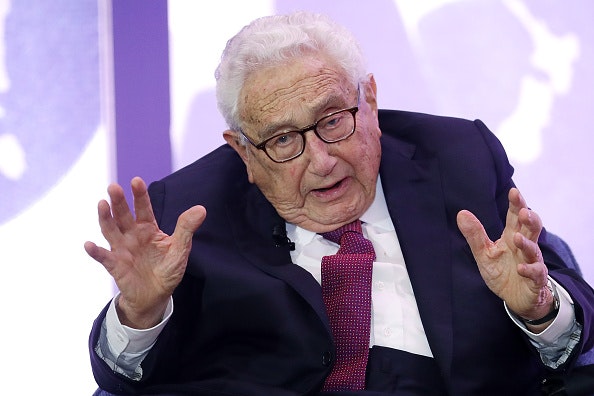
Henry Kissinger, who sexed up the art of diplomacy in the eight years between 1969 and 1977, will turn 100 in May this year.
Given his age, and his long influence on global affairs, several “anticipatory obituaries” have been written. Some laud Kissinger’s role in the shaping of East-West relations while he was in office as US Secretary of State. And many in their commentary on the decades beyond continue to call him a “statesman”.
Radical critics have pointed to Kissinger’s ruthless methods – like encouraging the coup in Chile in September, 1973 – and called for him to be put on trial for “war crimes”.
Traditionally, diplomacy was staid – a near-hidden enterprise for grey-suited men who (mostly by intuition) understood the grave matters of war and peace. Kissinger turned it into a site of celebrity, the jet-set and expert opinion. The world watched where he went.
Kissinger’s diplomatic achievements were quite astonishing – the recognition of China (1971/72) by the US was simply breathtaking. But domestically more important was America’s withdrawal from Vietnam (1973) and the Nixon administration policy of détente (easing of hostility) with the Soviet Union, which led to a series of strategic arms limitation talks.
These helped to secure Kissinger’s global brand. But his track record in the global south – especially in Africa – is dismal.
Not a little of Kissinger’s fame – or infamy, depending on the particular issue at hand – was facilitated by “shuttle diplomacy”, a tactic first used in the Yom Kippur War of 1973. In an effort to mediate between the warring Egypt and Israel, Kissinger very publicly jetted between the two countries.
A year later, a form of shuttle diplomacy was necessary in southern Africa as it became plain that Kissinger had misread the region’s place in world affairs and its politics.
This was evident from a 1969 leaked policy document which had set out America’s approach to regional affairs. The policy recommended that the US “tilt” towards the region’s white-ruled and colonial regimes to protect US economic (and strategic) interests.
As the grand narrative of Kissinger’s life story is written, his southern African interventions must be judged a failure as he neither ended colonialism nor minority rule in the region.
White minority rule
Famously, Kissinger’s doctoral thesis at Harvard was on the diplomacy of the Congress of Vienna (1814-1815). He argued that “legitimacy” in international affairs rested on establishing a balance between powerful states rather than promoting justice.
But 19th century Europe was no guide to managing 20th century southern Africa, when the legitimacy of states was seized with liberation rather than the niceties of big power diplomacy.
In April 1974, a coup in Lisbon had signalled an end to Portuguese colonialism in Africa. This exposed the vulnerability of white rule in Rhodesia (now Zimbabwe) and South African controlled South West Africa (now Namibia). Although hidden at the time, it is nowadays clear that the events in Lisbon helped to prime the fire that was to come to South Africa.
With the stability of the “white South” under threat, US policy required rethinking.
It was Cuba’s intervention in Angola that helped Kissinger reframe Washington’s approach to the region in Cold War terms. South Africa and the United States supported the rebel Unita movement to fight the government of the Popular Movement for the Liberation of Angola (MPLA, which was allied to Soviet Union.
It required drawing the apartheid regime closer while, simultaneously, urging change in Zimbabwe and Namibia.
The shuttle started with a speech in Lusaka, Zambia, which put pressure on white-ruled Rhodesia to accept the idea of “majority rule”. More gently, Kissinger asked South Africa to announce a timetable to achieve “self-determination” in Namibia. Kissinger then travelled to Tanzania to make a similar address.
A series of high-profile meetings followed with apartheid’s then prime minister, John Vorster. These took place in Germany and Switzerland. The record of these encounters make interesting reading. Over dinner on 23 June 1976, the ice was broken over a racist joke which established a bonhomie between a dozen white men who deliberated on the future of a sub-continent of black people for two hours.
The apartheid regime had catapulted directly into Kissinger’s star-studded orbit.
An official record of the talks suggests the South African delegation appear dazed. Were they overwhelmed by the occasion, or were they reeling from the events the previous week in Soweto, when apartheid police killed unarmed school children protesting against the imposition of the Afrikaans language as a medium of instruction?
For their part, the American side seemed keen to learn – at an early moment in the proceedings, Kissinger declared that he was “trying to understand”; at another, he was being “analytical”.
True to diplomatic form, apartheid was not discussed even though some attention was given to South West Africa. The discussion remained focused on Rhodesia.
Eventually a strategy was agreed: Vorster would get the recalcitrant Rhodesians to agree on majority rule; Kissinger would get the Zambians and the Tanzanians to support the deal; movement on the Namibian issue would be slower.
The high moment of the entire exercise was Kissinger’s September 1976 visit to Pretoria. By happenstance, Rhodesia’s prime minister, Ian Smith, was scheduled to be in town to watch a rugby match.
The New York Times reported that Kissinger was received with a small guard of honour – of black soldiers – at the Waterkloof Air Base when his plane landed. And Kissinger and his entourage – including the all-important press – set up camp in Pretoria’s Burgerspark Hotel.
For four days an increasingly isolated and internationally condemned South Africa basked in the spotlight of world attention – undoubtedly, it was the high point of apartheid’s diplomacy.
The drama of the weekend turned less on whether Kissinger met black leaders who were critical of apartheid – the activist editor Percy Qoboza was the only one – than on whether Kissinger, as an envoy of the US, could meet directly with Smith, whose regime was not internationally recognised.
In the event the two men met for four hours on the Sunday morning, and a deal was sealed. A tearful Smith, then prime minister, announced that Rhodesia would accept the principle of majority rule.
But the follow up processes were fumbled. The illegal regime limped on for another four years.
Kissinger had two further visits to South Africa. One was in September 1982 when he delivered the keynote address at a conference organised by the South African Institute of International Affairs. The second was when (with others) he unsuccessfully tried to solve the crisis over Inkatha Freedom Party leader Mangosuthu Buthelezi’s rejection of South Africa’s interim constitution in April 1994.
Kissinger’s interest in southern Africa in the mid-1970s was predicated on the idea that balance would return if the interests of the strong were restored. He failed to understand that the struggle for justice was changing the world – and diplomacy itself.


