Hoephoep (1)
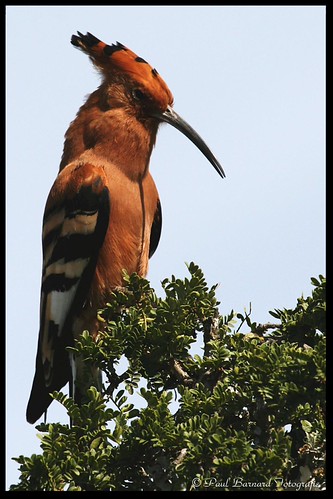
Image by Pixlab.co.za
Alternative Names:
English (Rob 6): African Hoopoe
English (Rob 7): African Hoopoe
English: Hoopoe
Scientific: Upupa epops
German: Wiedehopf
French: Huppe africaine
Indigenous: umZolozolo(Z),uZiningweni(Z),Ubhobhoyi(X),Kangungu(K),Nduranganga(K),Kukuku(NS),Mhupupu(Sh),Popopo(SS),Marimamalanga(Ts),Pupupu(Ts),Mmadilêpê(Tw),Pupupu(Tw)
Scientific Explained:
africana/africanus: Latin, of Africa.
upupa: Latin, a hoopoe.
Measurements: Length 25-27 cm; wing (26 male) 132-140-145, (13 female) 128-135-140; tail (39) 84-100; tarsus (39) 16,5-21; culmen (39) 42-56. Weight (2 male) 47,7-63,6 g, (2 female) 54,5-56,1 g, (19 unsexed) 46-56,8-67,7 g.
Bare Parts: Iris brown; bill dark horn, base paler; legs and feet yellowish pink.
Identification: About size of Laughing Dove; head, back and underparts bright rufous (male) or dull rufous (female); wings boldly barred black and white or cream; tail mainly black, white at base; bill long, thin, slightly decurved; conspicuous pointed crest can be erected into fan shape when alarmed; legs short. Immature: Duller than adult female.
Voice: Mellow hoop-hoop or hoop-hoop-hoop, repeated several times in phrases of 2-3 syllables; quiet zweee on take-off and when alarmed; fledgling calls sweet, sweet.
Distribution: Africa, Madagascar, Europe, tropical Asia; throughout s Africa, except extreme desert.
Status: Sparse to common resident; somewhat nomadic; some populations possibly seasonal migrants.
Habitat: Savanna, open woodland, gardens, parks, Kalahari thornveld; riverine woodland in arid areas.
Habits: Usually solitary or in pairs; sometimes in small groups when not breeding. Forages by walking on ground with short quick steps and nodding head, probing often with bill, especially in lawns. Flight heavy on broad floppy wings, somewhat butterflylike. Usually perches in tree when calling. Often raises crest after alighting.
Food: Insects (especially larvae, like cutworms), earthworms, small snakes, frogs; sometimes hawks termites in flight.
Breeding: Season: July to December (mainly August-October); may rear 2-3 broods per season. Nest: Natural hole in ground, termite mound, stone wall, hollow tree, under eaves, burrow in bank; does not excavate own hole; nest unlined, becoming foul-smelling after young hatch. Clutch: (26) 2-3,4-6 eggs (rarely 7). Eggs: Pale blue or olive green, fading to greyish or brownish with white pores; measure (73) 25,3 x 17,2 (22,2-27,6 x 15,8-18,5). Incubation: 17 days by female only. Nestling: 26-32 days; fed by both parents.
This Eastern Cape South Africa image was automatically curated and published with WP Robot plugin – CLICK HERE to learn more about WP Robot for WordPress – a massive time and money saver.
Visit the MyPE YouTube Channel.


