How a rural community built South Africa’s first ISP owned and run by a cooperative:
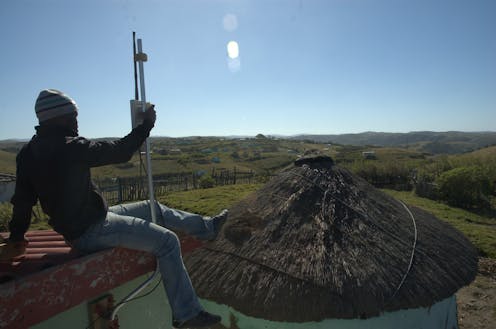
Mankosi is a remote rural community in South Africa’s Eastern Cape province. It is home to almost 6,000 people. The nearest city is Mthatha, about 60 kilometres away, as a bird flies.
Most homes are not connected to the electricity grid; residents charge their cellphones at a local shop or shebeen, for which they must pay. Both data and airtime for those phones also cost a lot: a survey shows that people spend up to 22% of their income on telecommunications. This is money that could be spent on food, education, transport and other needs.
They’re not alone. South Africa has some of the highest mobile voice and data costs in the world.
Yet, things are changing in Mankosi. A research team at the University of the Western Cape has worked with residents to develop a solar powered wireless community network.
The Zenzeleni Networks project – Zenzeleni means “do it yourself” in isiXhosa, the Eastern Cape’s most prevalent language – is, as far as we’re aware, the South Africa’s first and only Internet Service Provider (ISP) that’s owned and run by a rural cooperative. Just like any ISP, Zenzeleni installs and maintains telecommunications infrastructure and also sells telecommunications services like voice and data.
Yet what’s special about the project is that it involves a registered not-for-profit company which works with cooperatives in the community to deliver affordable voice and data services. Crucially, the project also keeps money in communities like Mankosi, often beset by high rates of unemployment.
The community networks model has proven successful elsewhere in the world: the largest is in Spain – the Guifi.net project. Others that have been developed successfully include projects in Zambia and Mexico.
How it works
The Mankosi project was launched in 2012 and legally registered in 2014. I have done research on information and communication technology for development in the Mankosi area since 2003. Since then, colleagues and postgraduate students, have also worked, even lived, in the area for extensive periods of time.
To establish the Zenzeleni network we approached local leaders to help get the community on board and we provided help and mentorship. Ultimately the residents run the project themselves.
With the local authority’s permission, a cooperative comprising ten local and respected people was formed. This group designed the network layout, and built and installed a dozen solar powered mesh network nodes or stations. These are mounted on and inside houses around Mankosi. These are organised in what we call a mesh network and WiFi stations cover an area of 30 square kilometres.
Zenzeleni constitutes a fully fledged Internet Service Provider, equipped with an Internet and Voice-over Internet Protocol gateway, community managers and a billing system in isiXhosa.
The Independent Communications Authority of South Africa (ICASA), which grants licences to ISPs and collects fees where necessary, granted Zenzeleni a licence exemption; so it costs Zenzeleni nothing in fees to operate infrastructure and sell services. The community only has to pay for the backhaul Internet connectivity, which they can get at wholesale prices from companies like EastTel and OpenServe, and for educational use from TENET.
Any device – even a low to mid-range smart phone – that’s WiFi-enabled can access the network. There’s a dedicated wireless connection to ‘point of presence’, or POP, fibre in Mthatha.
Zenzeleni’s voice calls and data costs are much cheaper than what’s offered by the big mobile operators. For example voice calls can cost 20c a minute rather than the standard R1.50 or more while data costs can be between 20 and 40 times cheaper.
The solar powered stations also charge cell phone batteries for R3.50 instead of the R5 usually charged by spaza shops or shebeens. Those shops tend to be some distance from the village, so people save time as well as money.
A true community project
Community is at the heart of Zenzeleni’s model. All revenues stay in the community: each cooperative has a bank account, and all residents get together to decide what to do with the money that’s been paid for Zenzeleni services.
For example, the Mankosi cooperative has provided micro-loans to residents for starting small businesses.
No one is currently earning a salary from the community network. But when usage grows, as we expect it will do with super cheap data, revenues are likely to grow so much that the cooperative will want to install more nodes and hire people to actively maintain them making the network more resilient. Since March 2014, the project has earned around R33,600 (about USD$ 2422.16).
Keeping money at home
On the surface it may appear that Zenzeleni cannibalises the revenues of big telecommunications companies like Telkom. We believe the opposite is true. Firstly, Zenzeleni purchases backhaul Internet connectivity from areas like Mankosi that Telkom and others have failed to connect – so it’s operating in entirely new areas that have been ignored because they’re considered too remote to generate good revenue.
Secondly, all telecommunications companies earn interconnect fees. Calls to mobile and landline numbers across South Africa incur these fees, which are charged when calling from one network to another. This is also true for Zenzeleni so that’s extra money in the bank for telecommunications companies.
Lastly, and most importantly, most of the money generated by this project stays in Mankosi. This is perhaps the most crucial aspect of the Zenzeleni model, and one we believe will foster economic growth which will benefit people living in and around the village, and enable them to purchase telecommunications, and other goods and services, they currently cannot afford.
Zenzeleni Networks’ next goal is to build critical mass to support between 20 and 30 communities surrounding Mankosi. When this happens, about 300,000 people will be able to sustainably connect themselves – and their schools, clinics, hospitals and homes – to cheaper voice, data and phone battery charging. This puts telecommunications into their own hands, by themselves.

Bill Tucker receives funding from Telkom, Aria Technologies, NRF, DST, Mozilla Foundation, AFRINIC, Internet Society, TIA and more. He works for UWC in the Department of Computer Science. He has no shares or business interest in Zenzeleni Networks Mankosi or Zenzeleni Networks NPC; both of which are non-profit entities.
Source: The Conversation – Articles (AFRICA)
Read more on The Conversation.
Join the fun: Add Your event | Submit a Press Release | Add your listing.


