How African researchers are adding to deeper knowledge about neutrons:
Matter is all around us. As human beings, we’re made of it. Matter is the “stuff” that makes up the physical world as we know it; a collection of atoms made up of particles called protons, electrons and neutrons.
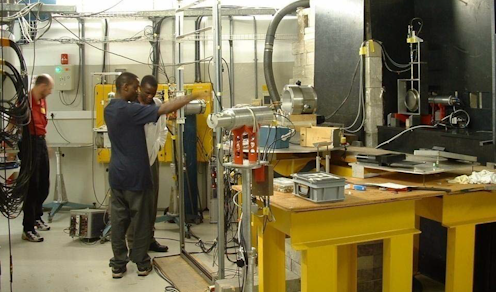
Part of my work, as a post-doctoral researcher at iThemba LABS (Laboratory for Accelerator Based Sciences) in Cape Town, South Africa, focuses on neutrons. These are subatomic particles that can penetrate through matter, which means they can be harnessed for all sorts of important work.
For example, high-energy neutrons may be used to destroy tough tumours that can’t be killed by the usual x-rays that are available in hospitals.
Neutrons can have negative effects, too. People who work with nuclear fission reactors, particle accelerators and fast neutron generators, for instance, get exposed to high-energy neutrons. Research has shown that this can be harmful: when neutrons interact with human beings, chromosomes in the blood can be damaged. In really severe cases, cells can become deformed; this can cause cancer and impair organ function.
There are facilities around the world where scientists can access neutrons for their work. But these are either slow neutrons or neutrons that come with a combination of all possible energies. In those cases, scientists can’t tell exactly which neutrons – slow or fast – had an effect on their samples.
There are only two facilities in the world where researchers can access fast neutrons of almost a single energy, which are necessary to develop and test new theories. One is Osaka University’s Centre for Nuclear Physics in Japan. The other is iThemba LABS. Researchers from around the world, and from the rest of Africa, use the Cape Town facility to conduct research that has global implications.
It’s important to keep studying neutrons to understand both their harmful properties and the ways they can be used for good.
What we’ve learned
Some of the most crucial work that’s being done to fill in our knowledge gaps and find new uses for neutrons is happening on the African continent.
For example, some of this research is being used in outer space. Neutrons are found naturally in outer space, so satellites are installed with devices called detectors to track how many neutrons they’re being exposed to. And also to figure out at what point that exposure becomes dangerous. These detectors can be adjusted and tested at iThemba LABS to ensure they’re accurate.
And next time you board a flight, it’s possible that your plane’s electronic components were also tested in our labs. By exposing such components to neutrons before they are installed and put to use in the real world, scientists are able to ensure that aircraft can safely withstand the amount of neutrons that will bombard them in the atmosphere.
It’s also at facilities like ours and Osaka University’s that research has started slowly unpacking the effect of neutrons on human health.
Scientists at these labs are also responsible for figuring out what kind of materials efficiently shield people from neutron radiation.
Room to grow
But there’s much more to be done in understanding neutrons, and particularly creating more space for Africa’s neutron science community to come and conduct research that’s relevant for the continent. More and more countries in Africa are investing in nuclear technology, and so having a facility relatively close to them is really important.
As a national facility of South Africa’s National Research Foundation, one of the mandates of iThemba LABS is also to provide support for research and training to all universities. Scientists working at iThemba LABS provide supervision to MSc and PhD postgraduate students, as well as providing in-service training. Postgraduates from countries outside South Africa can also come and learn more, then go back to their own countries and share that knowledge.
All of this has prompted iThemba LABS to develop and grow its neutron beam facility. To do this, it is working with the University of Cape Town in South Africa, Germany’s Physikalisch-Technische Bundesanstalt, the Institute de Radioprotection et Sûreté Nucléaire in France and the National Physical Laboratory (from the United Kingdom). Over the next two or three years, there will be big changes – and this will allow for even more neutron research to emerge from the African continent.

Ntombizikhona Beaulah Ndlovu works for iThemba LABS (Laboratory for Accelerator Based Sciences – NRF (National Research Foundation).
Source: The Conversation – Articles (AFRICA)
Read more on The Conversation.
Join the fun: Add Your event | Submit a Press Release | Add your listing.


