How Africa’s porous borders make it difficult to contain Ebola:
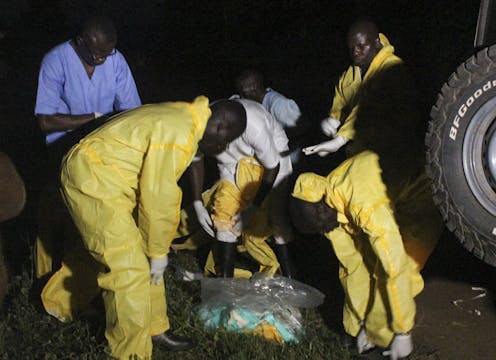
More than 2000 cases of Ebola have been recorded in the Democratic Republic of the Congo (DRC) since last August. Now, despite authorities’ efforts – such as screening millions of travellers moving between the DRC and its neighbours – the disease has spread. The World Health Organisation announced on 12 June that a five-year-old boy had died in Uganda after testing positive for Ebola. A day later, his grandmother died. It’s believed he contracted Ebola when they attended the funeral of his grandfather (who died of Ebola) in the DRC. The Conversation Africa’s Natasha Joseph asked Professor Mosoka Fallah to explain the implications.
There have now been two Ebola deaths in Uganda. Do we know anything more about these cases?
We now know that a family of 14 travelled from the DRC to Uganda. Most of them crossed at the formal border, but five evaded the main port of entry. Instead they crossed over informally. Those five arrived with symptoms that included diarrhoea and bleeding. This implies a period of illness in the DRC and that they were most likely symptomatic while travelling.
It appears they knowingly evaded the official check point that would have monitored their temperature and physical signs to pick them up as possible Ebola cases.
In some ways this is a replica of the cross-border import and export of Ebola cases between Guinea, Liberia and Sierra Leone that were hit by the 2014 outbreak. Many borders between countries in the region are porous: people are in fact much more likely to cross into a neighbouring country without even going through a formal border crossing.
People cross for all sorts of reasons. One of them is funeral rites. The spread of the cases from Guinea to Liberia and eventually to Sierra Leone centred around funeral rites.
Authorities have worked hard to keep Ebola from spreading beyond the DRC. Does the spread mean they need to do more, or do things differently?
The response teams from both the DRC and Uganda must be commended for preventing the mass cross-border export of Ebola cases given the complex nature of the current outbreak.
There are a lot more informal crossings than the formal ones. The surveillance system for scanning people who are crossing into Uganda are at these formal crossings. This isn’t always foolproof. When I was working in Liberia during the West African epidemic between 2014 and 2016, we found that some people would take antipyretic medications to avoid being detected at the formal border crossings. These drugs bring fevers down so that scanners don’t detect a high temperature.
You may wonder why people would do this. The reality is that people across geographical boundaries don’t have any physical boundaries in their minds. When they are in the DRC and fall ill, they will do what anyone would: seek support from their relatives and friends, some of whom are in border towns.
All of this means that health authorities’ interventions must be strategic. They cannot physically monitor all of the informal porous borders between these countries.
What they need to do now is to mobilise all of the towns and villages that share border points with the regions of DRC that are at high risk for the export of Ebola. These villages and towns can physically monitor their individual crossing points. The local leaders and chiefs can keep a visitor log and identify a common building to keep new visitors from the DRC for observation. These logs should be reported to the regional response team daily.
The visitors can then be tracked back to their village of origin to investigate any linkage to a cluster of cases. Coordinating visitors’ movements across the multiple borders will be the greatest strategic intervention. If possible, mobile application can be deployed to local youths to enter these data for real time reporting and coordination.
This strategy was employed in Liberia during the latter part of the Ebola crisis in the region and was critical in preventing the cross-border import of cases. Even within Liberia some counties – sub-regional division – did this to prevent the import of cases from Monrovia or neighbouring counties. When Lofa county went to zero in November of 2014, it was able to maintain that status by using these methods.
What is being done now to try and ensure the cases in Uganda do not lead to more Ebola infections?
Health workers are tracking the cases, finding out who the five people came in contact with and then taking them to a treatment centre immediately. From the recent situation report from Uganda, they have tracked down 98 contacts which is very impressive. As the average number of contacts per case is 10-12. But they have gone beyond that average.
These are very critical response steps in any epidemic. The surveillance team has to enter the mind of a typical villager from the DRC who knows they’re infected and is trying to escape to relatives in Uganda. They will have to figure out whether the infected people visited traditional healers or local medicine stores. How long were they in Uganda before they were picked up? In this way they’ll be able to identify all the contacts and monitor them.
Ebola is a very difficult disease to contain because of human social and behavioural factors. But it can be easily contained if 100% of the infected people’s contacts are identified and monitored and if cases are quickly removed into treatment units. The sooner you are treated, the higher your chances of surviving Ebola. And the more survivors there are, the more the community will trust response workers.

Mosoka Fallah consults for MERCK/MSD as an expert from Africa on the process of the Ebola vaccine licensing.
Source: The Conversation – Articles (AFRICA)
Read more on The Conversation.
Join the fun: Add Your event | Submit a Press Release | Add your listing.


