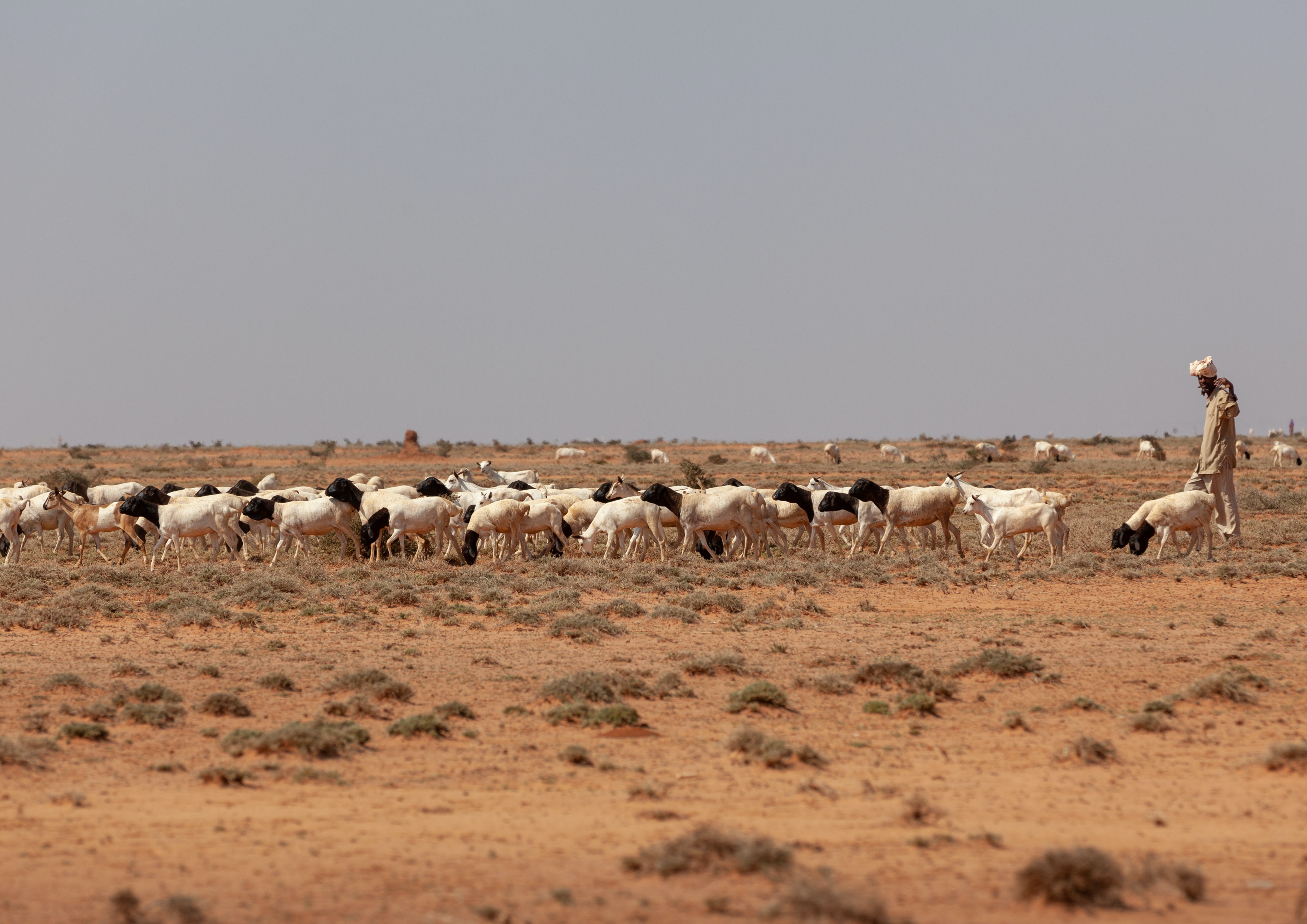
Climate change effects such as droughts, flash floods, erratic rainfall, disruption to the monsoon seasons, strong winds, cyclones, sandstorms, dust storms and increased temperature are being experienced across Somalia. These effects are affecting livelihoods, and contributing to local grievances and community tensions.
Some of these insights and conclusions were reached based on a special report done by the Somali government in 2013. This report remains the best estimate of the impact of changing weather patterns in the country as no newer data are available.
According to the report the country experienced a gradual and continuous increase in median annual temperatures between 1991 and 2013. Median daily maximum temperatures range from 30°C to 40°C. The report estimates that temperatures will increase by between 3.2°C and 4.3°C by the end of the 21st Century.
Climatic changes such as drought fuel herder–farmer conflicts because settled communities and livestock herders must compete for fewer resources. In 2019, 53,000 people were forced from their homes due to crop failure and reduced livestock profitability due to drought.
They joined an estimated 2.6 million Somalis already displaced by other factors like conflict. There were also disastrous droughts between 2000 and 2011; resulting in famine, food insecurity, water scarcity and loss of livelihoods.
These factors combined increase the risks of violent conflict. Many affected believe that they have less to lose from joining armed groups to survive when their livelihoods are threatened.
Studies have not found a direct causal link between climate change and conflict. Rather, researchers argue that climate change may exert an indirect and conditional effect on conflict risk.
Our fact sheet on Somalia identifies multiple pathways through which climate-related change interacts with political, social and environmental stresses to worsen existing vulnerabilities and tensions.
These tensions could potentially undermine development gains, impact ongoing conflict dynamics, and disrupt fragile peace processes. Additional pressures, such as COVID-19, compound the risk of climate-related conflict. This makes a country like Somalia even more vulnerable to shocks and setbacks.
For example, it’s current constitutional crisis arose because elections were postponed due to the pandemic. President Mohamed Abdullahi ‘Farmajo’ Mohamed is now in office without an electoral mandate after his term expired on 8 February 2021.
Thus, our research, which was compiled by the Norwegian Institute of International Affairs and the Stockholm International Peace Research Institute, examines the intersection between climate, peace and security in Somalia. It is part of an ongoing project which aims to generate actionable information and analysis on climate-related peace and security risks for selected countries and regions.
Conflict over resources
In Somalia, only 1.6% of the total land area is cultivated, and 69% is permanent pasture. For Somali farmers, livelihoods and labour cycles are closely linked to harvest seasons. For herders, calving is tied to specific months. And livestock migration is tied to grazing areas during wet seasons.
Thus, changing seasons and unpredictable shifts in the weather could have cascading effects on the livelihoods of herders, farmers and entire communities.
One such effect is the conflict between herders and farmers. Because of floods, heatwaves and droughts, farming and livestock outputs are diminishing. This means that settled communities and herders are competing for fewer resources like green grazing grounds and arable land. This could potentially fuel tensions.
And due to lack of government presence in parts of Somalia, pastoral communities sometimes resort to illicit trade and use of small arms and light weapons. They do this to protect themselves and their livestock from rustlers. Rustling has been a problem in Somalia for years but it is becoming an even bigger threat. This because more livestock are dying from the weather-related effects of climate change.
Political considerations
Climate change and environmental degradation are more likely to lead to local conflicts than to civil war. However, small-scale tensions can increase the risk of broader conflict when exploited by political elites and individuals or groups with more wealth, privilege, power or influence.
Those with power can use the disruptions of rapid-onset disasters like drought, floods, or the recent locust infestations, to augment their control over critical resources. In Somalia there are cases where minority communities were targets of looting and violence by more powerful majority clan militias where livestock and food stores were beseiged.
Political factions can exploit populations who have climate-change related grievances. These grievances include weather-related losses and resource scarcity due to extreme weather events. Those affected become susceptible to political agendas that promise to alleviate poverty.
Migration and terror
Climate-related migration can potentially exacerbate tensions between Somali communities. When clans migrate between regions the risk of violence from dominant groups in those regions increases. These groups are often seeking to maintain control of resources in their areas.
When violence does occur, ordinary Somalis are then displaced from their homes leaving them without clan and family protection. Those who find themselves in internally displaced person camps become vulnerable to recruitment from Al-Shabaab.
During the early 2000s, Al-Shabaab seized parts of southern Somalia where they occupied arable lands, extorted farmers and exploited their fertile soil to generate income. This allowed the terror group to consolidate its stronghold in the region.
And in 2017, Al-Shabaab capitalised on floods and droughts to establish its dominance. The terror group provided services and relief to regions of the country that were out of government control. They set up drought committees to coordinate relief operations in several administrative regions in different parts of the country.
Thus the effects of climate change have provided Al-Shabaab with an opportunity to capitalise on insecurity and the state’s weakness.
Way forward
The Somali federal government and federal states must integrate climate risks into their security planning. This will enhance their ability to prevent climate-related violence. It will also prevent Al-Shabaab and other armed groups from taking advantage of climate impacts.
In addition, the United Nations and international partners must support the federal government to integrate responses to climate-related security risks across government.
This should be done in coordination with regional institutions such as the Intergovernmental Authority on Development and the African Union. Also, the African Union Mission in Somalia should increase its preparedness to support Somalia to respond to slow and rapid-onset climate-related impacts.
And finally, the United Nations Security Council should support the federal government to mainstream climate security into its peace processes.
Additional research was done by Anab Ovidie Grand. She is a junior research fellow at the Norwegian Institute of International Affairs where she works on climate-related peace and security risks, the effectiveness of peace support operations, the African Union, and stabilisation.


