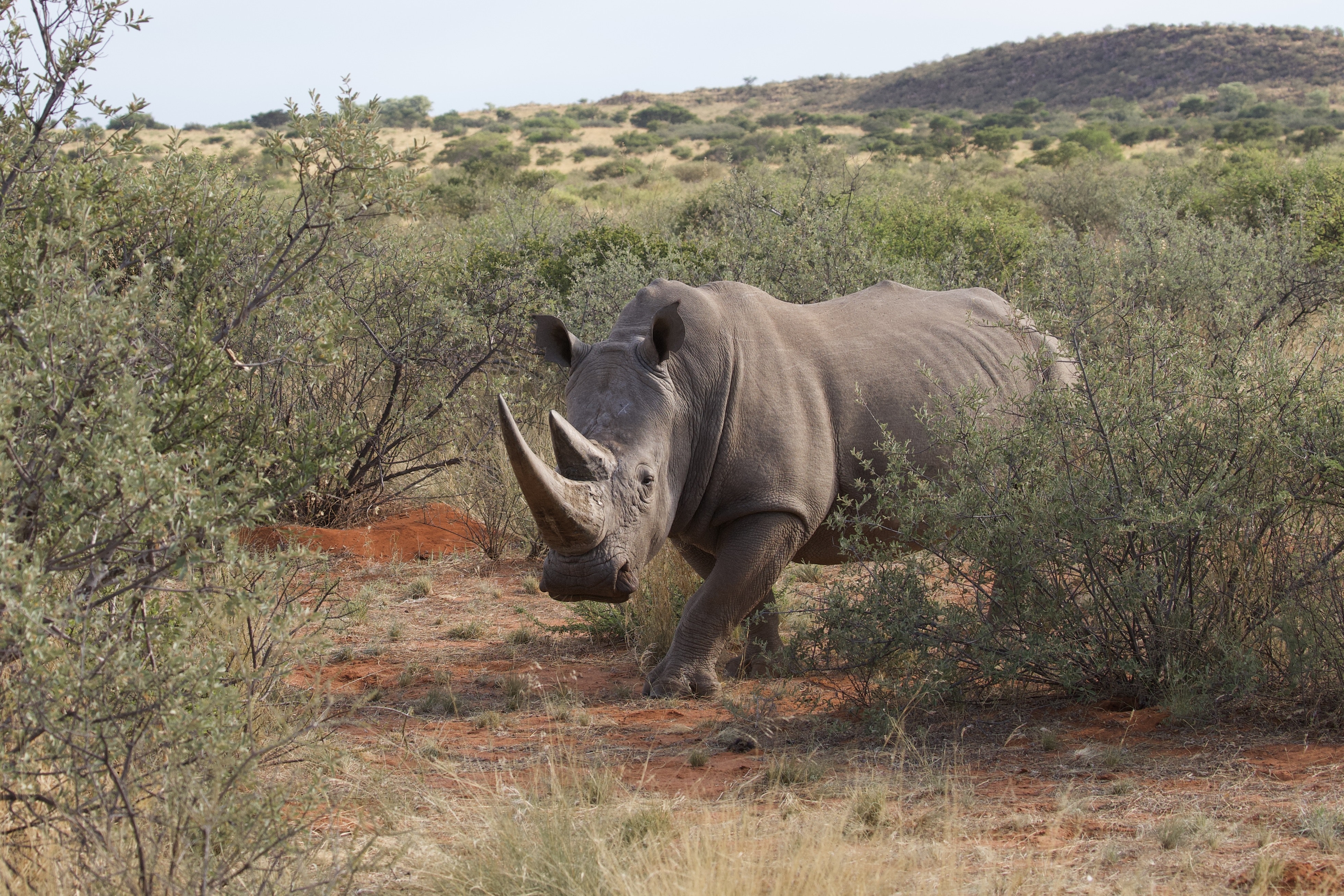
While the UK government has been considering a ban on imports of hunting trophies, the South African government recently approved an annual maximum quota of ten legal trophy hunts of endangered black rhinos for 2022. South Africa has permitted white rhino hunts, without quota limits, since 1972.
The South African government’s approval of this year’s quota is consistent with previous approvals since legal black rhino hunts started in 2005. Approval for hunting is given only when specific individual animals to be hunted meet a set of criteria established by a scientific rhino management group.
But given that both rhino species are threatened by poaching, and that the black rhino is considered critically endangered, does it make sense to allow any rhinos at all to be killed?
We considered this question in some detail in a recently published study. We examined the regulated legal hunting of both rhino species in South Africa and Namibia over the last half-century. By analysing historical information and data on rhino numbers and hunts, we explain that this issue is not as simple as it seems.
While public sentiment against hunting rare wild animals and taking their trophies is certainly growing, in the case of African rhinos this practice has an established history. For the most part, it has supported conservation rather than undermined it.
This is because, counter-intuitively, removing a small number of specific rhino males can enhance population demography and genetic diversity. This can also encourage range expansion and generate meaningful socioeconomic benefits to help fund effective conservation, which is costly.
History of rhino hunting
Along with large-scale land conversion and habitat loss, uncontrolled and illegal hunting (poaching) caused the dramatic decline of all rhino species across Africa and Asia during the 19th and 20th centuries.
But from the early 20th century, some rhinos started to benefit from the creation of state protected areas. The world’s last surviving southern white rhino population, in South Africa’s Hluhluwe-iMfolozi Park, recovered from fewer than 50 individuals to more than 1,200 in 1960.
Following management concerns about potential overpopulation in the park, from 1961 many rhinos were moved to create founder populations in new areas in South Africa. But the recipients of these rhinos wanted more females than males because this enables faster breeding. This created a problem of skewed sex ratios at the source. This problem was then addressed by allowing some males to be moved and sold for the purpose of regulated safari hunting.
Moving surplus rhinos to set up new populations, and hunting small numbers of males, helped encourage population growth and range expansion. It was gradually adopted across South Africa and in neighbouring Namibia, and then extended to include black rhinos.
Currently, poaching to supply persistent consumer demand for rhino horn remains a major problem. It has been responsible for a recent serious decline in white rhino numbers in South Africa’s Kruger National Park, where no hunting is allowed. Numbers fell by 75% between 2011 and 2020.
In contrast, relatively few rhinos (under 100, making up less than 0.5% of the total population) are legally hunted each year. Unlike poaching, where valuable breeding females and calves are also killed, legal hunting is selective and focused on specific males.
How legal hunting works
Legal hunting helps rhino conservation for both biological and socio-economic reasons. Conservationists have learned that the best way to counter the poaching threat is by maintaining high rhino population growth rates, and by investing in rhino security on the ground.
Better breeding rates make a big difference in the longer term. Almost all surviving African rhinos are found in enclosed (fenced) areas. Their population growth starts to decline when the area approaches its carrying capacity. To keep growth rates high and expand rhino range, rhino conservators regularly move them to new areas. But neither donor nor recipient areas want too many males.
Higher proportions of rhino males can act as a drag on population growth for several reasons. Populations with more females breed at a faster rate. At increasing density, males fight for territory, often killing each other and even sometimes females and young. Mortality rates are higher when males are moved into areas with existing males and there are few other areas that can provide homes for surplus males. Some old males may no longer be dominant enough to breed, but still have an impact on food reserves for breeding females. Removing selected males through hunting can help address such problems.
These hunts can also raise substantial amounts of money to support conservation, directly and indirectly. In both South Africa and Namibia, wildlife economies are structured through smart regulation to create the incentives to ensure that such economic benefits flow to local people and help cover relevant conservation spending. Where it has been practised, legal rhino hunting has generated significant income to help cover the very high costs of effective anti-poaching security.
Stopping this hunting would leave a big hole in conservation funding of some areas – already under pressure after two years of COVID-19 travel restrictions.
Evidence of impacts
Currently, South Africa and Namibia are the two countries with the most African rhinos. In 1970, before legal hunting was introduced, they jointly held about 1,950 white rhinos, some 61% of Africa’s total. That number had risen to about 16,600 (92%) by 2017.
In 2004, the year before legal black rhino hunts were introduced, the two countries conserved about 2,310 black rhinos, some 66% of Africa’s total. By 2018 that number had risen to about 3,975 (70.6%) despite an increase in poaching during this period.
Looking at these numbers, it is difficult to argue that legal hunting has had an overall negative impact on rhino populations in South Africa and Namibia. If anything, the opposite is true. This is because of the biological and socio-economic benefits generated by these hunts, which can boost conservation performance through enhanced population growth and funding. If appropriately governed, legal hunting and trophy trade can therefore support conservation of species and their habitats.
Dr Richard Hannington Emslie, a rhino conservation specialist, also contributed to this article.


