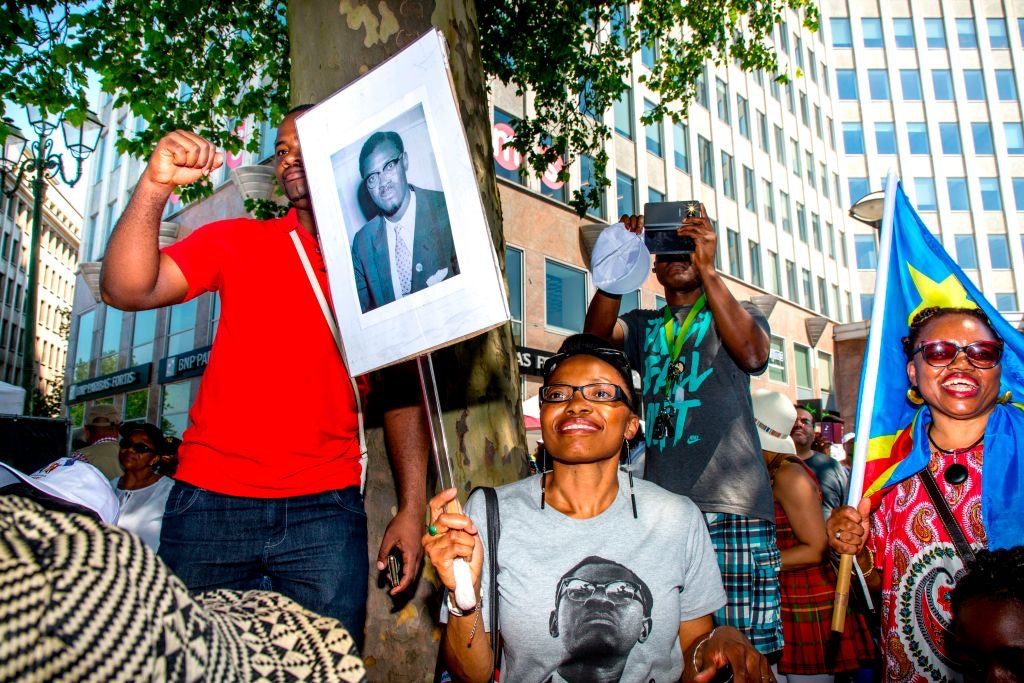
During a recent visit to the Democratic Republic of Congo (DRC), King Philippe of Belgium made a speech to the national parliament in Kinshasa expressing his “deepest regrets” for the exploitation and oppression of Belgian colonialism.
The European nation ruled the Democratic Republic of Congo from 1908 until 1960. Before that it had been a personal colony of Leopold II, Philippe’s great great grand uncle, for more than 25 years.
Philippe also addressed students at the University of Lubumbashi, in the capital of the Southeastern province of Katanga. “Today, let’s look towards the future,” he urged. Philippe declined to expand on his regrets, and only mentioned the colonial past, “our shared history,” in veiled terms.
His exhortation to dissipate colonial memories is particularly problematic in Lubumbashi. It is only a few kilometers away from where Patrice Lumumba, the Congo’s first Prime Minister, was assassinated. This happened in the presence of the Katangese secessionist leader Moïse Tshombe and his Belgian advisers on January 17, 1961.
Lumumba’s tooth, which had been kept by the Belgian policeman who destroyed his body, will finally be repatriated to the DRC – a gesture his family have been requesting for a long time.
Belgian researcher Ludo De Witte has described Lumumba’s murder as the most important assassination of the 20th Century. A charismatic leader, Lumumba embodied the struggle for pan-Africanism and Congolese unity. He unequivocally denounced Europe’s racist oppression of Africa. His vision of decolonisation, as a process of total liberation, marked millions of people in the Congo and around the world.
While Belgium has partly acknowledged its responsibility for the murder, no protagonists have been brought to justice. A parliamentary commission found that King Baudouin, the monarch at Congo’s decolonisation, was aware of plans to assassinate Lumumba. However, Baudouin’s complicity remains to be officially recognised.
The commission “tried in a way to limit the damages with its conclusions” and shied away from linking Belgium directly to the assassination. That was because “the diplomatic, ideological and financial consequences would be extremely great.”
This might be why King Philippe is focusing on moving forward. His speech in Lubumbashi positioned Congolese students as a future-oriented group with whom Belgium could forge a new partnership.
But there’s a crucial element missing from this logic: the specific role historically played by university students in further entrenching decolonisation in the Congo. This appeared most strongly during the 1960s.
In a forthcoming book on the history of this movement, as well as in previous publications, I argue that Lumumba’s death triggered students towards the political left. It created a generation of intransigent activists. These students pushed for total liberation from exploitation and oppression, as Lumumba had envisioned.
Many students today still feel committed to this tradition, and might not easily accept the clean slate envisioned in the monarch’s call to turn away from the past.
Shifts in the student movement
Congolese only began accessing universities a few years before the end of the Belgian regime. This was much later than in other colonial territories in Africa. This was a deliberate move by colonial officials, afraid that educated Congolese would challenge the status quo.
But as the anticolonial struggle was taking off, the Belgians revised their judgement and authorised the opening of two universities. They hoped that having been given access to the last echelon of European education, educated Congolese would support the maintaining of strong ties between Belgium and the Congo.
In the late 1950s, some students adopted the moderate tone that the Belgians had wished for. Several leading student figures from this period, whom I interviewed for my book, told me how they had criticised the politicians as demagogues unfit to rule the Congo. They argued that only a properly trained elite like themselves, and not uneducated politicans, could lead the country towards development and prosperity.
But, in the aftermath of Lumumba’s assassination in 1961, the student movement shifted. Its orientation became a vocal voice in defence of a fully independent Congo and for a more radical break with the colonial era. Students became increasingly critical of their Belgian professors and began identifying with revolutionary figures from Africa, Asia and Latin America.
The murder opened the eyes of many to the violence of neocolonialism. Lumumba immediately became viewed as both a martyr and hero by people around the world. This strongly impressed students and they felt like it was their role to continue the work he had started.
The student movement of the 1960s adopted Lumumba’s commitment to pan-African unity. It built on his conviction that independence involved more than a political transition. It had to be a revolutionary process that abolished economic exploitation and ensured mental liberation from colonial worldviews.
Student demands
Students denounced the continuous power of Belgian administrators and faculty at Congolese universities. They demanded the Africanisation of curricula and the democratisation of governing boards.
Their activism transformed higher education. It paved the way ultimately to the nationalisation of universities. But it also reverberated beyond university campuses, challenging the political elite’s refusal to continue the unfinished decolonisation of Congolese society and economy.
After General Mobutu Sese Seko staged a coup in 1965, he attempted to co-opt students and change their ideas about radical independence.
However, Mobutu’s uneven adherence to the ideal of Congolese nationalism alienated the students. By the end of the 1960s university students continued to oppose Mobutu’s increasingly dictatorial power. This was despite the fact that the regime suppressed critical voices.
Their protests were violently repressed and did not succeed in immediately challenging the president. Yet, they planted seeds that grew over the years and led to the powerful movement for democratisation of the 1990s. I believe that this significantly weakened Mobutu’s power and contributed to his ultimate downfall in 1997.
In June 1970, when King Baudouin went on the first Belgian royal visit of Congo since independence, he stopped, together with President Mobutu, at Lovanium University in Kinshasa. In an interview with students from that time, they told me how they sprayed the royal delegation with water. It was an expression of their opposition to the regime and unfinished decolonisation of their university.
King Philippe didn’t experience an incident like this. Yet, it doesn’t mean that students aren’t looking critically at the relationship between Belgium and Congo. Students rose up in 2015 against then President Joseph Kabila’s attempt to change the constitution. Recently, they have protested against the ongoing war and massacres of civilians in Eastern Congo.


