How planting trees can protect cocoa plants against climate change:
Worldwide, areas suitable for cocoa production are predicted to shrink by up to 20-30% over the next 30 years. This is because cocoa trees are already struggling to cope with drier, hotter conditions – attributed in large part to climate change.
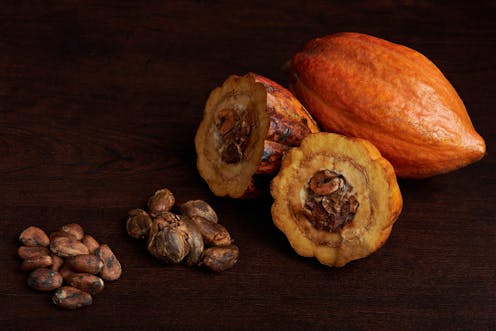
Chocolate, one of the most popular and widely consumed products in the world, comes from cocoa trees. These trees produce pods that contain beans which are harvested, fermented, dried and turned into cocoa powder or butter. They grow in the humid tropics where temperatures ranges from 20°C-35°C, annual rainfall is over 1200 mm and the dry season is less than two months long.
In 2016 the global chocolate market was valued at USD$ 99 billion. And demand for cocoa is likely to keep increasing as more and more people eat chocolate bars, drink hot chocolate or eat chocolate ice cream.
Over 60% of the world’s chocolate is produced by smallholder farmers in Cote d’Ivoire, Ghana and Indonesia. They will suffer as a result of climate changes, producing less cocoa per unit area on their farms. They will get less money for their hard work as their profit share, along the cocoa supply chain, is unlikely to increase.
This will have a huge impact on the livelihoods of about 25 million people. It will also have an impact on the economies of some cocoa producing countries, like Cote d’Ivoire and Ghana, that rely on cocoa for a large part of their export income.
Our research shows that agroforestry is an excellent strategy to help smallholders cope with climate change and to avoid further deforestation in new cocoa producing areas. But it must be done wisely as the shade tree species must suit the local context and farmers’ needs.
Trees and cocoa
Shade trees – such as Erythrina, Inga or Gliricidia in Latin America or Terminalia, Ricinodendron or Albizia in West Africa – are advocated as a key adaptation strategy against the negative effects of climate change.
Shade trees buffer cocoa plants from heat and water stresses, and create conditions that benefit the cocoa tree growth. Other advantages include:
-
enhanced soil fertility due to leaf shedding and pruning residues. These enrich the soil in organic matter and recycle nutrients.
-
reduced soil erosion because the leaf litter, which covers the soil, prevents surface run-off.
-
improved pollination by creating a more favourable climate for pollinators.
-
enhanced biological control of pests and diseases by creating a more favourable environment for natural enemies.
In addition, farm households benefit economically from using agroforestry. Their revenue streams are diversified, as they get fuelwood and timber, and food from fruit trees.
Farmers can manage their cocoa plantations, with permanent shade, in a variety of ways:
-
thinning down the original forest canopy and keeping forest trees of interest;
-
planting fruit and timber species;
-
protecting the growth of valuable trees which grew naturally.
Context matters
While the number of trees and tree species per hectare can vary widely, the trees being planted must be suited to the local context and farmers’ needs. It’s not worth trying to promote tree species that farmers do not want, are not suitable locally; there is no single tree species that can provide all the services needed. For example, some tree species have shallow root systems, which means they are well suited to wet areas, but will compete with cocoa plants for soil water in drier conditions. This was seen in our recent study in Ghana.
Scientific knowledge has to be combined with farmers’ knowledge of tree species because rural communities have valuable experience with many local trees. This can be turned into decision-sup port tools, like the Shade Tree Advice Tool, which are becoming increasingly available and can help farmers make the right choices.
More steps
Agroforestry is getting more attention. Locally, the increasing impact of climate change means more awareness of the benefits of trees to cocoa farms, landscapes and communities. Globally, increased consumer awareness of environmental and food safety issues means that cooperatives, like Ghana’s Kuapa Kokoo, are successfully promoting agroforestry and environmentally sound cocoa production.
But more steps need to be taken to promote the use of trees.
Policies have to be put in place that give rural communities and farmers incentives to adopt climate-smart practices on their farms and landscapes. This includes passing laws and regulations that secure land tenure, encouraging farmers to invest in that land. Farmers also need to have ownership over trees, giving them the right to plant and nurture them, but also to fell them for revenue. Finally, farmers will more readily adopt agroforestry if they get economic incentives for various schemes; for examples, premium prices for eco-certification, payments for provision of environmental services at local level (water, scenic beauty) and at global level (carbon sequestration, climate mitigation and biodiversity conservation).

Over the years, Philippe Vaast has received funding from various organisations or governmental agencies to undertake exclusively research and development work.
Source: The Conversation – Articles (AFRICA)
Read more on The Conversation.
Join the fun: Add Your event | Submit a Press Release | Add your listing.


