If you go for a walk in the green hills of Mpumalanga in the north east of South Africa, you may stumble across some stone walls. Either stubbing your toe or appearing through the grass at about chest height, these walls direct and disrupt your path.
Climbing to the top of these gentle slopes, your eye is drawn to circular and linear patterns. From above you quickly realise these patterns are the remains of towns – clusters of homesteads, traditional households, terraces and roads. These ruins are the remnants of the Bokoni polity, a region that contains the southernmost collection of stone terrace farming sites in Africa.
Archaeologists study the Bokoni sites as they are a marvel of urban farming innovation and ingenuity.
In our research we have broken new ground about the Bokoni sites, and solved a mystery that’s puzzled scientists for decades – when the first sites were built. Our findings were made possible with techniques and technology usually used in geology.
The search for the beginning
Archaeologists, in collaboration with historians, have defined four phases of occupation for Bokoni. Oral histories provide particular insight into phase II, the zenith of the Bokoni’s urban growth and planning, when the larger towns were occupied.
For instance in 1936, as part of his research into the seKoni language, linguist C.W. Prinsloo mapped the extent of Bokoni in the 1800s and indicated earlier capitals. Pedi oral traditions recorded by missionaries in the 1960s refer to the Marateng (Pedi) royals encountering seKoni speakers in approximately 1650CE.
But there are no known historical accounts of Phase I. So, until now, it hasn’t been known exactly when the Bokoni emerged. But, by turning to the material record and archaeological science, our research has solved this enduring mystery.
We applied a technique called luminescence dating to resolve the origins of this tradition. We now know that Bokoni Phase I was built as early as the 15th century – before the arrival of European colonisation or trade reached the interior. And that the Bokoni farmers continued to thrive for centuries despite the turmoil that was arriving at nearby shores.
These findings disrupt past narratives that decry the presence and ability of African farmers before and during colonisation. They also offer new ways of understanding individual lives and familial patterns. This research helped us reconstruct when people began to build these incredible structures, how long a household was occupied before abandonment, and how their successors interacted with the structures they left behind.
Four phases
The four phases identified by researchers as being key periods in the Bokoni polity are as follows.
Phase I marks Bokoni’s emergence (the date of which remained unknown until now). Phase II, in the 17th and 18th centuries, saw the peak of Bokoni’s urban growth and planning. During this period, most Bokoni residents would have been urban farmers, first in and around the capital called Moxomatsi, and later at the succession capitals Mohlo-Pela and Khutwaneng, which lies in modern day Mpumalanga, South Africa.
Phase III marks the start of the upheaval that resulted in Bokoni’s decline in the 19th century, while Phase IV documents the diaspora from the mid-19th century onwards. Bokoni broke apart because of regional conflict in the early to mid 1800s.
Given the dearth of written or oral history from Phase I, we turned to the science of dating in our search for answers.
Dating methods
Only two radiocarbon dates exist for sites from this period and region. This is because radiocarbon dating is not ideal for Bokoni. Radiocarbon dating measures the radioactive carbon isotope in organic remains. The technique provides the date of death by measuring the remaining radiocarbon component of organic remains like bone or wood. But in certain conditions the soil does not preserve organic remains.
Read more: Explainer: what is radiocarbon dating and how does it work?
Luminescence dating was far more suitable for the Bokoni site. Optically stimulated luminescence is a dating technique that measures when quartz or feldspar grains within the soil were last exposed to light or heat. This time stamp tells us when these minerals were buried (or trapped in an object like a pot).
When quartz grains are exposed to light, their electrons become excited and leave their correct orbitals; this is called bleaching. At the point of bleaching, the grain has age zero. Once the grain is buried, it uses the radiation within the surrounding soil to return its electrons to their correct orbital.
A GIF showing the process, Ruby-Anne Birin via GIPHY
Scientists then measure the dose absorbed by the grain and divide it by the rate at which that dose was absorbed. This value provides the date of the last exposure to light, which allows us to determine when a material or surface became buried, or when a pot was last fired.
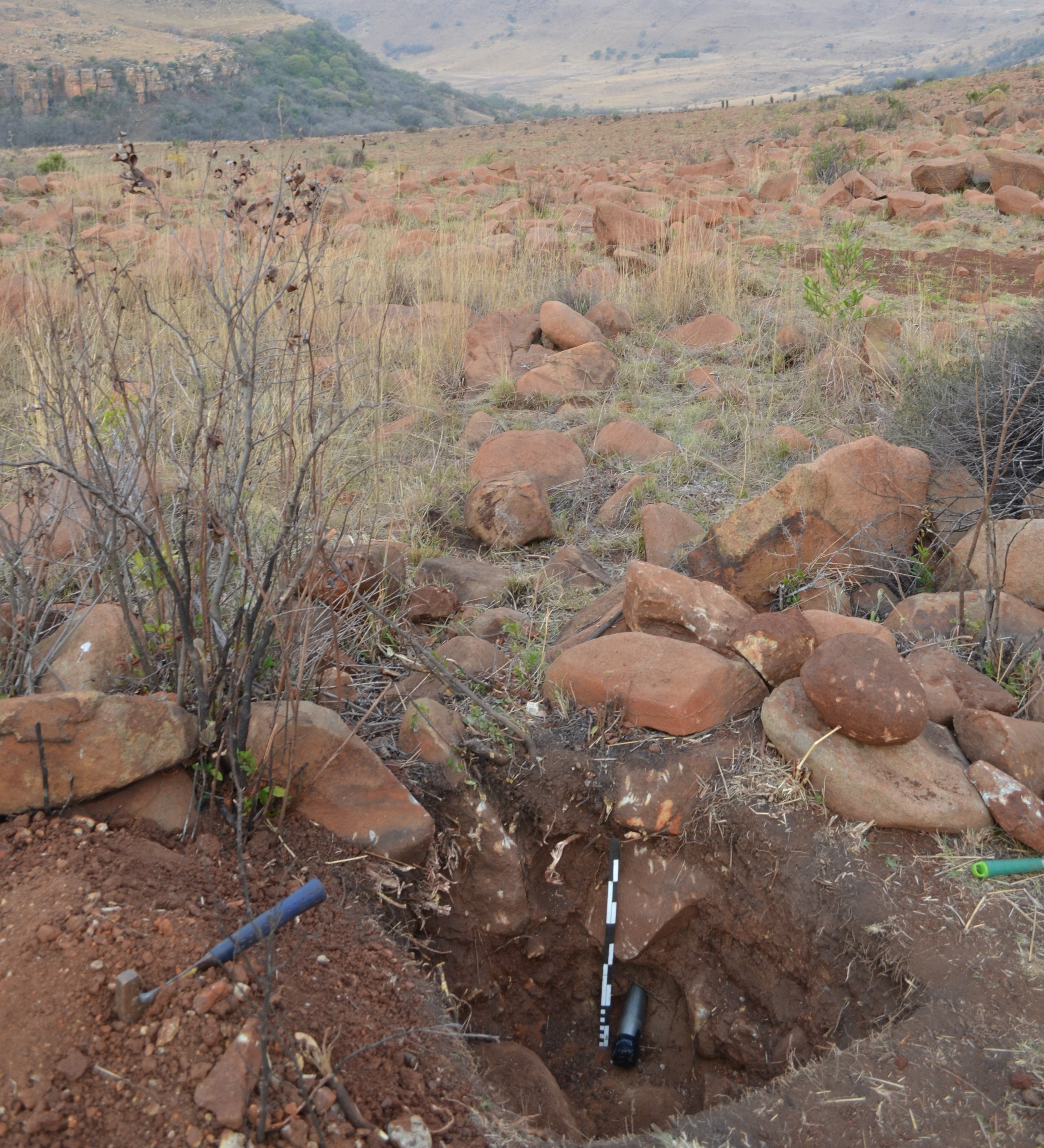
Our team used this technique at two homesteads in Komati Gorge Village, a southern town within Bokoni. We already knew that one homestead was older than the other because many of its stones were re-purposed to build the more recent settlement.
Our results indicate several periods of occupation, abandonment and new construction. The older homestead was occupied from as early as 1489CE until it was abandoned around 1577CE. The builders of the younger homestead reused the older from approximately 1682CE to 1765CE. The younger homestead itself was reused at some time between 1738CE and the early 20th centuary.
Future work refining our understanding of the occupation periods of Bokoni may also allow us to better reconstruct the environmental and political landscape people lived within.


