How shark spotting can help reduce attacks. A Cape Town case study:
It is summer time in the southern hemisphere and locals and tourists are flocking to the coast to enjoy the sunshine, salt air and some of the best beaches this part of the world has to offer.
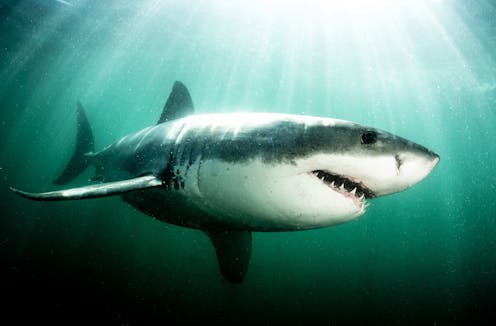
In southern Africa it’s also the time when great white sharks migrate closer to Cape Town’s shore to take advantage of warmer waters and abundant fish prey.
This raises the danger of people being bitten or attacked.
Shark bites are in fact extremely rare and there were only eight deaths annually from shark attacks between 2011 – 2015. In Cape Town, there have been 13 shark attacks – four fatal – since 2000.
It’s obvious that the chance of incidents is greater when the number of people and the number of sharks in the same space increases. As George Burgess, Director of the Florida Program for Shark Research, says
The number of shark-human interactions occurring in a given year is directly correlated with the amount of time humans spend in the sea and as the world population continues its upsurge and interest in aquatic recreation, we realistically should expect increases in the number of shark attacks and other aquatic recreation-related injuries.
Interactions between sharks and humans happen in a variety of places. That means reducing conflict needs different interventions. Some have included lethal shark control methods like shark hunts, shark (gill) nets or other fishing devices, aimed at targeting and killing the predators. For example, along South Africa’s KwaZulu-Natal coastline a combination of shark nets and baited hooks (drumlines) are used to catch and kill large sharks close to beaches to reduce the chance of shark attacks.
In 2006, following a cluster of four shark bites over a two-year period, Cape Town decided to do things differently and supported a non-lethal method – Shark Spotters. The idea was pioneered in 2004 by local surfers and lifesavers with the aim of reducing the chance of a shark attack while still conserving them.
Our study argues that the warning system works. Our analysis of shark sightings and the behaviour patterns of water users like swimmers, surfers and paddlers shows that the overlap between the two is high on a seasonal and a daily basis at two of Cape Town’s most popular beaches, Muizenberg and Fish Hoek.

Shark Spotters
During the summer months there is a significant overlap between high numbers of people spending time at the beach, and the number of sharks frequenting the waters off Cape Town. The times of highest concentration are around midday to early afternoon.
During the summer months up to 40 trained shark spotters are employed in Cape Town’s pioneering shark spotting programme. They keep watch over eight of the city’s most popular beaches.
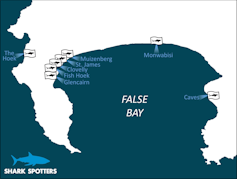
Two spotters (each working shifts of six hours) are on duty at each beach. One is the shark lookout, positioned high (40 m – 110 m) above the beach, and the other is stationed on the beach to communicate directly with the public and change the shark flags.
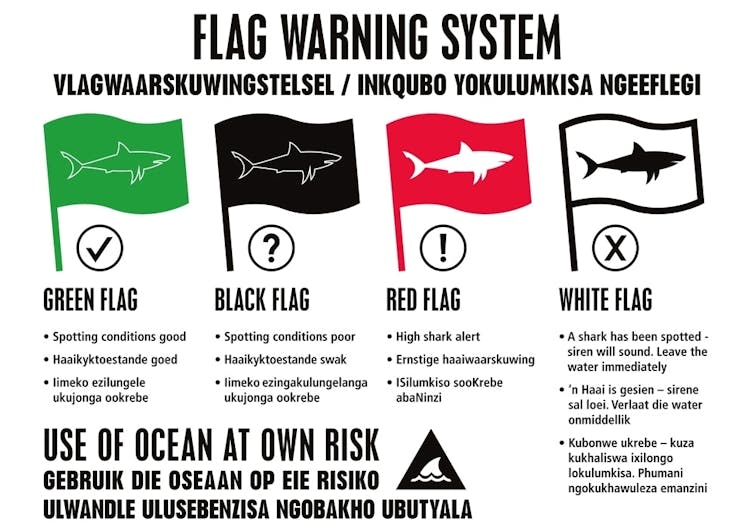
A system of coloured flags and a siren are used to let swimmers know about how high or low the risk is of sharks being in the water.
When a shark is sighted close to people in the water, a white warning flag is raised with an accompanying siren. Spotters will also actively encourage people to leave the water.
The programme’s aim is to reduce the risk of a shark incidents without harming the sharks and the marine environment. The programme also provides research, education and job opportunities.
There has been an exceptionally low rate of shark incidents over the past decade (one every two years) with no increase in the rate of incidents since a cluster of attacks between 2004 and 2006. This is despite an increase in global numbers.
We attribute some of this success to the Shark Spotters programme.
Our findings showed that water users responded to the white flag and siren warnings that followed a shark sighting. But we also found that the red flag warning – the sign for an increased risk of a shark in the area or that a shark was spotted within the last hour – was largely ignored. This could be because people are not aware of the meaning of the red flag, or because they didn’t see the flag, or that they accepted the risk.
Impact of a fatal shark bite
Even though fatal shark bites are rare, their impact is significant and can have repercussions for local communities and economies that rely on tourism. Analysis of the number of water users before and after a fatal shark bite in False Bay showed that attacks drove people away. Fewer people used the sea at Muizenberg and Fish Hoek for three months after the incident.
Managing the overlap between people and wildlife in a balanced, sustainable way is becoming more and more challenging as populations grow, and Cape Town leads by example with this unique solution to mitigating conflict. Shark Spotters shows how it can be done.

Tamlyn Engelbrecht is affiliated with Shark Spotters and the University of Cape Town (UCT). She conducted this study as part of her BSc (Honours) degree in 2013. She is currently a PhD student at UCT, and receives funding from UCT and the National Research Foundation.
Alison Kock is on the Shark Spotters executive committee and was employed as the research manager at the time of this study. She is currently employed by South African National Parks (SANParks) and receives funding from the Save Our Seas Foundation for great white shark research.
Source: The Conversation – Articles (AFRICA)
Read more on The Conversation.
Join the fun: Add Your event | Submit a Press Release | Add your listing.


