How solar kits and battery lamps are replacing kerosene across Africa:
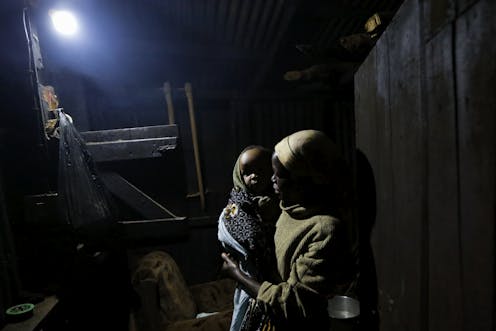
For decades, people in rural Africa have been using sooty kerosene lamps to dimly light their homes. But in recent years households, even in poor areas, have started to replace their kerosene lamps with non-rechargeable dry-cell battery driven lamps and solar kits. This is happening largely without any governmental or donor involvement. These devices are equipped with light-emitting diodes (LED) that have become significantly cheaper over the years. This has, in turn, made them a highly efficient technology affordable, even for poor people living in rural areas.
Our study covering seven countries across sub-Saharan Africa shows how privately supplied dry-cell battery driven lamps as well as solar kits have facilitated a lighting transition. Cheap supplies of disposable batteries and lamps mostly from China, have found their way into the most remote villages in the region.
A quote from a Senegalese expert we engaged with in the field summarises this transition:
Chinese torches have electrified Africa, not World Bank.
At least for basic electric lighting provision this seems to be true. Obviously, LED torches do not replace the need for more powerful electricity that can be used for productive purposes.
The lighting transition away from kerosene is a remarkable development that challenges the traditional understanding of how mass electrification happens – and how mass adoption of a technology shapes up. The convention is that these processes are initiated from the top by governmental or non-governmental organisations supported by a development agent like the World Bank or its Lighting Global programme, which specialises in supporting sustainable growth of the global off-grid lighting market.
But, in the case of dry-cell battery driven lamps, the technology has diffused without any top-down support. It’s an amazing tale of technology diffusion that has happened without any institutional support.
The transition away from kerosene
We came across an intriguing example in small villages in rural Rwanda we were surveying for a randomised controlled trial on solar kits. We found that people had replaced kerosene lamps with dry-cell battery LED lamps. Slightly better-off households were using ready-made flashlight – either smaller torches or much brighter multi-diode lamps.
Even the poorest people could afford the investment by hand-crafting one-diode torches, connected to disposable batteries tied by banana leaves. We were told by a number of people that kids had brought the idea from school, where it spread through word-of-mouth channels.
Admittedly, our lighting transition study covers only selected places in seven countries. But the similarity of these patterns across all of them suggests it can be generalised to other regions.
And the economic argument – affordability and scalability of LED-lamps – seems to be universal. LED torches are cheaper to run than kerosene lamps. In addition, the scalability from handcrafting dim one-diode lights (that come at less than a dollar) to bright multi-diode lamps (that can cost several dollars) solves the liquidity constraint problem attached to more lumpy investments.
LED seems to be a perfectly adaptive pro-poor technology. Households can scale the investment according to their ability to pay. Not least, rural dwellers everywhere have a high preference for LED over kerosene.
How about quality?
The concern of many donor agencies – including Lighting Global – is that the quality of these LED lamps and low cost solar lanterns is poor, particularly when it comes to their durability. Based on this assumption they advocate quality verified products.
Yet, in a case study in Burkina Faso we showed that this is only true when one considers the absolute quality, not the quality relative to the upfront costs. For a household with low purchasing power it is not rational to invest in a high-quality kit that lasts, say, twice as long but costs three times as much. Given that poor people don’t have much cash and have many other urgent and essential things to deal with, it’s perfectly reasonable that they would prefer a cheaper solar lamp over a more expensive one – even if it breaks sooner.
This raises concerns about the inappropriate disposal of electronic waste. The shorter durability of non-quality-verified products and the surging consumption of dry-cell batteries in rural Africa is leading to more and more electronic waste. This increasing environmental burden needs to be addressed. Here, quality-verified solar kits and their licensed vendor network can have an important role, as we argue in another paper.
Conclusion
The LED dissemination success story has provided poor people in Africa with access to clean lighting sources.
This suggests that expectations about the impact of electrification have to be updated. Most notably, positive health effects by a reduction of kerosene induced air pollution as it was observed in El Salvador might not materialise anymore in Africa. At the same time, policy makers should have an eye on an emerging new problem: the massive increase of electronic waste in areas were no waste management system is in place.

Jörg Peters has done consultancy work for foundations, bilateral and multilateral donor organizations such as World Bank, GIZ, 3ie, and Social Impact. He is affiliated with RWI – Leibniz Institute for Economic Research. His research group at RWI receives funding from the German Federal Ministry for Economic Affairs and Energy, the Ministry of Innovation, Science, and Research of the State of North Rhine-Westphalia, 3ie, and the Federal Ministry of Education and Research.
Source: The Conversation – Articles (AFRICA)
Read more on The Conversation.
Join the fun: Add Your event | Submit a Press Release | Add your listing.


