How South Africa’s jazz musicians are making the digital leap:

The performing arts is one of the sectors hit hard by COVID-19, with tens of thousands of gigs cancelled across the world.
While pop and electronic music has evolved with online platforms like YouTube as their natural habitat, jazz has remained more strongly tied to live performance, using social media and online videos mainly as publicity rather than as a primary point of dissemination.
South African born vocalist, trumpeteer and musical director Mandisi Dyantyis was perhaps the first to turn to the virtual concert as a substitute for the band’s cancelled performance at Cape Town International Jazz Festival. On 26 March, the band livestreamed the set they would have performed at the festival, charging R100 per household to access the gig.
But this was before lockdown, when musicians could still get together to perform in a room with good recording equipment and a stable internet connection. These are technologies musicians don’t necessarily have in their homes.
Since the lockdown in South Africa several jazz musicians have begun to harness online platforms in novel ways.
Lockdown performances
Shane Cooper, the bassist and electronic music producer performing under the alias Card on Spokes, initiated the Quarantine Collabs on YouTube.
Thanks to his electronic work, Cooper has an equipped home studio to record, the technical know-how to produce and edit his music and already has a presence on virtual platforms to release his music.
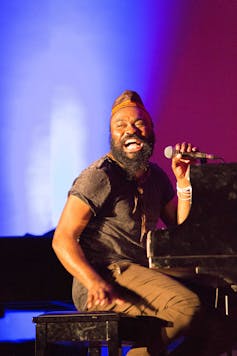
For the Quarantine Collabs, which features musicians like Bokani Dyer and dancers he recruited through a call on social media, Cooper asks his collaborators to send him a prompt (such as words, colours, tempo) to which he composes and records a musical response. He sends the music to the collaborator to record their own response in turn, and finally mixes and edits the results into a one-minute video posted on YouTube and Instagram. The Collabs are made possible, in part, by everyday technologies like mobile phones.
Another jazz musician to turn to digital platforms is Nduduzo Makhathini, who has done a virtual album launch of Modes of Communication: Letters from the Underworld, his first record released on the Blue Note label.
For Makhathini, lockdown coincided with an entire roster of events scheduled in Europe and the US to promote the new album. Social media, which was formerly considered “alternative” spaces of dissemination, have now become central. Makhathini’s launch harnessed these newly central platforms, and took form as an Instagram real-time video conversation with the British saxophonist Shabaka Hutchings and a Facebook Live broadcast of a performance by Makhathini and his wife, the vocalist Omagugu Makhathini from their home.
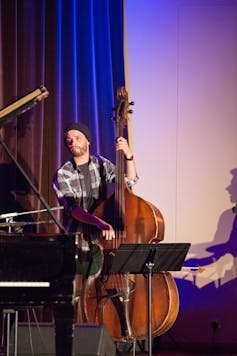
At one point, more than 100 people joined on Instagram, and Makhathini’s Facebook video has clocked more than 7 000 views. Clearly the benefits of going online is the possibility to reach bigger audiences than physical events.
The problem for performing musicians, however, is also pressingly an economic one.
No simple solutions
The solution is not a simple matter of moving activities online. In these days of free online content and minimal royalties paid by music subscription services like Spotify and Apple Music (at least for those who don’t hit above 1 million plays), artists mostly use online platforms for publicity rather than as a means of generating an income.
Yet there’s a delicate balance between getting the music out there (which risks adding to the expectation that music is free) and placing a value on artistic work.
Lockdown has the potential to dramatically change the jazz landscape, with artists who do not have an online presence disappearing from the map. Now the pressure is on to adapt quickly. Some might turn to online teaching or performing, but need to generate content, learn to film and edit, find dissemination platforms and manage to reach paying patrons first. Some promising opportunities are on the cards, like creating virtual jazz clubs similar to the virtual house parties deejays have been hosting. But these will take time.
More immediately, the best way to support artists is to buy albums digitally. Streaming only pays a few cents per play, but it does help. Create playlists of your favourite independent artists and play them as often as you can – even if you’re not actively listening. Listeners pay a fixed subscription regardless of their usage, but artists will receive more royalties. It would simultaneously boost their algorithms, which heightens the artist’s visibility in turn.
Makhathini takes heart in Wynton Marsalis’s dictum that: “The death of the artist is when he stops creating.” Judging by the initiatives of many musicians the past few days, artists are alive and more innovative than before. The concern, however, is how long they will be supported to do creative work.

Stephanie Vos is a post-doctoral fellow and project leader of the Interdisciplinary Forum for Popular Music (ifPOP), funded by the Andrew W. Mellon Foundation. She is affiliated with Africa Open Institute for Music, Research and Innovation at Stellenbosch University.
Source: The Conversation – Articles (AFRICA)
Read more on The Conversation.
Join the fun: Add Your event | Submit a Press Release | Add your listing.


