How the continent’s languages can unlock the potential of young Africans:
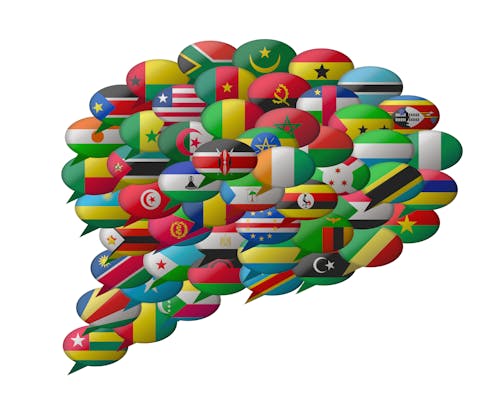
Africa is the home of 2144 languages. Oddly, most development theoreticians consider this a barrier to economic and social growth. Sociolinguists and educationists know better: the African continent’s multilingualism is a powerful resource.
The problem begins at school, and continues right through the education system. This includes tertiary level.
I have watched South African university students’ call for “fees to fall”, and – coming as I do from a country that offers free primary through tertiary education and whose economy thrives partly for this reason – I fully support them. However, in terms of just and sustainable education, fees are only one side of the coin. Language is the other. As a linguist whose work has focused for decades on African language matters, I remain convinced what Africa needs are political campaigns that tackle language: #EnglishOnlyMustFall. #FrenchOnlyMustFall. #PortugueseOnlyMustFall.
The continent needs a new strategy for mother-tongue based bilingual education, from primary through to tertiary level. In this, it can draw from what many other emerging markets and societies, as well as developed countries, do very successfully. From South Korea through Japan and China, to Russia, all of Europe and North America, schools’ language of instruction is children’s mother tongue (also known as first or home language). They also learn “global” languages like English and French so they can later function and communicate all over the world.
Crucially in these countries, the mother tongue is not suddenly abandoned at university. That’s because research has shown the level of a foreign language acquired at school is not enough for the required “Cognitive Academic Linguistic Proficiency”, or CALP. So students continue to learn in their mother tongue, while also studying a global language – or two, or even three. They do this at a stage when their cognitive, creative and critical potential are reaching maturity. In this way, they come to fully grasp the complexities and applications of their own home languages and a foreign language.
Applying these lessons in postcolonial Africa means embracing truly multilingual education. Unfortunately too many African tertiary systems operate solely through a foreign language – English, French or Portuguese. This disadvantages mainly black African students and creates what South African educationist Neville Alexander called a kind of “neo-apartheid”.
Putting African languages first
Research has made it explicitly clear: if efficiency of learning and cognitive development is the target, the mother tongue should be the medium of instruction from primary school, through secondary and into universities. Other languages, like English, can be introduced as subjects from lower primary level.
There are several objections to introducing African languages into the education system. Cost is one. But this is a myth. Sociolinguist Kathleen Heugh has shown that “…investment in such programmes in Africa at the moment is usually less than 2% of a country’s education budget – and is recovered within five years”.
Another argument is that multilingualism is somehow difficult to achieve. Yet many African children learn two or more languages before they ever reach school, and often use such languages interchangeably. Sociolinguists are intrigued by the ways in which Africans communicate mainly in urban contexts – in what appears to be talking in two or more languages at the same time. The new academic terminology for this is translanguaging or polylanguaging.
Why not use this as a highly welcome asset to teach through both African and European languages across the educational system, since people freely apply this strategy outside classrooms and lecture halls anyway? Why should educational authorities insist on using only English rather than “translanguaging” when teaching content subjects?
Others have inferred that African languages are simply not fit for teaching and learning at university level. This argument combines ignorance with racism. And it’s not borne out by evidence. In fact, the reverse is true. A recent PhD thesis currently being submitted at Rhodes University in South Africa, where I am a visiting Fellow, found that students with a background in languages other than English profit immensely from being assisted with teaching materials, terminology and translation aids in their mother tongues.
At Rhodes, isiXhosa features as more than a language subject. It is used as a medium of instruction in support courses for Journalism and Media Studies. Pharmacy students are taught vocation-specific isiXhosa skills. Bilingual teachers in Politics, Commerce, Sociology and Economics are recognising the linguistic diversity of their classes by using students’ lived experience as an important aspect of teaching and learning.
There’s more. The University of Limpopo offers multilingual studies, including a BA in Contemporary English language studies in both English and Sesotho sa Leboa. Masters and PhD students write their theses in any official language of their choice – recent examples have included theses in Sepedi, Tshivenda and Xitsonga. Both Stellenbosch University and the Cape Peninsula University of Technology offer multilingual glossaries in English, isiXhosa and Afrikaans for various faculties. These are also accessible online.
Multilingualism opens doors
These and other initiatives work towards two outcomes. The first is to produce university graduates who are able to converse freely in both a world language like English and in one or more African languages. A good command of global languages will open a window to the world for all those who’ve come through such a tertiary system – and put an end to the marginalisation of Africa.
The second outcome is that ultimately, African societies can be transformed from merely consuming knowledge to producing it. Until today and exclusively, knowledge came to Africa from the North, wrapped up in the languages of former colonial masters. This one-way road must change into a bidirectional one. For this, universities are the hub.
One of the ways to ensure this happens is to upgrade teacher (or lecturer) training. Whatever language is used in teaching content subjects, when language is the subject it must be taught professionally and well. Good English, but likewise good isiXhosa, for instance, must remain the teaching goal. Teacher training is critical.
All of this work is a worthy investment in the quest to give African languages their rightful place in African societies. Re-empowering African languages is a way to contribute sustainably to societal transformation and economic progress by fully exploiting the cognitive and creative potential of all young Africans.

H. Ekkehard Wolff is currently benefiting from a "Hugh le May Fellowship" for senior scholars in Rhodes University's Faculty of the Humanities.
Source: The Conversation – Articles (AFRICA)
Read more on The Conversation.
Join the fun: Add Your event | Submit a Press Release | Add your listing.


