How the COVID-19 pandemic will affect informal workers. Insights from Kenya:

COVID-19 is going to have a devastating impact on economies. Africa has a particular vulnerability because so many people work in the informal sector. In an interview with Moina Spooner from The Conversation Africa, Njeri Kinyanjui explains how this could unfold for Kenya’s informal labourers and whether there’s anything that can be done to support them.
How many people in Kenya’s work force are informal workers and what type of work do they do?
The informal sector thrives in Kenyan rural and urban centres. According to 2015 estimates there were 11.8 million people employed in the informal economy, against 2.4 million working in the formal sector. By 2018 the informal sector accounted for 83.6% of total employment.
But we can’t be sure of these numbers. There are no accurate statistics on how many people work in the informal economy. The figures are estimates which governments and international development organisations reach by excluding workers employed in the modern formal sector and those in small-scale farming. The methodology is in line with what multilateral agencies such as the World Bank and International Monetary Fund recommend.
There are many different categories of workers in the informal sector. And, worryingly, despite the huge number of people in this labour force, the earnings differentials between the formal and informal sectors are significant. Entry level staff in the formal sector earn between KES 10,001 and KES 50,000 (US$ 100-$ 500) a month. Those in the informal sector typically earn a monthly income of between KES 5,000 and KES 25,000 (US$ 50-$ 250).
There are those who are self-employed and work for themselves. These people – for instance tailors or welders – then hire others on weekly or monthly contracts.
Then there are those who will take up any job that may arise. For instance, house cleaners or porters.
Some informal workers are trainees who are learning on the job or family members who are helping a family business by overseeing accounts or running errands.
The informal sector is typically viewed as a stopgap measure where people subsist while they wait for jobs in the formal sector. For these reasons, the sector is neglected by government policies at the local level and by development financiers at the global level.
But, aside from job creation, it’s hugely important to the country’s economy and many households depend on the informal sector. For instance, a lot of vehicle repair and metal work takes place in the informal sector. And the fresh vegetable trade in Kenya is largely informal and unregulated.
What are the main challenges they face because of this pandemic?
Like any other businesses, informal sector business will end up with a reduction in customers because of the pandemic. The government is forced to implement quarantines and stay-at-home orders which will have negative consequences for spending in shopping malls, markets and restaurants.
For instance, customers will avoid crowded markets like Gikomba, Kariakoor and Wakulima – the biggest informal markets in Nairobi. The demand for their goods will decline and stocked goods may go to waste. Those making school boxes, suitcases that children use for school, or school uniforms may be affected by the closure of schools.
The businesses that supply the informal sector could, depending how long the measures last, run out of supplies. That will increase the cost of goods. This will affect the cash flow that businesses have.
Travel time to and from work will be affected if public transport is disrupted during the pandemic. This may also mean increased transport costs or delays in getting to work.
Those with children will be affected by school closure because there will be nobody to supervise their children at home. During my field work studies and visits to markets I observed that young market women usually take their children to informal daycare centres. If these close due to the pandemic, it means they cannot go to the market every day. Those who take their children with them to their workplaces may now be too concerned for their children’s safety.
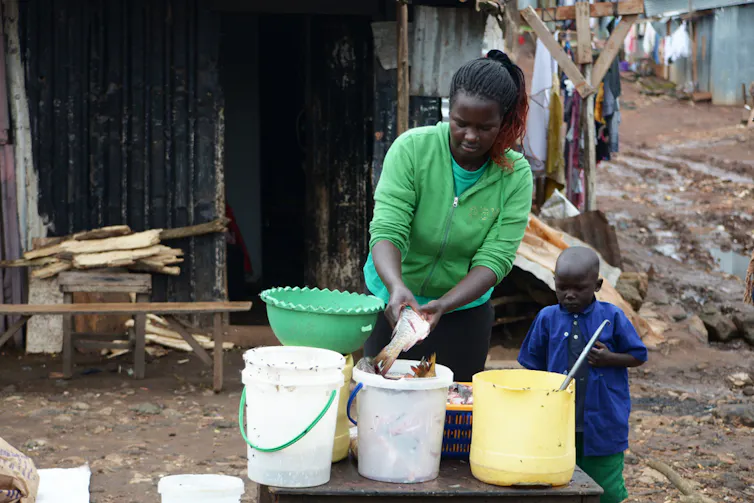
Informal workers will also not be able to take many of the precautions that health authorities suggest, such as social distancing, hand washing or self isolation.
Social distancing between workers in informal markets may be difficult because of crowding. For instance in markets people work close to each other and don’t have walls separating them. The same can be found in other informal sectors like in public “matatu” transport, vehicle repair and metal work.
Maintaining hygiene by hand washing with soap and water may also be a problem because there aren’t any facilities. For example in my research, I’ve not seen any water points in Githurai and Ruiru markets. I think this will apply to most of the other markets.
Working from home is also difficult. Most informal workers live in informal settlements in single rooms or bedsitters. They do not have enough space to work from. For others, their jobs require them to be on-site, where they’re in contact with their customers. The informal economy operates in agglomerations in different parts of the city. In Kenya these are known as jua kali (hot sun) sites.
Is there anything that can be done to support them?
There is a lot that can be done to support informal workers.
In light of this pandemic, because many informal workers are in contact with large numbers of people, they should be provided with masks to protect themselves and others. Water points should also be set up in markets and other informal sector clusters.
Longer term, the pandemic highlights the need for government and urban planners to plan cities with building designs that cater for traders, artisans and peasants. These facilities should include adequate room size for work, storage and display. There should also be a good supply of clean water, electricity and garbage collection. And there should be facilities that allow traders to access the internet.

Njeri Kinyanjui does not work for, consult, own shares in or receive funding from any company or organisation that would benefit from this article, and has disclosed no relevant affiliations beyond their academic appointment.
Source: The Conversation – Articles (AFRICA)
Read more on The Conversation.
Join the fun: Add Your event | Submit a Press Release | Add your listing.


