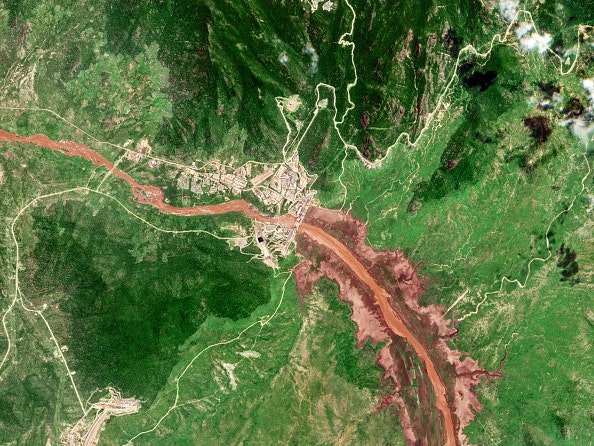
Since Ethiopia announced the construction of the Grand Ethiopian Renaissance Dam (GERD) in 2011, there have been disagreements between Egypt and Ethiopia on the filling and operation of the dam. With turbines of about 5100 MW it has more than two times the energy generating power of the nearest major hydropower dam – the High Aswan Dam in Egypt which was commissioned 50 years ago.
Ethiopia, as an upstream country in the Nile basin, contributes the lion’s share of the Nile waters. It’s three tributaries – the Blue Nile, Sobat, and Atbara – carry about 86% of the total flow in the Nile. With a population of more than 100 million it is singularly dependent on the Nile River for its freshwater needs.
According to the Nile Waters Agreement of 1959 between Egypt and Sudan, Egypt receives an annual average flow of 55.5 km3/year (about 75% of flow coming from Ethiopia). Thus, the GERD project challenges Egypt’s historical hegemonic position on the Nile basin. And it aspires to project the power of Ethiopia on Nile water sharing.
Beyond the escalated tensions and the complexity of politics among the Nile countries, a key question is: what effects will GERD have on securing the future water supply in the Nile basin and the region?
This question inspired my PhD research. My findings shed light on different pathways that could curtail the challenges imposed by GERD while ensuring the development goals of all countries. They are informed by the insight that a lack of data – such as operating policy or storage plans – hinders the management and operation of reservoirs. Countries having this data, and sharing it with their neighbours would be a game changer.
My work focused on the High Aswan Dam and GERD as typical paradigms of large hydropower dams in a transboundary basin.
The pathways introduced in my PhD research answer the following questions:
-
Can satellite observations with hydrologic modelling be used to understand dam operation in the Nile River Basin?
-
How can the High Aswan Dam adapt its operation to the filling and operation of the GERD?
-
What is the value of streamflow forecasts in improving High Aswan Dam operation?
-
How can we take advantage of the existing models and data to build an operational system that supports decision making in the Nile river basin?
Pathways
Pathway 1: Monitoring dam operation from space: In one of my studies, we explored the integration of hydrological modelling with the satellite earth observations over the Nile basin as a way to monitor the operation of dams.
This offers the opportunity to overcome the challenge of data sharing among Nile countries. This challenge is particularly evident in transboundary rivers shared between developing nations. More often than not neighbouring countries don’t share reservoir operating policies or storage plans.
The success of this satellite-based framework will have significant implications for policy makers. It will supply them with timely information about dam operations. In turn this will help them make more informed decisions about a wide array of water management issues.
Pathway 2: Adapting to future challenges
The High Aswan Dam is known as the faucet that controls the only source of surface water in Egypt. Its operation is based on the assumption that most of the Blue Nile flow will contribute to its power production and water supply. A lack of provision to adapt to GERD filling and operations will make inflow less predictable.
It is important therefore for Egypt to understand what changes GERD will bring to its water security. In particular it needs to know how the High Aswan Dam will have to adapt its operation to impending challenges.
In a recent study, we proposed an adaptive approach for the High Aswan Dam. It could change its seasonal operation by storing more water during the summer in lieu of historically releasing water during the high flow season (June through September).
Pathway 3: Harnessing forecasts to predict and improve dam operations
Predicting future climate can help make efficient adaptive operating decisions. For example, if a dam operator is informed about a coming dry year they can take early action by storing more water to offset the expected reduction in river flow.
A Forecast-based Adaptive Reservoir Operation (FARO; pronounced “Pharaoh”) framework is proposed to integrate streamflow forecasts in deriving adaptive operating policy. This presents another opportunity to translate research into practice by predicting the GERD inflow (12 months ahead) and plan in advance for the operation of High Aswan Dam.
The developed FARO framework demonstrated that using forecast information can yield a significant improvement in the High Aswan Dam operation under different conditions.
Pathway 4: Develop user-ready decision support systems.
Taking advantage of free satellite observations, available globally at high spatial and temporal resolutions, I operationalised the results of my research work through a web portal system. It aims to advance societal impacts by converting the results from the scientific research into a sound decision support system.
The system integrates complex back-end models with front-end user needs. Integrating the outcomes of scientific research results into the system will:
-
promote the societal applications of various water-related satellite/forecast products in the Nile basin;
-
communicate the potential of such products to understand water management issues; and
-
provide a real-time tool forward to facilitate the negotiations for new dam plans.
Pathway 5: Promote training and capacity building. Building the skills of people in the riparian countries is key to understand the existing tools and models and thus cope with future challenges. The outcomes of a workshop I arranged recently saw more than 20 attendees from the Nile River countries (particularly from Egypt, Sudan, and Ethiopia) build their skills with satellite remote sensing datasets. Discussions and feedback from the attendees help promote the ongoing research efforts and therefore lead to more practice-oriented outcomes.
Path forward
The transboundary GERD dam, with its large storage capacity in the Upper Blue Nile, will gradually tip the balance of the Nile water sharing in Ethiopia’s favour. The politics around the Nile river is further complicated by the different factors involved in making decisions amid riparian countries.
Thus, communicating the scientific findings is a potential route to reach common ground and avoid political tensions in the Nile region.
The pathways presented here highlight opportunities to integrate scientific research into the ongoing negotiations. They provide a tangible way forward for existing dams to adapt their operations to real-world transboundary challenges while considering the equitable rights of development in the riparian countries.
Further, the results from my models and tools can benefit the ongoing multilateral negotiations and turn conflict into cooperation.


