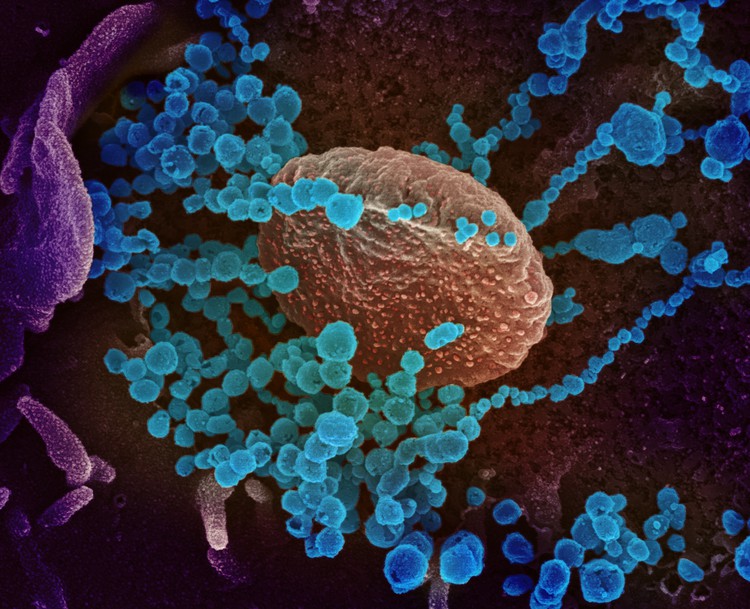
SARS-CoV-2, the virus that causes Covid-19 (round blue objects), emerging from the surface of cells cultured in the lab. Image by the US NIAID (CC BY 2.0)
- Western Cape public health officials and experts presented the latest results of a Covid-19 survey on Thursday.
- Tests at public clinics suggest that many people in Cape Town have already been infected.
- Various measures will be rolled out to monitor for any resurgence of the epidemic.
A large Cape Town survey of pregnant women attending public antental clinics, as well as people with HIV, suggests many people in the city have already been infected with the virus that causes Covid-19. It may help explain why, at least for now, the epidemic is waning in the city.
On Thursday 3 September, in a digital press conference hosted by Western Cape Premier Alan Winde and Provincial Health Minister Nomafrench Mbombo, provincial public health officials and experts presented the results of the survey. They also presented a health surveillance strategy designed to prevent a second wave of Covid-19.
Nearly 40% of pregnant women using public clinics have been infected
Professor Mary-Ann Davies of UCT and Dr Keith Cloete, head of the provincial health department, presented the province’s latest Covid-19 data, and revealed the results of the Western Cape Provincial Health Department’s first survey, using serology tests, of the prevalence of Covid-19 in Cape Town.
Serology testing is used to indicate whether a person has antibodies of a particular virus in their blood. Serology testing has only recently been approved in South Africa for limited uses (including research). The tests have shortcomings: they produce more than the occasional false negative (indicating that a person hasn’t had the virus, when they have) and somewhat less occasionally false positives (showing that a person has had the virus when they have not). But they have been used to good effect in some parts of the world, like Spain, to understand the spread of the virus.
3,700 blood samples were tested from the end of July to the beginning of August from women attending public antenatal clinics and people with HIV attending their public clinics. These blood samples were anonymised “leftovers” from patients who had used blood samples taken as a matter of routine. Nearly all the samples were drawn from health sub districts in the Cape Town metropole.
The researchers found that in this sample 37% of people had Covid-19 antibodies present, indicating that they had probably been infected at some point. While the share of those with Covid-19 antibodies was consistently high across subdistricts, the more densely populated areas of Cape Town had slightly higher rates.
It’s important to understand that this is not a representative sample of Capetonians. The city-wide prevalence is likely much lower. These are, after all, mostly young to middle-age adults who have attended health facilities where the odds of contracting the virus may be higher.
Nevertheless, according to Davies, the results were surprisingly high. The survey results are also consistent with what’s being seen in the Western Cape: a reduction of new infections despite easing lockdown restrictions. “It’s likely that some degree of immunity is contributing to that,” Davies said. The data from the serology tests suggest that in the short term that we are “unlikely to see explosive outbreaks in our high-density, most vulnerable communities”.
Further serological studies are being planned that will provide researchers with a more representative sample of the Western Cape or Cape Town population.
Epidemic in decline for now
Beginning in July and throughout August, all measures of Covid-19 infection in the Western Cape have shown a steady decline in new infections. The epidemic hit hard: The Medical Research Council estimates that there have been over 5,000 “excess” natural deaths in the province between 6 May and 25 August, and nearly 4,000 in Cape Town.
Davies showed graphs of deaths due to other diseases (except diabetes) declining during this time, suggesting that nearly all the excess deaths are Covid-related. Cloete supported this saying that “the disruption of Covid has not seemingly impacted significantly on other care”.
As cases decline and society resumes much of its normal function, there is the possibility of another wave of infections, as seen in many European countries. To detect this early the department has three interventions planned.
One of these is a representative population survey discussed above.
The second, and according to Davies most important, is to rapidly establish where new infections are occurring and the rate at which they are occurring. One way to do this is to test wastewater for the virus. This can signal when a particular area is experiencing a new outbreak.
Thirdly, new individual cases need to be identified by continuing to test symptomatic people, so that they can be isolated or quarantined, and their contacts can be traced to stop further spread. The launch of the national government’s contact tracing app will likely be part of this strategy.
Cloete finished the presentation by highlighting the success of the province’s medication delivery service, which has ramped up its operations during the pandemic. Since February 2020, over 100,000 new people have been registered with the Province’s chronic dispensing unit.
Cloete said, “We have started scaling up comprehensive health services in a balanced manner, building on the innovations from the last five months … It’s essential to ensure that we have a very strong focus on surveillance and containment for the next 18–24 months until we have a vaccine.”
Apparently similar surveys will be carried out in other provinces.
© 2020 GroundUp. This article is licensed under a Creative Commons Attribution-NoDerivatives 4.0 International License.
You may republish this article, so long as you credit the authors and GroundUp, and do not change the text. Please include a link back to the original article.