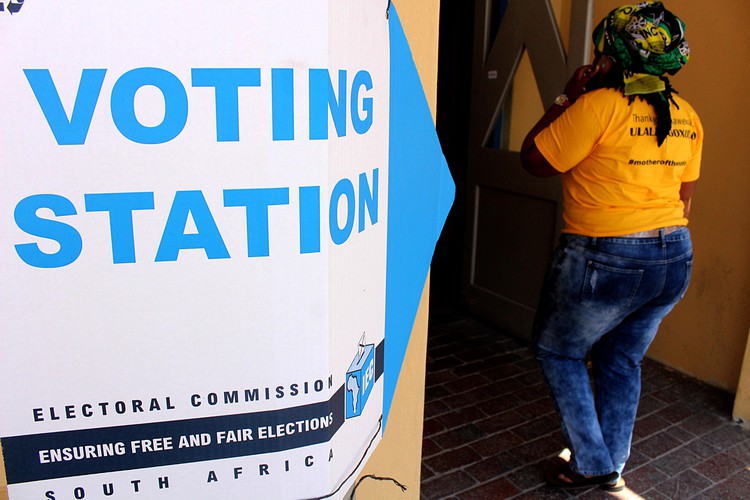
The Electoral Amendment Bill currently on President Cyril Ramaphosa’s desk proposes major changes to the way we vote. Archive photo: Masixole Feni
The Electoral Amendment Bill currently on President Cyril Ramaphosa’s desk proposes major changes to the way we vote. But the Bill has serious flaws and should be referred back to Parliament or to the Constitutional Court. As we head to the 2024 national and provincial elections, the matter is urgent. 
The Bill amends the Electoral Act in many ways to allow for independent candidates to contest the elections. Most importantly, it amends the electoral formula for allocation of seats.
In the new electoral system proposed in the Bill, provinces are treated as distinct constituencies (called regions). The National Assembly is divided into 200 “regional” seats and 200 “compensatory” seats drawn from proportional representation lists. Independent candidates can only compete for the 200 regional seats.
In other words, half of the seats will be filled by candidates from lists of political parties (compensatory seats) and the other half by independent candidates and candidates from political party lists contesting the nine regions (regional seats).
The Electoral Commission will divide the 200 regional seats among the regions before every election of the National Assembly based on the registered voters in each. A quota of votes necessary to win a seat is determined for each region by dividing the total number of votes cast in that region by the number of seats allocated.
The total votes for a political party in a region will determine how many seats from that region they hold. On the other hand, even if an individual contests the election in multiple regions, they can only occupy one seat.
Criticism
During the public participation process on the Bill, the main criticisms of it were that it creates unequal competition between independent candidates and political parties in the National Assembly elections, because independent candidates are eligible only to contest 200 seats while political parties contest all 400.
As a result, when an independent candidate wins more votes than the quota necessary to secure a single seat, the additional votes are wasted. This is because each candidate can only obtain one seat because they are “one person”.
If for example an independent candidate wins enough votes for five seats, they still actually can get only one seat. The other four seats go into a pool of seats to be contested by another independent candidate or political party in a second round.
In the second round, votes that made up the quota for the independent candidate who won are discarded. This means there will be fewer votes and one less seat, which means the quota needed to win will be lower. Independent candidates and political parties contest again and this goes on.
By default, political parties will win more seats as there is a recalculation when an independent candidate gets a seat, because the quota drops. When an independent’s seat becomes vacant, the results need to be recalculated in the same way.
As a result, the new system distorts proportional representation because of the high number of wasted votes.
It also undermines meaningful participation of independent candidates because of the entry requirements. To register as a candidate, an independent candidate will require a higher threshold of supporting signatures than a political party. Individuals are required to obtain 15% of the quota for a seat. This means that if the requirement for a seat in the National Assembly is 45,000 votes, then an independent candidate must submit 6,750 signatures to be able to contest. On the other hand, political parties, upon initial registration, are only required to obtain a standard 1,000 signatures.
Public consultations on the Bill in Parliament were limited. The Portfolio Committee did not give the required notice to the public for its public hearings. And the Committee did not provide sufficient information for the public to properly understand the purpose of the process and complexities of the electoral system. Parliament introduced the Bill with only six months left until the deadline. This led to a rushed parliamentary public participation process. By the time the Bill got to the President, Parliament had twice missed the deadline to complete the process.
History
The Electoral Amendment Bill follows a 2020 Constitutional Court ruling declaring the Electoral Act unconstitutional (New Nation Movement NPC & Others case) because it does not allow for adult citizens to contest provincial and national elections as individuals.
The court, in its ruling, ordered Parliament to fix the defects in the Electoral Act. The judgment did not prescribe the electoral system to be adopted but merely ordered that the new system should result in general proportional representation as per the Constitution.
Parliament was given 24 months from the day of the ruling to amend the legislation.
The Minister of Home Affairs established a Ministerial Advisory Committee in February 2021, tasked with working on changes to the electoral system to comply with the judgment. The committee compiled a report in June 2021 that included two options to change the electoral system – a minority view which proposed including independent candidates to contest alongside political parties in the existing electoral system, and a majority view which proposed a mixed electoral system, with half the seats in the National Assembly being voted directly from constituencies and the other half being allocated according to proportional representation. The majority view was ignored by the Minister, was not presented to the public, and was not discussed in Parliament.
Parliament missed the initial deadline set by the Constitutional Court, of 10 June 2022. Parliament was given another extension until 10 December 2022 which it also missed, and the Constitutional Court granted a further extension until 28 February 2023 which was finally met.
The campaign to #RejecttheBill, launched in September 2022, cites fundamental flaws with the Electoral Amendment Bill process. If this Bill is adopted without being remedied, it will threaten the right to vote and weaken our democracy.
As we wait for the president to sign, we implore him to apply his mind to the constitutionality questions and act in the best interests of South Africa citizens. We recommend that he either refer the Bill back to Parliament to get it to comply with the Constitution or refer it to the Constitutional Court to decide. The President must act swiftly, because we are heading to the 2024 elections and the Independent Electoral Commission is running out of time to implement the changes that would be brought by the Electoral Amendment Act.
Views expressed are not necessarily those of GroundUp.
© 2023 GroundUp. This article is licensed under a Creative Commons Attribution-NoDerivatives 4.0 International License.
You may republish this article, so long as you credit the authors and GroundUp, and do not change the text. Please include a link back to the original article.
We put an invisible pixel in the article so that we can count traffic to republishers. All analytics tools are solely on our servers. We do not give our logs to any third party. Logs are deleted after two weeks. We do not use any IP address identifying information except to count regional traffic. We are solely interested in counting hits, not tracking users. If you republish, please do not delete the invisible pixel.