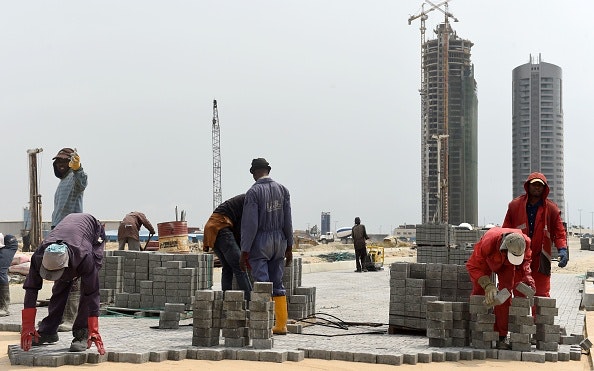
The construction industry is widely considered to be one of the world’s largest industrial employers of labour, and is linked to all other sectors of countries’ economies. It presents a path to empower women economically but it tends to be dominated by men.
In spite of past initiatives in many parts of the world to increase their participation in the construction industry at all levels, women remain a minority. This is not only an issue of equitable gender representation but one of meeting the industry’s needs. Researchers have identified skills shortages as a problem in construction. Attracting more women to careers in the industry could help bridge these gaps.
In Nigeria, women make up only 16.3% of the construction profession. Research on this is scarce but one 2006 study of the informal housing delivery sector found that women’s participation was extremely low. This was presumed to be due to certain cultural ethics and values in Nigeria.
In our study, we investigated the current level of women’s participation, challenges faced by professional women and the factors that influence them in the course of developing careers in construction. We found that gender discrimination and dominance of male culture were among the top constraints. The top strategy suggested for changing this was to make young women aware of opportunities that exist for them in the industry.
Barriers to participation
We conducted a survey among women and their employers in construction companies in Nigeria’s capital city, Abuja. We administered questionnaires to 93 women construction professionals and 52 employers (managers). 66.7% of the employers were men and 33.3% were women.
The women professionals who responded told us that the top reason for low participation of women in construction was that women preferred other kinds of jobs. The next most important reason identified was gender discrimination. This finding is in tune with research that asserts women face various forms of discrimination in the male-dominated construction industry, especially sexual harrasment. Family obligations was the reason ranked third. The results affirmed research elsewhere that negative perceptions of women’s capabilities hindered their interest in construction work. Recruitment policies and procedures were ranked after family obligations.
In fifth place was lack of mentoring or role models. Lack of career progression, as well as the nature of the construction industry, were also of high influence.
The managers who responded ranked the dominance of male culture and the attitudes, perceptions and behaviours of the society as the main barriers to women joining the sector. Inflexible and harsh working conditions were third. Limited influence of women in construction was fourth. The low level of women’s self confidence at the career level when compared to men was ranked fifth, along with unequal job opportunities. Those were the most significant variables. Unlike the women professionals, the employers and managers did not consider lack of mentoring as important.
Strategies
Our analysis shows that better representation of women, extending the influence of women and making them aware of the opportunities that exist could be useful strategies to keep women participating in construction. More women would be encouraged to go into the construction industry if they had models to look up to. So regardless of what few opportunities exist for women at the moment, they should be made aware of the potential. This would help younger women to see construction as a viable career path.
This is consistent with the results of other researchers, who have said that when a clear path for career opportunities is provided, women are more likely to remain within the industry.
Both the women professionals and their employers gave top ranking to making young women aware of opportunities in construction.
The women professionals considered opportunities for networking and mentoring schemes as crucial to retaining female workers in construction. Employees and managers should incorporate these strategies in their plans.
Our analysis showed that women sought flexible working hours, a strategy supported by previous studies.
Another way to encourage women is to tackle the issues from the root. A way to do this is to create scholarship opportunities, especially for secondary school and university students, to pursue degrees in the built environment.
Awareness and encouragement has to start with schools. We also recommend career advancement activities like training and mentoring to retain women professionals.


