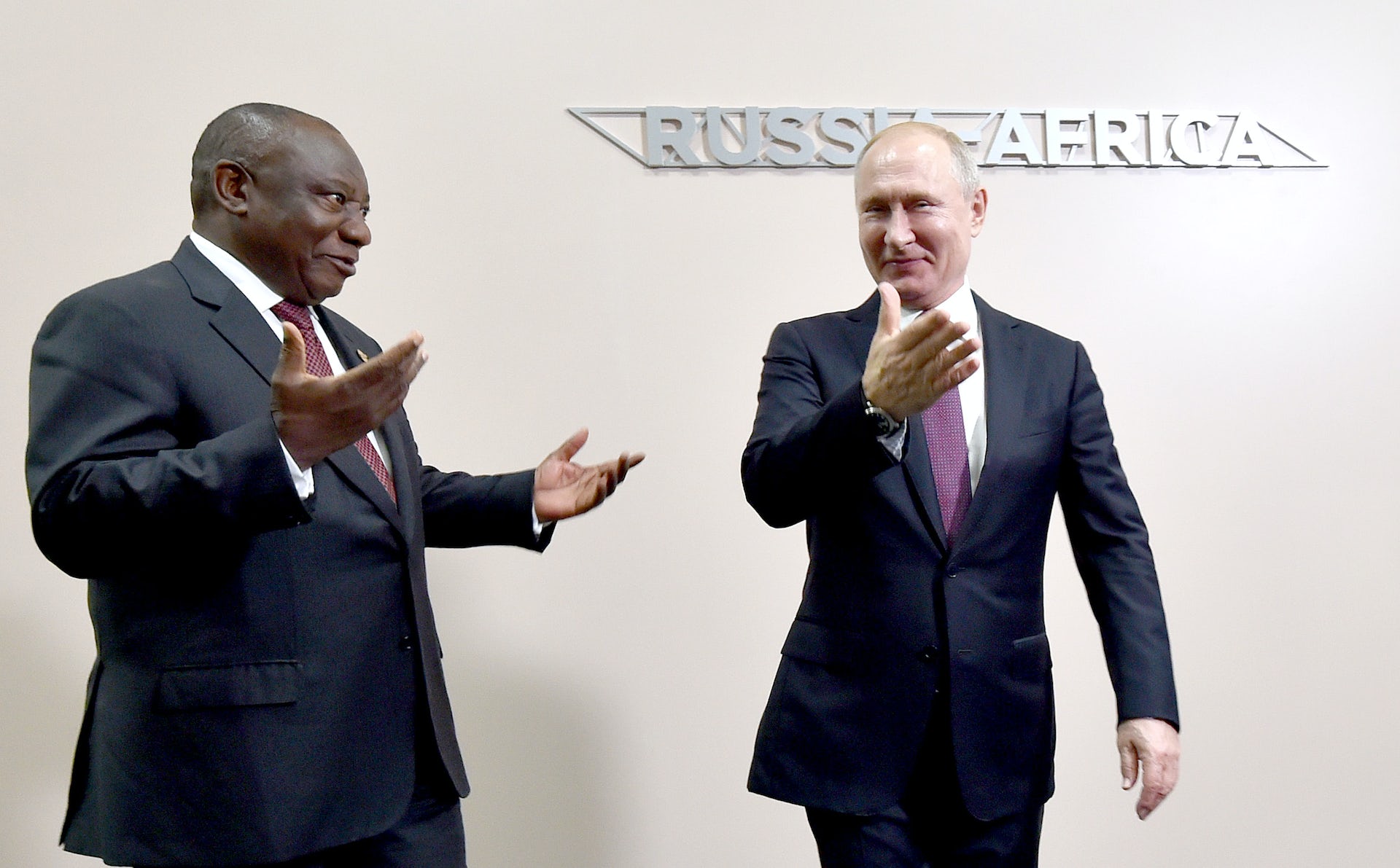
The International Criminal Court (ICC) has issued an international arrest warrant for Russian president Vladimir Putin for alleged war crimes regarding the unlawful deportation of children from Ukraine to Russia. Such acts are war crimes under two articles of the Rome Statute, which established the court.
ICC arrest warrants against sitting heads of state are rare.
Putin faces arrest if he sets foot in any of the 123 signatory states to the statute. Of these, 33 are African states. The issue could come to a head in August when South Africa is set to host the 15th summit of the Brazil, Russia, India, China and South Africa (BRICS) bloc in Durban.
As the head of state of a member state Putin has been invited to attend. But as a member of the court, South Africa is obliged under Article 86 of the ICC statute and domestic law to cooperate fully by arresting the Russian President.
This is not the first time the country has faced such a dilemma.
In 2015 Sudanese president Omar Al Bashir visited the country to attend a summit of African Union heads of state. In terms of South Africa’s ICC obligations, it was obliged to arrest Al Bashir, who had been indicted for violations of international humanitarian law and human rights law in Sudan’s Darfur region. The government, then under the presidency of Jacob Zuma, refused to arrest him, citing immunity from prosecution for sitting heads of state under international law.
The arrest warrant for Putin has put President Cyril Ramaphosa’s government between a rock and a hard place. Complying with its domestic and international obligations by executing the arrest warrant would alienate Russia. This would have bilateral consequences – the country is still considered a friend by the ruling African National Congress based on the Soviet Union’s support during the struggle against apartheid – as well as ramifications within the BRICS given Moscow’s strong ties with Beijing.
It is not unreasonable to argue that Ramaphosa’s government would want to tread carefully to avoid any such tensions.
Read more: Five essential reads on Russia-Africa relations
On the other hand, welcoming Putin, thus underscoring South Africa’s independent foreign policy, would see the country lose international credibility.
One likely effect is that South Africa might lose preferential trade terms. For example, it could jeopardise its treatment of exports to the US under the African Growth and Opportunity Act (AGOA). AGOA has been used recently as a punishing tool against Ethiopia, Gambia and Mali for “unconstitutional change in governments” and “gross violations of internationally recognized human rights.”.
Importantly, its trade with the US far exceeds that with Russia.
The dilemma
When the Zuma administration refused to arrest Al Bashir, it landed the government in judicial hot waters. South Africa’s Supreme Court of Appeal found that it had violated both international and domestic law.
Following the ruling of the Supreme Court of Appeal, Zuma’s government notified the United Nations Secretary General of its intention to withdraw from the Rome Statue. This ill advised move was challenged in the High Court in Pretoria. It ruled that the notice of withdrawal was unconstitutional due to the absence of prior parliamentary approval. Consequently, the government “withdrew from the withdrawal”.
In 2017, the ICC found that South Africa had failed in its obligations under the Rome Statute towards the court by not arresting and surrendering Al Bashir. The court, however, decided not to pursue the matter further for pragmatic reasons. It also reasoned that to refer South Africa to the United Nation Security Council for noncompliance “would not be an effective way to foster future cooperation.”
In the event that Putin attended the upcoming BRICS summit and President Ramaphosa’s government did not arrest him, it would mean that South Africa was flouting domestic legislation as well as its own constitution. Article 165 (5) of the country’s Constitution makes it clear that the government is bound by court orders and decisions.
Read more: Al-Bashir: what the law says about South Africa’s duties
How should South Africa respond to the dilemma?
At present the government’s response is not clear. On the one hand, President Ramaphosa’s spokesperson has said that the country was aware of its obligations to arrest and surrender Putin to the ICC.
On the other hand, Naledi Pandor, the foreign relations minister, confirmed the invitation to Putin to attend the BRICS meeting. She noted that cabinet would have to decide on how to respond in view of the ICC warrant.
The government would want to balance its ICC obligations, domestic responsibilities and its historically friendly relations with Russia carefully. Unless it is hellbent on defying its own court decisions and laws, there are options available to avoid another round of international condemnation. And that would help it avoid potential court battles by civil society for non compliance with the country’s own laws and court decisions.
Options
Firstly, South Africa should continue to extend an invitation for Russia to attend the summit. But, through diplomatic channels, request that the Russian delegation be led by its Foreign Minister Sergei Lavrov. Lavrov has in essence became the face of Russia on the international stage since the start of the war in Ukraine.
Secondly, during the COVID pandemic, it became clear that physical presence at international gatherings for heads of states can be substituted with virtual attendance. The UN General Assembly set a good benchmark for this when heads of states submitted video statements due to pandemic restrictions. Putin could attend the BRICS summit virtually.
The need to sign summit documentation by the heads of state is not an impediment to virtual attendance. Putin can sign the documents electronically or after the summit, if a non electronic signature is required.
The ball is now in the South African government’s court. The hope is that it makes the right decision, one which is in the best interests of the country and its people – not Russia or the likes of the US, especially as neither major powers are signatories to the ICC’s statute. Neither should prescribe to South Africa what it should decide.
Most importantly, the government must not trample on its own laws and court decisions. Compliance with the Constitution must be the prerogative. Making a decision that is in the interests of South Africa and its people would also provide guidance to the other 32 African ICC signatory states, should they ever be faced with a similar dilemma in the future.
This article was co-authored with Sasha-Lee Stephanie Afrika (LLD), Attorney of the High Court of South Africa and former lecturer at Stellenbosch University and University of Johannesburg.


