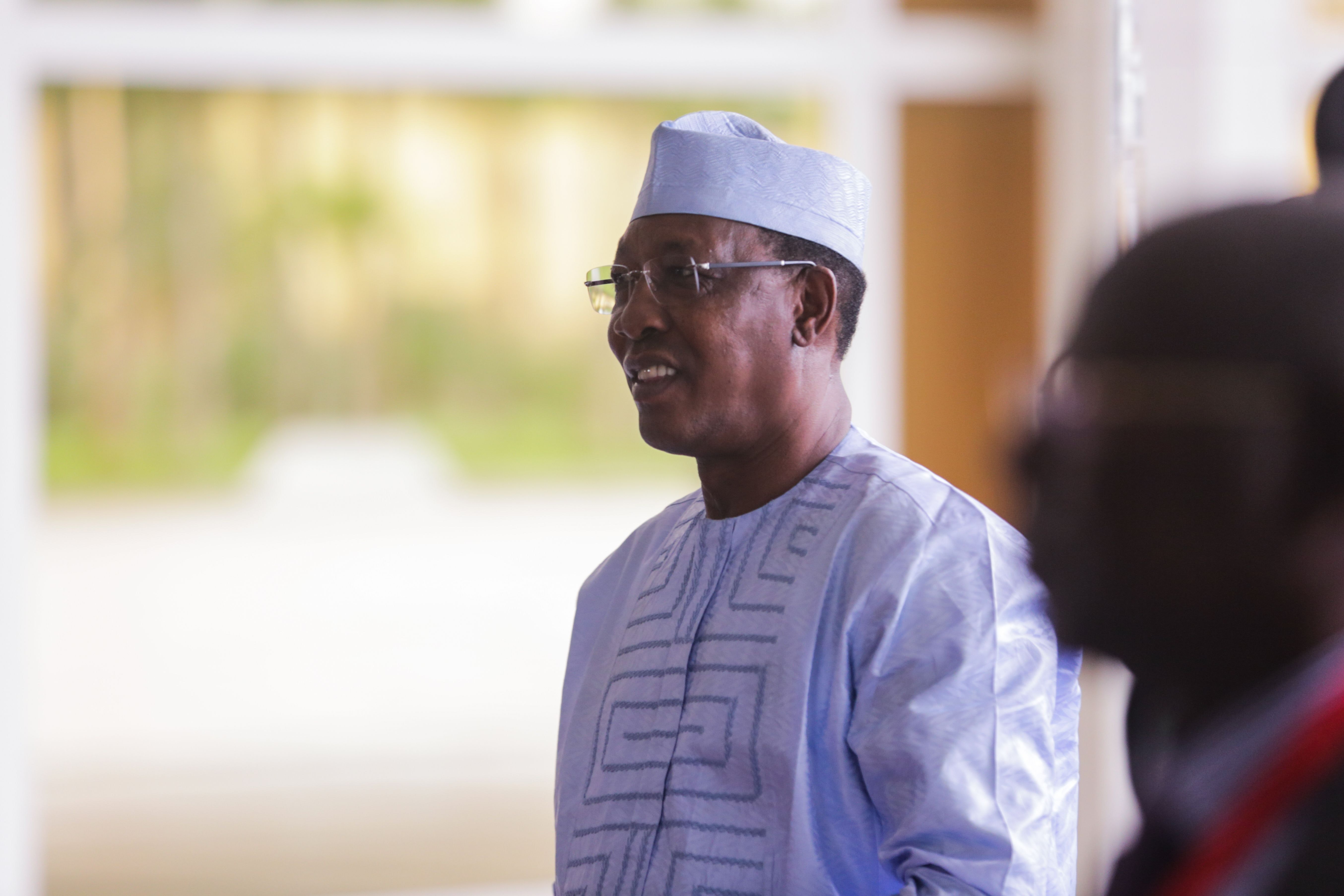
The death of Chadian president Idriss Déby Itno from injuries sustained on the battlefield just days before he was to start his sixth term in office has been met with shock and incredulity. The Chadian military announced immediately that it would form a transition government headed by Déby’s 37-year-old son, Mahamat Idriss Déby Itno, for the next 18 months. Like his father, Mahamat is highly ranked in the military. He is a decorated general.
The military’s decision already conflicts with the constitution, which provides that, on the death of a president, an election should be held within 90 days.
Idriss Déby was born to a herder in the northern Chadian desert in 1952 – eight years before Chad gained independence from France in 1960. The country was torn apart by civil wars shortly afterwards. Chad, with 15 million people, is bigger than Ethiopia. It’s ranked 187 out of 189 countries on the Human Development Index. Most people live from agriculture and herding. Cotton and cattle used to be the main export goods, before oil extraction started in 2003. It now ranks tenth in terms of oil reserves in Africa.
The country never has seen a peaceful change of regime.
Déby grew up to become a military man, completing part of his training in France, which he finished in 1976. This cemented what was to be an enduring close relationship with France.
In the 1980s he served as commander-in-chief of the military under former Chadian president Hissene Habré, a brutal ruler who was in office from 1982 to 1990. In December 1990, Habré was deposed by the Movement Patriotique du Salut, which was led by Déby.
On taking power Déby promised to create a democratic society. After years of civil war Chad was a devastated country.
Déby’s reforms were greeted with great relief. For the first time political parties and a free press could be established, and six years after he came to power Chadians voted for a new constitution in a referendum.
Chad became a presidential republic with a multiparty system, along the lines of the French model. The first elections took place in 1996. But even these foreshadowed potential problems. They were marred by allegations of fraud – a pattern that was to repeat itself in all future polls in the country, including those held earlier this month.
Déby and his ruling party MPS won all of them – six presidential and four parliamentary. The opposition never had the slightest chance.
But there was hardly an objection, neither from other countries nor multilateral institutions. They simply watched – and applauded Déby.
Since he came to office different groups have engaged in political and military rebellions to challenge Déby’s power. The more Déby cemented his power the more members of his inner power circle, like his nephews Timane and Tom Erdimi and others, went into rebellion and formed different movements and alliances. There were repeated rumours about failed coups in N’Djamena. The common aim was a change of the head of state. The last alliance reached N’Djamena from Sudan in 2008. Since then battles have taken place in the north of the country.
On a knife-edge
Chadians are bracing themselves for trouble. Even as the first rumours about the wounded president started making the rounds in N’Djamena, citizens of the capital city could see the power of the Chadian military dominated by Déby’s Zaghawa clan. About to lose its leader, it was getting ready to defend the city against the Chadian rebels “Front pour l’Alternance et la Concorde au Tchad” (FACT) led by Mahamat Mahdi Ali.
Tanks blocked all the crossroads and some citizens immediately headed across the river for refuge in Kousseri in neighbouring Cameroon. Fear has dominated the city since. The country’s borders are closed.
What happens next is open to question. The military has announced a military transition regime for the next 18 months. But the constitution foresees elections within 90 days – not rule by the military. This means that the military’s decisions go against the Chadian constitution, as well as democratic principles.
It also means that power continues to be concentrated in the hands of Déby’s clan. The Zaghawa make up only about 3%-4% of the population. Strategic alliances, like marriages, enabled Déby to build alliances with other ethnic groups. In the past there were rebels based on clan affiliations. This time FACT doesn’t appear to be based on ethnic affiliation.
What went wrong
The new century had begun so hopefully: Déby promised to be the right person who could assist Chad to develop as a democracy, and improve its economy. Help was at hand. International organisations and institutions, like the World Bank, stepped up to the plate. The World Bank provided a loan that supported Chad to construct a pipeline to transport oil into neighbouring Cameroon.
The expectation was that, with the help of oil revenues, Chad could improve its very poor and undeveloped education and health system and build infrastructure and supply jobs. Ordinary Chadians dreamed of a way out of poverty.
But careful observers could already detect Déby’s will to consolidate his grip on power. He invested the first World Bank loan in a military helicopter to defend his rule against rebels. And reports began to emerge that his former allies as well as relatives wanted part of the country’s riches.
Déby used the oil revenues to secure his leadership: a big portion of the revenue from oil went into the pockets of his Zaghawa clan and close allies who took central positions in military and society.
The hopes of ordinary Chadians that their lives would improve came to nothing. The poor became even poorer, health and education system are among the worst worldwide.
Déby had great tactical skills. He tied people to himself – often with monetary or other favours. He also blackmailed and humiliated even close collaborators. And he was very adept at playing off people, ethnic groups and religions against one another to finally present himself as the reconciler. Repeatedly former rebel leaders were convinced to leave the rebellion and join government ranks.
Part of the oil revenues went into strengthening the military and security forces. This enabled Déby to become a loyal ally of the French army on the Sahel battlefields against Islamist terrorism.
Déby successfully defeated rebel attacks in 2006, 2008 and 2019. This was in no small part due to his own capacities as a good military and political strategist as well as the loyalty and support of the French government.
As commander-in-chief of the army Déby used to lead the battles against rebellions, as well as against alleged Boko Haram attacks. He was joining his troops on the battlefields against FACT when he was mortally wounded in northern Chad.
A painful legacy
Déby leaves behind one of the poorest countries of the world.
The few Chadians who have benefited from his rule will mourn. Like his wife Hinda, many of them might have already left the country and taken their fortune with them. But ordinary Chadians cannot leave. They will cry out of fear. It is most likely that FACT and other alliances will not just accept the Déby Zaghawa clan’s continued grip on power and resources.
It is most likely that these movements will continue their advance on N’Djamena. At the moment they seem to be about 500km to 800km from the capital. However, the spokesperson of FACT promised to respect the period of mourning.


