African countries are estimated to lose US$17 billion each year to illegal logging. High-value timber species are in global demand.
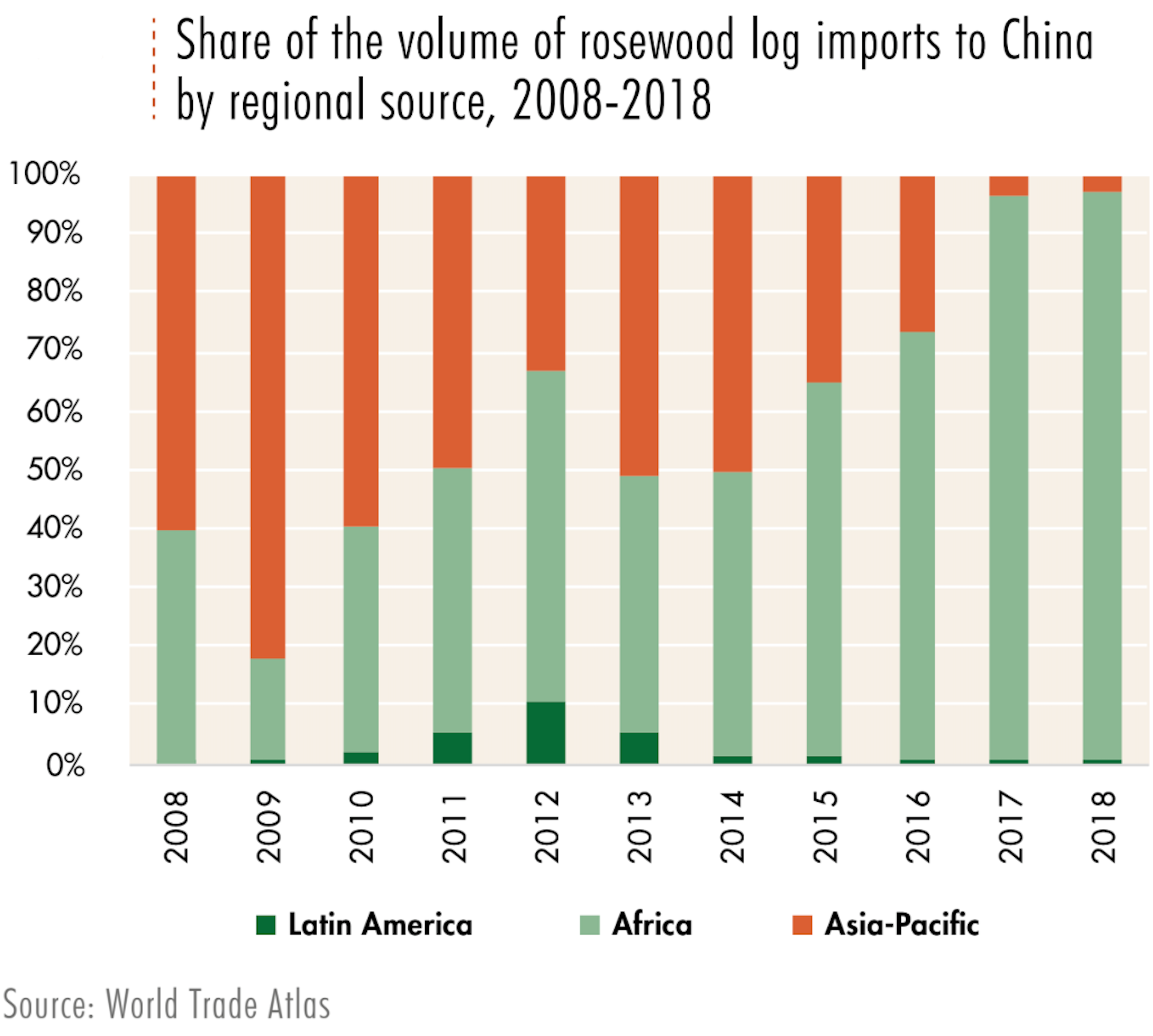
Illegal logging is most prevalent in the continent’s tropical rainforests. Foreign demand for rare hardwoods from these forests has dramatically increased. A significant driver is Chinese demand for teak, redwood and mahogany. According to the United Nations Office on Drugs and Crime, Africa’s share of rosewood exports to China rose from 40% in 2008 to 90% in 2018.
Illegal logging has negative environmental effects that weaken human security. Deforestation in the world’s second largest carbon sink, the Congo Basin, is an urgent example.
Beyond environmental degradation, timber trafficking also affects national security. Drawing from our recent report, which is based on our recent research and programmatic work at the Africa Center for Strategic Studies, we have analysed three ways that illegal logging affects national security and what that means for current measures to counter it.
Firstly, illegal logging amplifies threats posed by organised criminal groups and violent extremist organisations. Secondly, illegal logging amplifies governance problems. This is because it facilitates collusion between senior corrupt officials and criminal networks. Thirdly, such collusion weakens accountable governance of natural resources in African countries. That’s a key ingredient of peace and security and a source of resilience to national security challenges.
Countering illegal logging requires two things. One is dismantling the high-level criminal networks driving it. The other is stopping the government-embedded actors who facilitate it. Oversight and accountability are therefore vital. Here, civil society can play a role.
The knock-on effects
Illegal logging happens through small-scale and commercial operations.
The ENACT Organised Crime Index is a well-known measurement tool for assessing criminality and resilience. It identifies and tracks criminal networks, state-embedded actors, foreign actors and “mafia-style” armed groups that are locally well known and that control territory.
The work of these groups has several knock-on effects.
Violent extremism and insurgency: The illicit timber trade fuels conflict and instability by providing resources for violent actors. For instance, trafficking networks in Tanzania and the Democratic Republic of Congo linked to Ahlu-Sunnah Wa-Jama and related militant groups in Mozambique made an estimated US$2 million per month from illegal logging in 2019.
In Senegal, the Movement of Democratic Forces of Casamance recently funded its insurgency through the illicit logging of rosewood. Warlords and militias in Liberia, Central African Republic and the DRC have also used the trade for financing.
Collusion and corruption: Illegal logging often relies on government corruption and elite collusion with criminal networks. This subverts the rule of law and accountable governance.
Criminal networks are often aided by high-level state actors. For private gain, they help criminals purchase commercial concessions, acquire fake permits, or falsely declare the species of timber exports to launder them.
Elites colluding in this trade then use the international financial system to move the profits into private bank accounts. This contributes to the estimated $88 billion in illicit financial flows leaving Africa yearly.
In Equatorial Guinea, Teodoro Nguema Obiang Mangue, son of President Obiang, profited immensely from the transport and export of rare hardwoods. As minister of agriculture and forestry, he sold some national forests to private companies and used a shell company linked to the ministry to charge fees for processing, loading, and transporting timber.
In 2021, the Zambian Anti-Corruption Commission seized 47 trucks illegally laden with rosewood bound for Namibia and Zimbabwe. The operation was allegedly facilitated by certain ministers and family members of former Zambian president Edgar Lungu.
Read more: Africa’s Mukula trees score a victory as trade is put under closer scrutiny
In 2019, Gabon’s vice-president and minister of forestry were part of a rosewood trafficking scandal. Since then, the government has sought to increase transparency in natural resource governance.
Solutions
Many African states have tried to halt logging – with limited success.
Guinea-Bissau, the DRC and Kenya have controversially ended moratoria on logging. Mozambique lacks the capacity to enforce existing bans.
It’s easy to get around a moratorium when state security and justice systems do not operate transparently. A moratorium can even harden criminal networks without addressing the corruption and livelihood challenges that facilitate illegal logging.
Several other approaches to forest monitoring are being tried at smaller scale. These include using satellites or genetic markers of protected trees.
The Kenya Forestry Service is pioneering an app for officers to use satellite data in community-based initiatives.
Read more: What Cameroon can teach others about managing community forests
Regional responses have potential. In 2008, the Central African Forests Commission established an agreement involving the environment and forestry ministries of eight countries to help coordinate law enforcement.
The agreement emphasises cross-border and interagency coordination between security, justice, and forestry officials. These harmonised forest management practices are also promising in southern Africa.
Agreements like these are valuable but politically difficult to implement.
An example is the Convention on International Trade in Endangered Species of Wild Fauna and Flora . It is a binding agreement about the international trade of certain timber products. But it depends on states adopting relevant domestic legislation and policies.
Nonbinding instruments like the Zanzibar Declaration on the Illegal Trade in Timber and Forest Products and the Accra Declaration on Combating Illegal Trade in Rosewoods, Timber, and Forest Products also signal countries’ intent to honour commitments.
But doing so requires credible enforcement mechanisms.
Bridging gaps
Stronger oversight of actors involved in natural resource governance can help. Civil society has a role here.
For example, in Gabon, civil society has pressured the government for greater transparency in logging contracts. In Cameroon, it has facilitated independent monitoring of forest regulations.
In Ghana, legal cases have been filed that aim to preserve forests. And independent journalism has pressured officials to curtail illegal transport of rosewood.
Civil society also builds economic resilience to illegal logging. In Tanzania and the DRC, civil society has enhanced community control over land management and made legal livelihoods in the logging sector more feasible.
Uganda’s afforestation projects have also helped.
Key takeaways
External oversight is a key part of countering illegal logging. It works best where civil society is strong.
Internal oversight is also important. Inspectors general, specialised prosecutors and independent anti-corruption bodies can help expose the kingpins organising illegal operations.
International cooperation between security, justice, and forestry officials should accompany oversight, so that these actors can share intelligence and facilitate the arrest, investigation, and prosecution of those engaged in illegal logging.
Regional and international agreements are working in the right direction. What they need is better implementation.
Caden Browne, a Political Science PhD student at Boston University, contributed to this report while on internship at the Africa Center for Strategic Studies, National Defense University.


