South Africa’s electricity utility Eskom has made it clear that “loadshedding” – rolling scheduled power cuts – isn’t going to end any time soon. This reality, and President Cyril Ramaphosa’s announcement during his annual state of the nation speech on 9 February 2023 that tax incentives for solar power use are imminent, mean that many people are considering alternative electricity supply systems for their homes.
But deciding on the best system isn’t a simple matter. There’s a bewildering array of jargon to sift through and many elements to consider, from the right kind of inverter to the size of your solar panels.
We are electrical engineers who are working on a standalone charger for small electric vehicles with the South African National Energy Development Institute as part of the Long-Term Joint European Union – African Union Research and Innovation Partnership on Renewable Energy. The way the charger is designed resembles the sort of system needed for domestic power cut solutions. So, we’re able to answer a few questions for those who feel overwhelmed by the options. Our full and detailed instructions for designing a loadshedding system will be available online soon.
What is an inverter?
This is a key component of any alternative power system. It’s an electronic device that changes direct current (like energy stored in a battery) into alternating current (power for your home).
There are a few kinds of inverters. Some are grid-tied (synchronous) with Eskom’s power grid. They are typically used with solar systems that augment the Eskom supply. But they are not suitable for loadshedding solutions.
You also get off-grid (grid-forming) inverters, which form their own mini-grid and can operate during power cuts.
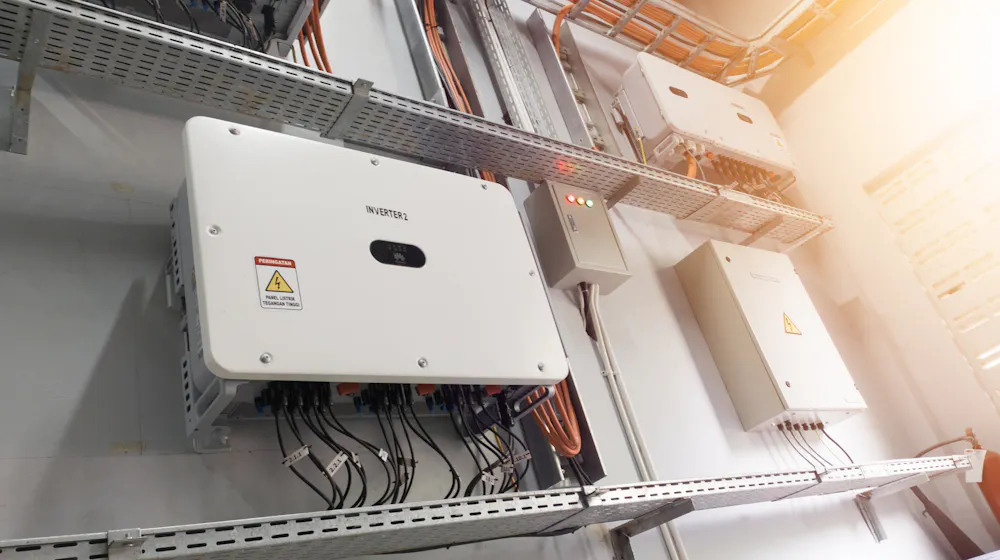
We recommend a hybrid inverter, which can be grid-tied to augment supply and seamlessly continue operation as an off-grid solution during loadshedding. You want a hybrid inverter that can connect to the grid, battery backup, and to solar panels. To extract the maximum power from the solar panels, be sure to get one that has maximum power point tracking (MPPT).
What size should the system be?
This purchase should be a long term investment. The inverter must be able to carry the sum of all the loads that are drawing power at any instant in time and the battery must be able to supply the energy required.
To reduce both the upfront capital cost and operational expenditure, you need to decide what is essential. Lights? Your washing machine? The stove and electric kettle? Then you need to make sure they are as energy efficient as possible before you size the backup system. For example, old incandescent lights use ten times more energy than LED lights do.
This table lists a few typical household items and their power consumption.
Why do I need batteries for my system?
It is theoretically possible for an inverter to generate electricity for household use directly from solar panels. But the supply from panels is intermittent and often not powerful enough to reliably supply power to the varying loads in the house.
To overcome this problem, energy is stored in the batteries. This provides a more stable source of power which responds to demand during loadshedding.
Battery capacity is specified as kWh (kilowatt hours) or Ah (ampere hours). This determines the amount of energy it can supply. A battery with a capacity of 5kWh can theoretically supply 5kW for an hour. But if a lithium battery is discharged beyond 20% of its capacity, it loses capacity and ages faster. A 5kWh battery therefore has an effective capacity of only 4kWh. It can supply 4kW for one hour, or 1kW for four hours.
As a practical example, if you want to power only 20 10W LED lights and a medium sized LED TV, drawing a total of 0.5kW, a 3.5kWh battery will suffice for four hours.
Are solar panels crucial for a backup system?
No. The batteries store energy to provide a stable supply to the inverter when needed. Technically, you can use the mains power to charge the batteries, rather than rely on solar panels. Solar panels are merely there to augment the supply of electricity and could give you a bit more range during loadshedding if the sun is shining.
But if everyone installs backup systems without solar panels, we are just using batteries to carry us through power cuts. That increases the load on Eskom outside loadshedding periods, as the batteries must be replenished. This will neuter Eskom’s ability to use loadshedding as a grid management tool. It could destabilise the grid and lead to a complete blackout.
And if, as is expected, the finance minister introduces tax breaks for solar generation expenses in the budget speech on 22 February, solar panels will have to be part of your setup if you want to benefit from these incentives.
No matter what Enoch Godongwana announces, we think this is a good time to make the switch to a solar powered backup system, for your peace of mind and future savings.
Read more: South Africa’s power grid is under pressure: the how and the why
How much does it all cost?
Inverter prices are falling as the market grows, and vary across suppliers. Inverters cost about R3,000 (about US$165) per kW for bottom of the range, and closer to R7,000 (about US$380) per kW for top of the range. Most households will get by with a 3kW to 5kW inverter, if its loads are managed well, costing between R9,000 (around $US490) and R35,000 (about US$1,915).
Lithium (LiFePO4) batteries also vary in cost but normally retail for about R5,000 (aboubout US$270) to R7,000 per kWh. Most households will get by with a 5kWh to 10kWh battery if the loads are optimised and managed well. So you’re looking at a cost of between R25,000 (around US$1,370) and R70,000 (US$3,830 or so) for the batteries.
Solar panels tend to range from R8,000 (about US$440) to R10,000 (around US$550) per kWp (a measure of how high the panels’ power output is). Again, they’re not crucial, but are necessary if you want the system to pay for itself over time.
Can I install this system myself?
No, unless you’re a certified electrician. The inverter needs to be installed into the distribution board and the cost will depend on how many of your circuit breakers need to be moved to the backup as well as how easy the solution is to install; installation typically ranges from R10,000 to R20,000 (just about US$1100). The inverter must be approved by the municipality if you want to feed back into the grid. Installing the solar panels is separate, and costs vary widely.


