‘Invasion’: an exhibition that presents an artist’s healing touch:
Some people disparage beautiful art because it seems to deny the painful complexity of life. They feel it is just sentimental and it leaves them with a sense that something is lacking. But for other viewers, beautiful art can also provide hope and healing.
The difference in responses to beauty might be related to the medium of the artwork. Invasion, a forthcoming exhibition of work by the South African artist Ernst van der Wal, seems to resist or overcome this difference. Where the photographer assumes the authority to look and objectify, Van der Wal uses the slow, gentle, personal craft of drawing and redrawing, carving and woodturning to validate the human need to be seen – and healed.
In the mid-1930s the German-Jewish intellectual, Walter Benjamin, asked how the photographer compares with the painter. He turned to the analogy of healing to answer the question.
The magician, he argued, heals by the laying on of hands. There is distance between the magician and the patient but the gesture is personal and tactile. It involves looking each other in the eye. This healing is “auratic” or visceral and is likened to the painter’s communication with the canvas – and eventually the viewer – through the body, the laying on of hands.
The surgeon, in contrast, uses a scalpel to cut so as to heal. There is no confrontation with the patient. The surgeon, for Benjamin, is not unlike the photographer, whose images mechanically fragment and objectify the subject.
Resisting the unwanted presence
Van der Wal’s exhibition draws attention to the modern sense of entitlement to look. It is especially powerful in South Africa, where looking is so often asymmetrical: some have the privilege of looking or being looked at while others feel invaded by the look.
But invasion is not just about looking. Whether it’s medical, military or scientific, invasion alludes to the control or authority of an unwanted presence. And the drive to invade or breach a barrier is an impulse that humans share with other species.
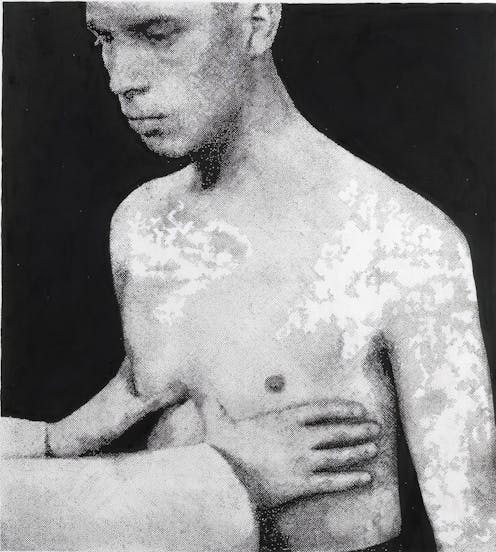
The exhibition, staged in a gallery in Stellenbosch, is in two rooms. In the first, large drawings hang against the walls. They reference photographs that were printed in medical textbooks and scientific journals from the 1940s and 1950s that used halftone dots as printing technique.
These images were blown up from roughly 5cm to one metre in height, and redrawn by hand using pen and ink, as well as the careful application, erasure, scratching and reapplication of charcoal dust onto Fabriano paper. Through quiet, time-consuming and careful labour, Van der Wal counteracts the mechanical reproduction of the camera that has so infected our consciousness. His slow, careful and intimate work also counteracts the alienating impact of capitalism on the arts.
The drawings are a powerful combination of portraits and landscapes. Some of the portraits are of medical patients, with the trace of the surgeon represented through, for instance, a hand on a chest in lieu of a cardiac impulse.
In other drawings, Van der Wal portrays planets whose surfaces are erased and mutilated through scraping. There are also monumental drawings of the HI virus, an invasive force drawn with an underlying grid pattern that reminds us of the early acronym given to the virus: GRID, or gay-related immune deficiency.
These viral landscapes are indistinguishable from the drawings of galaxies. In a nod to the Orphism of Robert Delaunay and Guillaume Apollinaire, Modernists who in the early 20th century were obsessed with abstracted, circular forms, Van der Wal renders the inner, microscopic world of the body and the outer realm of space as equally abstract in structure and open to human scrutiny.
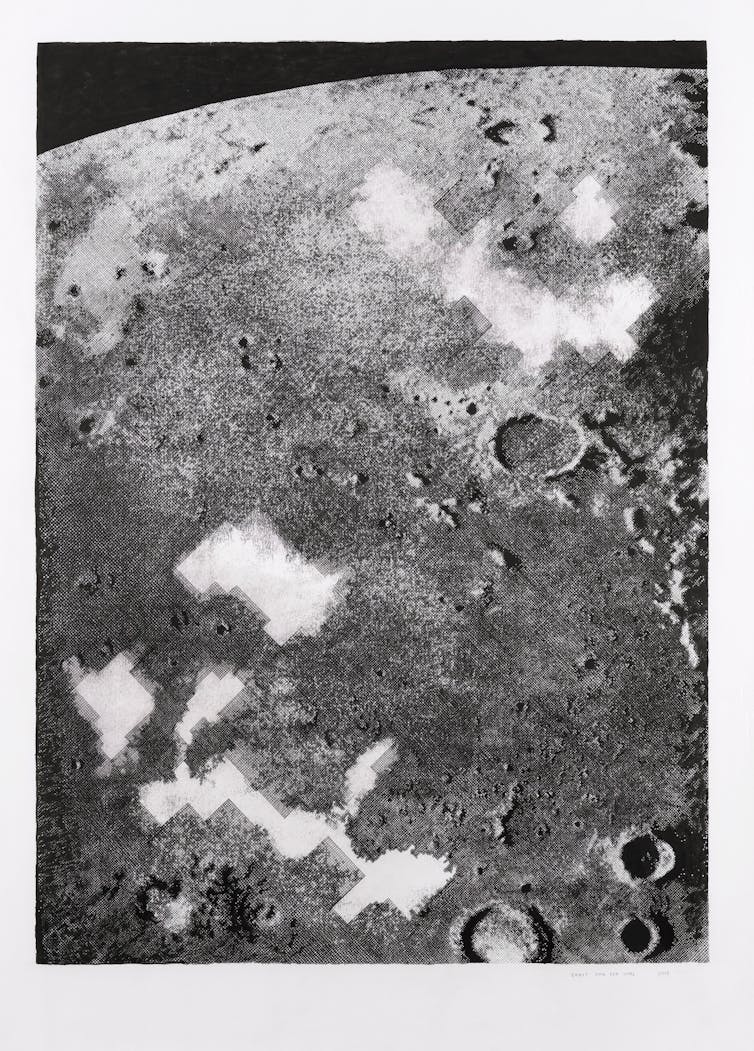
The drawings have a childlike yet sophisticated quality. There is an element of chaos – the juxtaposition refuses tidy resolution, the hybrid images merge and clash. They can’t be placed precisely in historical time.
An exhibition of drawings of viruses and galaxies may sound impersonal but together the effect is both of sadness and an almost comic delight at the odd pairings. Scientific fact is tempered by memory and an almost gossipy intimacy. The political argument regarding the prevalence of invasive forces is delivered with a gentle nudge.
The second room contains an installation of wooden sea urchins, inspired by Tetrapygus niger, an invasive species of urchin that was unintentionally introduced to the west coast of South Africa with oyster spat imported for aquaculture since at least the early 21st century. This species is a voracious kelp grazer and is capable of converting healthy underwater kelp forests into barren landscapes. They look like the HI virus.
But unlike the drawings, which appear to reference photographs, and subsequently feel familiar and intimate, the installation of carved, wooden urchins provokes a kind of Verfremdungseffekt or sense of estrangement in the viewer.
This technique affords the viewer the distance to critically appraise the moral dilemma of Van der Wal’s urchins: they are beautiful but memorialise a destructive force. They sadden, but their aesthetic sophistication is also a spectre interlaced with optimism since they remind us of the vibrancy and vitality of nature.
Vulnerability and surrender
The care taken by the artist, his attention to detail, provides a kind of hope. The viewer may, in other words, interpret these artworks and their own responses to the difficult subject of invasion in multiple ways. But, the observer may also find that in negotiating the dual identities of aesthete and political agent, the skin of conscience is peeled back to reveal the vulnerability and surrender that results from viewing all good art.
Ernst van der Wal’s exhibition is on at SMAC in Stellenbosch from 10 October-29 November 2019.

Stella Viljoen does not work for, consult, own shares in or receive funding from any company or organization that would benefit from this article, and has disclosed no relevant affiliations beyond their academic appointment.
Source: The Conversation – Articles (AFRICA)
Read more on The Conversation.
Join the fun: Add Your event | Submit a Press Release | Add your listing.


