Invasive alien plants in South Africa pose huge risks, but they can be stopped:

There is a massive army marching across South Africa. It’s silent and looks harmless, but it’s growing by the day. It’s depleting the country’s water supply, intensifying wildfires, reducing agricultural productivity and threatening globally significant biodiversity. This is South Africa’s unwanted army of over 380 invasive alien plant species.
Invasive alien species are a threat to human livelihoods and biodiversity globally. In South Africa, they cost the economy billions annually in lost productivity and funds spent on control programmes like Working for Water. Experts have advised that to get on top of the problem, intensified control efforts are needed. There is also a need to change existing programmes including increased funding, better prioritisation, more integrated control strategies and less bureaucratic interference. Studying the best ways of managing these species is also important for better control strategies.
All land owners should be aware of any invasives on their properties. Control plans must be implemented, and easy-to-eradicate emerging invasions should be targeted. Taking action now means saving money and effort: the longer such invasions are left to establish themselves, the more difficult and expensive removal becomes.
Green water guzzlers
Invasives steadily diminish water resources, as they typically use significantly more water than native vegetation. Across the country, invasives reduce mean annual runoff by 1.4 billion m3 (3%) – the equivalent of 577 600 Olympic size swimming pools.
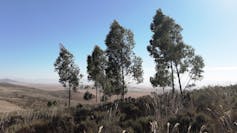
The importance of alien clearing as part of good catchment management has long been recognised, but with the severe three-year drought in the Cape, fully addressing this issue is now vital. A 2016 study on the impact of invasives on the Western Cape Water Supply System indicated that they reduce water yields by 38 million m3 per annum, which equates to losing the entire Wemmershoek Dam annually.
Cape Town recently felled 50 hectares of city-owned pine plantations. There are also plans to fell another 110 hectares, which will result in daily savings of about one million litres. But much larger-scale clearing is needed to make more substantial gains.
Working for Water, which controls invasives countrywide while facilitating job creation, has cleared 2.5 million hectares of invasions since its inception, but this is only a fraction of the invaded area. Experts have recommended several changes to this programme. These include sufficient funding for planning, monitoring and evaluation, increased operational flexibility, and integration with fire management.
Enemies of biodiversity
South Africa is remarkably biodiverse, and the Cape Floristic Region – a World Heritage Site containing the unique fynbos biome – is famed for having one of the highest concentrations of plant species per unit area globally. Two-thirds of the region’s 9000 plant species are found nowhere else on earth, and no less than 2000 of these species are threatened with extinction by invasives.
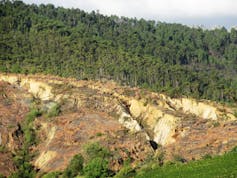
Alarmingly, over two-thirds of the Cape’s protected areas are invaded by aliens, and the forest, grassland and thicket biomes also have extensive invasions. The success of invasives results from their ability to out-compete local flora and alter the environment to suit themselves. Fynbos, for example, depends on fire at appropriate intervals to stimulate regeneration through flowering and germination. Post-fire fynbos recovery depends heavily on seed germination. While invasives’ seeds often tolerate alien-fueled fires, these severe infernos can kill fynbos seeds, which severely compromises natural vegetation recovery.
Some invasives change soil chemistry, resulting in soils unsuitable for indigenous species. Eucalyptus trees release chemicals which inhibit indigenous plant growth and may result in severe erosion due to the lack of native vegetation cover. Many Australian Acacias alter soil chemistry by enriching it with nitrogen. This is a major problem in some critically endangered fynbos types adapted to nutrient-poor soils.
Fire lighters and fuels
Many of South Africa’s vegetation types are dependent on fire. However, invasives may alter natural fire regimes through changes to the flammable biomass. The most problematic invasives in fynbos are trees and shrubs, for example pines and Australian Acacias that are larger than the native shrublands. Fuel loads can increase by up to 60% in invaded fynbos, which could then support higher intensity fires.
Other fuel attributes of invasives, like moisture content, chemical composition and fuel structure also affect fire behaviour. The fuel moisture contents of some invasives may be higher than that of fynbos. But under extreme fire danger weather conditions, the increased fuel loads associated with the invasions may still result in elevated fire intensity.
South Africa’s Garden Route on the south coast of the country is home to indigenous forests, fire-prone fynbos shrublands and fire-sensitive plantations of invasive alien trees. Ongoing research shows that fire intensities during the 2017 Knysna fires were higher in pine plantations and invasions than in uninvaded fynbos. Over half the total area burned consisted of invasives and this likely increased the overall fire severity.
Invasives also threaten infrastructure at the urban-wildland interface. In the March 2015 Cape Peninsula fires, all properties that were badly damaged were adjacent to stands of invasives. Increased fire intensities fuelled by invasives may also damage soils and worsen erosion. After the 2000 Cape Peninsula fires, soil loss was 60 times higher in pine plantations than in adjacent fynbos.
Invasives often alter fire regimes to suit themselves leading to more invasions – a process known as feedbacks. However, fire is an important management tool when used in prescribed burns, and experts recommend that fire be increasingly integrated into invasive alien control programmes.
Working together to solve the problem
The problem is huge and complex, but it affects everyone, and serious collaborative action is urgently needed to fully address the problem. Volunteers can also contribute by participating in alien hacks in their local communities. Everyone can be part of the solution. The time to act is now.

Stephen Cousins receives funding from the National Research Foundation and the Table Mountain Fund.
Elzanne Singels receives funding from National Research Foundation and the Palaeontological Scientific Trust.
Tineke Kraaij receives funding from Nelson Mandela University.
Source: The Conversation – Articles (AFRICA)
Read more on The Conversation.
Join the fun: Add Your event | Submit a Press Release | Add your listing.


