Is South Africa’s opposition party ready to challenge for power in 2019 elections?:

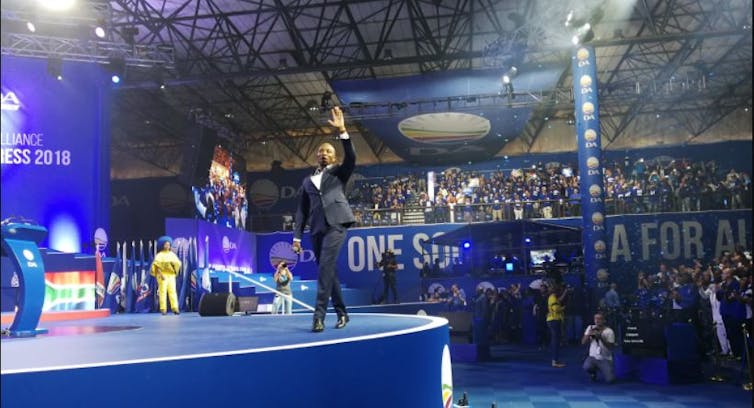
The Democratic Alliance (DA), South Africa’s main political opposition party, has held its national congress and declared its readiness for the 2019 elections. It considers these its most important to date.
Apart from electing a not-so-new leadership, the congress was marked by robust debate about setting a political agenda for the future. It reflected on key issues such as land reform and promoting diversity in its ranks.
It also addressed the need to recreate the party’s image in preparation for the 2019 general elections. The DA must stand strong and not be divided on the basis of race, said Mmusi Maimane, who was re-elected unopposed as federal leader.
Born from a merger between the former Democratic Party’s amalgamation with the New National Party and the Federal Alliance, the DA sought to become a “party for the people” on the platform of non-racialism and a formidable opposition to the governing African National Congress (ANC). The DA espouses liberal politics and has claimed a long history of resistance to apartheid, most notably through its hero Helen Suzman who was a thorn in the flesh of successive apartheid regimes. Yet, the party struggles to lose the label of a “white party” that would bring back apartheid.
The DA is potentially in a good position to become a challenger for power. The dominant ANC suffered a loss of legitimacy under the leadership of Jacob Zuma, most evident in its steady loss of electoral support. It is fighting to regain ground after it emerged quite bruised from the 2016 local government elections. It lost the key metropolitan municipalities of Tshwane, Johannesburg and Nelson Mandela Bay where it dominated since 1994.
The governing party is trying to repair its image by riding on the positive sentiment that has accompanied President Cyril Ramaphosa’s leadership – of both the ANC and the country.
But history might be against the ANC. It has been shown that dominant parties tend to break down due to a crisis of legitimacy. Weak political leadership, corruption, factional battles and governance, all of which have recently plagued the ANC, have been known to favour challenger parties.
Challenging for power
It would seem that the 2019 general elections may be the opportunity for the DA to emerge as a credible challenger for power. It is the largest opposition party with a track record in governance. But, one will also need to consider the potential impact of the Economic Freedom Fighters (EFF) which – like the DA – will campaign in ANC strongholds for votes.
The DA still has a lot of work to do, most notably around race and representation. More specifically, it needs to break down perceptions that it is a white party. These perceptions were evident in its failure to win outright majorities in the 2016 local government elections; it had to rely on coalitions to oust the ANC from power in key municipalities.
In building the DA as a sound alternative to the ANC, Maimane has claimed that the DA rather than the ANC now embodies the non-racial vision of Nelson Mandela.
Racialised politics
Yet, a racialised dynamic continues to find expression within the internal dynamics of the DA, as shown by talk of a “black caucus” in its ranks. It indicates that racial prisms shape internal party dynamics.
Significantly the party’s former parliamentary leader, Lindiwe Mazibuko, has urged it to reflect on
“a culture that isolates black members and leaders”.
She was responding to the DA’s anti-racism pledge that all new members would be required to sign.
The debate on diversity at the congress shaped the contest between mayors Solly Msimanga and Athol Trollip for the position of party federal chairperson. In celebrating his victory, Trollip proclaimed that he was “humbled that the DA election was not all about race”.
Given the reports about the narrow margin of Trollip’s victory, it’s possible his win could have been the result of political pragmatism. Potentially, some members may have voted for him so that the party could demonstrate unity ahead of the motion of no confidence against him brought by the EFF in his capacity as Nelson Mandela Bay’s mayor.
The battle of ideas
Maimane avers that the DA remains committed to creating a non-racial and equal South Africa in which each person will have equal opportunity, regardless of background. He draws on the vision of African liberalism.
He has highlighted the need to carve out a new agenda for African liberalism:
As African liberals, we know that poverty is the greatest threat to individual freedom, because civil liberties mean nothing if there is no food on the table. A hungry person cannot claim freedom. This is why we believe in social welfare and a growing economy that lifts people out of poverty.
The ANC similarly seeks to secure “political hegemony in society” through what it posits as the “battle of ideas”.
Through the battle of ideas, the DA may now move to further lay claim to Mandela’s and the ANC’s historic mission of creating a non-racial, non-sexist and democratic post-apartheid society. The DA has reclaimed the vision of Nelson Mandela and placed African liberalism at the core of its ideological battle of ideas. The extent that they will win the vote in ANC strongholds remains to be seen given a lack of political trust towards the DA in those areas.
Towards a party for all
The challenge for the DA seems to be ironing out issues of representation, voice, and feelings of black marginalisation within its own party structures before embarking on the 2019 election campaign.
This would require the party to decisively solve its internal divisions and put an end to such labels as “black caucus”, which effectively undermine its message of non-racialism and stated quest to be a party for all South Africans.

Joleen Steyn Kotze receives funding from the National Research Foundation and the Konrad Audenauer Stiftung.
Source: The Conversation – Articles (AFRICA)
Read more on The Conversation.
Join the fun: Add Your event | Submit a Press Release | Add your listing.


