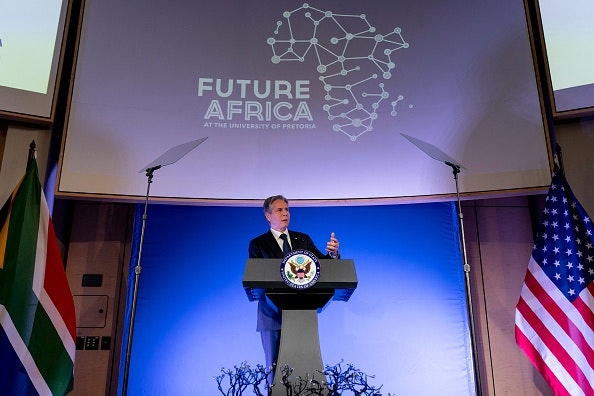
US Secretary of State Anthony Blinken’s whirlwind visit to three African countries is the second in less than 12 months.
In November 2021 he visited key U.S. regional partners Senegal, Kenya and Nigeria.
In South Africa – the first stop on this trip – Blinken unveiled the U.S Strategy Toward Sub-Saharan Africa, marking a remarkable paradigmatic shift in America’s engagement with Africa.
Why do I call the new strategy a paradigmatic shift?
First, it sets a positive tone for US engagement with Africa. Previous US strategies began from the premise that Africa was not a strategic actor in the broad scheme of American foreign policy.
This strategy is different. It starts from the assumption that Africa is a core priority of US foreign policy.
This guiding assumption frames the fundamental commitment to working together toward common aspirations in the advancement of a shared agenda.
The tone is matched by the emphasis on African agency. And the ability of the continent to lead and participate effectively in decisions when it comes to economic, political and military engagements.
But, first some reflections on Blinken’s three-country visit.
Significance of three-country stopovers
The visit to South Africa underscored US interest in re-engaging the South African government within the context of the US-South Africa Strategic Dialogue framework. This was crafted by the Barack Obama administration in 2010 to deepen the relationship between the two sides.
The dialogue provides a forum for both partners to review common aspirations and objectives while also addressing persisting disagreements. But it was interrupted by the Donald Trump administration as well as the onset of the COVID-19 crisis.
South Africa is one of the few African countries with this kind of strategic partnership with the US. The forum therefore reinforces South Africa as an African actor that Washington takes seriously. This is despite differences which both partners should manage amicably.
Hopefully, the Blinken delegation may have had the opportunity to cautiously raise concerns about the instability and disarray in the governing African National Congress (ANC) coalition. This has had a detrimental impact on South Africa’s stature in foreign policy. In Africa and globally.
In the DRC and Rwanda, Blinken will confront the unending conflicts in the region. These have decimated lives and communities, frustrated international and regional stabilisation efforts, and consigned the Great Lakes region to global marginality. This is despite its abundant resources.
Bilateral, regional, and international efforts to resolve the root cause of the problem – the antagonism between the DRC and Rwanda – have failed. They need the injection of US mediation to break the impasse.
Read more: Rwanda and DRC’s turbulent past continues to fuel their torrid relationship
The government of President Felix Tshisekedi has made decisive attempts to mend fences with Rwanda’s President Paul Kagame. But the two are incapable of resolving their problems while conflict persists.
Kagame will not cease his relentless military adventures in the region if the DRC and its supporters cannot eliminate insurgent Hutu rebels implicated in the 1994 genocide.
In addition, neither the DRC government nor the United Nations Mission in the DRC (MONUSCO) seem able to marshal the resources to be able to pacify the eastern DRC sufficiently to address Kagame’s concerns.
It is going to require US diplomatic dexterity and a sustained economic and political re-commitment to resolve this 30-year-old crisis. A start may be a US-led military force composed of new military contingents from various countries. This could be bolstered by a bold US commitment against authoritarian and autocratic regimes in the region.
But Blinken is bound to face opposition from some of the key players .
The paradigm shift
The strategy outlined by Blinken has four key objectives. These are fostering openness and open societies; delivering democratic and security dividends; advancing pandemic recovery and economic opportunity; and supporting conservation, climate adaptation and just energy transition (pp. 7-10).
An innovative idea is the involvement of the US International Development Agency (USAID) on the education front. What’s been tabled is that US academic institutions and the private sector provide online courses for African students. Subjects could include science, technology, engineering and Maths (STEM) (p.16).
The strategy also emphasises digital democracy, the centrality of cities, and incorporation of African American diaspora in US-Africa relations.
Beyond these, the four objectives capture the continuity of policies that past administrations have articulated.
The change prescribed in the strategy, therefore, is in tone rather than substance.
Third, sensitivities to race play a dominant role in the strategy, reflective of the convergence of Africanists and African Americans in the Biden administration and its Africa policy.
Throughout the document, there is mention of placing people of colour at the heart of US-Africa relations as well as
recognizing the historical and ongoing connections between addressing racial justice and equality in Sub-Saharan Africa and the United States (p.12).
Equally germane, the strategy acknowledges past criticisms of US training and support for African militaries that launch coups against civilian regimes and abuse human rights.
Finally, the strategy is cleverly articulated to undercut critics who often invoke US competition with China and Russia in Africa as the main driver of engagement with Africa. The strategy poignantly addresses this issue. It states:
the United States has an abiding interest in ensuring that the region remains open, and accessible to all, and that governments and publics are able to make their own choices, consistent with international obligations.“ (p.7).
Instead of being preachy and prescriptive with respect to African relations with other powers, the strategy presents African states with the enticing option of working with the US in the advancement of common values, mutual respect, democracy, and prosperity.
The strategy is a fresh beginning in US-Africa relations. But its outcomes will be judged on two factors. Will the Biden administration be able to negotiate implementation in the fractious US political process? And will African countries be able to seize opportunities that the strategy presents?
The December 2022 Africa-US summit in Washington will be an excellent opportunity to gauge responses to this strategy.


