The African continent is bursting with biodiversity. In a 2016 report, the United Nations Environment Programme wrote:
Africa’s biomes extend from mangroves to deserts, from Mediterranean to tropical forests, from temperate to sub-tropical and montane grasslands and savannas, and even to ice-capped mountains.
About a quarter of the world’s species of plants and animals are found on the continent.
But biodiversity isn’t just beautiful. We need it to survive. Different species and biomes provide ecosystem services to humans: food, clothing, potable water and the very air we breathe. The disappearance of a seemingly unimportant animal, like a certain species of bee, may result in the extinction of certain plant species. That, in turn, affects humans and other species.
Experts have estimated that each country, globally, must protect the biodiversity of 30% of its territory by 2030 to at least mitigate the effects of ongoing environmental damage.
But we found in a recent study that huge swathes of Africa remain unstudied and their species undocumented. Why? Because scientists keep returning to areas whose biodiversity has already been mapped, rather than visiting new, unexplored areas.
We show that at the current rate of discovery it may take more than 150 years to visit every 100km x 100km area in Africa even once. And, our analysis suggests, one visit won’t be enough. It may take up to 27 field expeditions to document just 50% of an area’s existing species.
If scientists don’t start venturing outside well-mapped areas, thousands of new species will remain undocumented. Adequate data is crucial to identifying and delineating species boundaries, understanding spatial biodiversity patterns and effectively promoting species conservation. We cannot protect what we don’t know.
Assessing the data
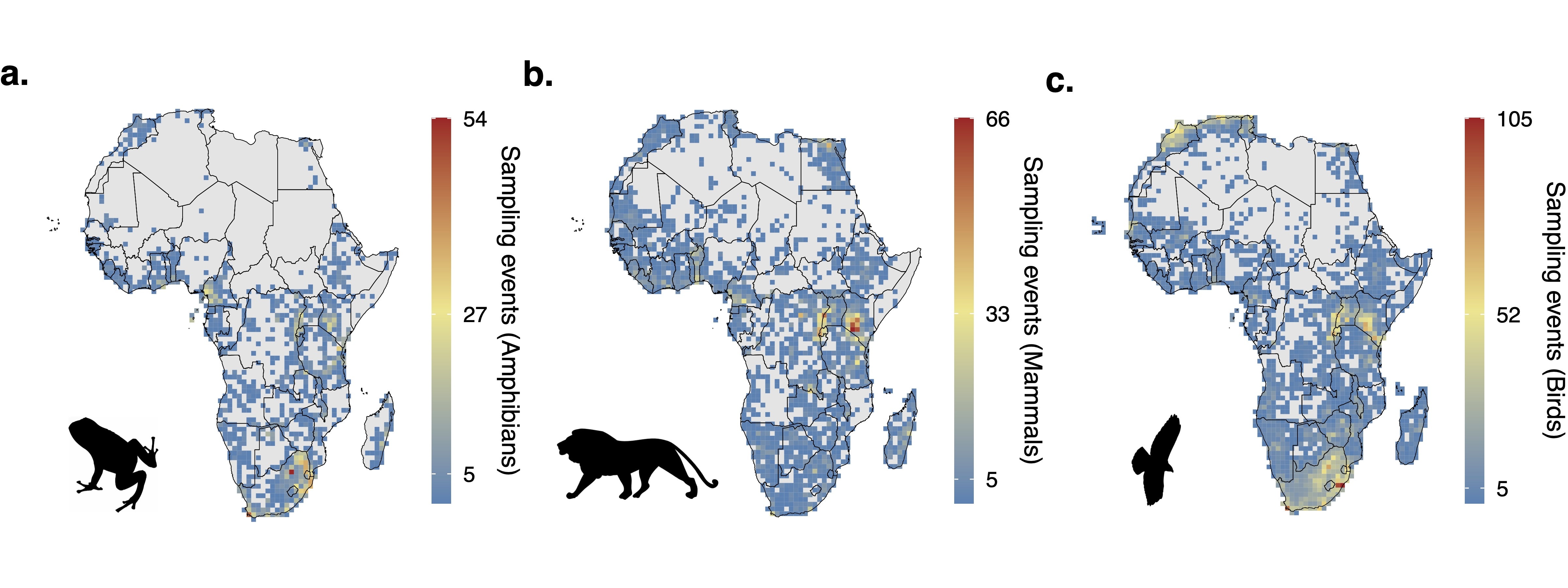
Our estimates are based only on birds, mammals and amphibians — three well-studied groups. The knowledge bias and spatial patterns we report are likely to be considerably worse for other already under-described groups such as plants, fungi and insects.
We wanted to use data to produce visuals of the continent’s unstudied or under-studied areas. Usually when scientists go to the field, they collect specimens which end up in museums and then show up on the museums’ databases. These databases have been aggregated into one by the Global Biodiversity Information Facility, so all the data sets can be accessed at once.
This was the source of our data and meant we were counting scientific expeditions, a better representation of species mapping than, for instance, researchers’ anecdotes or a random sample of journal articles.
To estimate the number of expeditions in each 100km x 100km grid cell in Africa, a standard method for conducting analyses of this sort, we counted the number of years which had at least one collection involving either amphibians, mammals or birds. So, a value of five, for instance, shows that there were collections made by scientists in five different years.
Then we applied statistical tools that use the current rate to model the future trend if the behaviour (the rate of expeditions) stays the same.
Our results emphasise that current practice is insufficient to adequately classify and map African biodiversity. This can result in misleading and self-reinforcing conservation priorities: areas are considered to be of high conservation value largely because they are better surveyed rather than because they are actually more diverse.
Pushing for change
There are ways to improve this situation.
Agencies, companies and philanthropists that fund research should actively promote projects that aim to sample areas where baseline biodiversity data is lacking.
Researchers should, meanwhile, increase the taxonomic and methodological scope of their collection efforts. Given the logistical and legislative challenges of carrying out fieldwork across most of Africa, we urge scientists to collaborate with specialists in different institutions and with varied taxonomic expertise to responsibly sample the maximum possible number of taxa – in full or as tissue samples, especially for endangered or large species.
There’s also a need for scientists to engage with each other beyond borders. Biological sampling in Africa has, to a large extent, been carried out by European and North American institutions. Researchers from institutions in those regions need to collaborate with local universities, rather than just using locals as field assistants.
At a government level, the process for sampling permits should be made transparent and available online for every country in the continent, to encourage and streamline biodiversity research.


