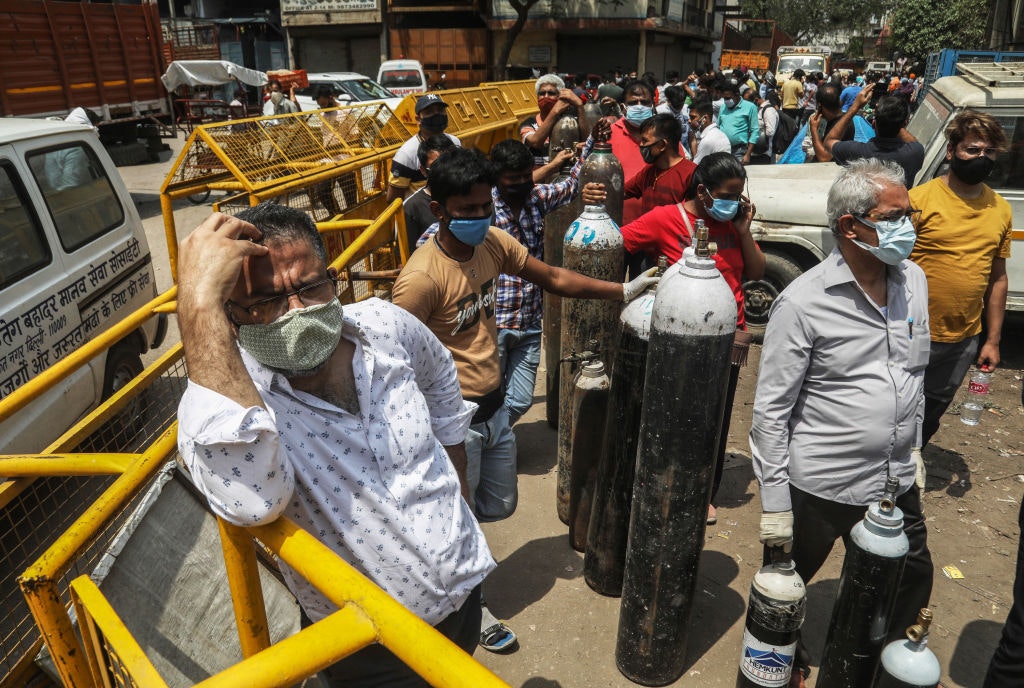
COVID-19 is overwhelming hospital oxygen systems. COVID-19 pneumonia creates breathing difficulties leading to low blood oxygen levels (hypoxaemia). Unable to get enough oxygen to supply vital organs, patients with hypoxaemia are at very high risk of death. Supplemental oxygen is the only treatment.
About 20% of COVID-19 patients globally have required hospital admission for oxygen therapy. But oxygen access was already a challenge for hospitals in low- and middle-income countries, particularly smaller facilities in more remote geographies. This is due to three major challenges:
-
low-quality, poorly functioning equipment, with inadequate access to maintenance and repair support;
-
lack of clinical and technical education and protocols;
-
deficiencies in local infrastructure – such as unreliable power supply – and management systems.
The COVID-19 pandemic has exposed these challenges, leading to horrifying situations, such as the one in India.
While the magnitude of this oxygen crisis is unprecedented, the reality of caring for patients without adequate oxygen systems is not new. Every year, around 15 million children are admitted to hospital with life-threatening low blood oxygen levels, due to pneumonia and other conditions like malaria, sepsis and premature birth.
We are part of a team of health workers, engineers and researchers who support hospitals and governments to build stronger oxygen systems. We’ve been doing this for more than two decades in Africa and Asia-Pacific regions.
Our new paper outlines the practical ways hospitals can immediately strengthen their oxygen systems. They can improve testing for oxygen levels (pulse oximetry) and oxygen use, support biomedical engineers, and expand on existing oxygen systems with robust equipment and smart design.
Policy makers and programme managers can use our recommendations to ensure investments in oxygen systems are more effective and efficient.
Poorly functioning systems
An effective oxygen system requires prompt recognition of those who need oxygen. It then needs a reliable supply and safe delivery to get it to them. Prior to COVID-19, there were gross deficiencies in many countries, illustrated by our detailed analysis in Nigeria.
-
Less than one in 20 patients had their blood oxygen levels measured. Without access to, and routine use of, pulse oximeters (which measure the level of oxygen in the blood), healthcare workers had no reliable way of determining who to prioritise.
-
While more than 80% of hospitals had some oxygen supplies, only 5% of oxygen concentrators worked properly. These machines concentrate oxygen from ambient air. Without access to spare parts or basic maintenance tools, biomedical engineers and technicians faced an impossible task.
-
Oxygen costs were high for patients and families. It cost them more than all other admission and treatment costs combined.
But it doesn’t have to be this way. Our work with hospitals in Nigeria, Kenya, Papua New Guinea and elsewhere has shown that hospital oxygen systems can be improved and save lives.
Improving systems
To make oxygen delivery more effective and efficient, we offer these suggestions:
Pulse oximetry and oxygen use training: Healthcare workers must be trained in the use of pulse oximetry and oxygen provision. Taking someone’s oxygen saturation level should be a standard procedure for all acutely unwell patients. It allows healthcare workers to target oxygen towards those who need it most and adjust the dose needed.
In many low- and middle-income countries, pulse oximetry and oxygen therapy are largely absent from medical and nursing curricula and clinical guidelines.
Education and support for healthcare workers should also cover basic checks and maintenance of vital equipment.
Assistance for biomedical engineers: Oxygen is a medicine that depends on technology. It requires effective teamwork between healthcare workers, technicians and managers. However, biomedical engineers and hospital technicians are frequently left out of decision-making processes. This means they often lack maintenance budgets or system support.
Engineers and technicians are already coming up with innovative solutions to make oxygen delivery more reliable and efficient. With training, tools, spare parts and access to stronger maintenance and transport systems, engineers and technicians can do much to optimise existing oxygen equipment and supply chains.
Expansion of existing oxygen systems: There are several oxygen source systems. These include: small oxygen bedside concentrators which concentrate oxygen from the air; oxygen plants used to fill oxygen cylinders for distribution; and bulk liquid oxygen which is produced by gas plants and delivered via tanker trucks to fill liquid oxygen tanks at major hospitals.
Robust equipment and smart design should be used to build on what exists. For instance, countries with extractive industries – such as mining – typically have better access to liquid oxygen. Recent experience in India shows that it is possible to divert industrial oxygen supplies for medical use. However, this is only useful if hospitals have the infrastructure and ability to safely store and use liquid oxygen.
The World Health Organisation (WHO) and UNICEF have also released guidance on oxygen-related equipment and specific guidance for COVID-19. This will help health providers to make better use of what they have. For instance, it includes recommendations on the use of low-cost oxygen bedside concentrators distributing oxygen to patients using simple plastic tubing.
Benefits for the future
Over the past year, donors have sought to support low- and middle-income countries to boost their oxygen supply systems. For instance, UNICEF delivered over 20,000 oxygen concentrators and about 15,000 pulse oximeters to 94 countries.
Hospitals can use our practical installation guidance to put this equipment to use rapidly and effectively. Otherwise – without enough understanding on how to integrate them – there’s the risk that they end up in equipment graveyards.
Improving patient outcomes always hinges on doing the basics well. The COVID-19 pandemic offers the opportunity to refocus efforts on the basics of acute care, knowing that improvements in oxygen will benefit patients both now and in the future.
Dr Bernard Olayo – founder and chairman of the Center for Public Health and Development – and Sheillah Bagayana – a Ugandan biomedical engineer – contributed to the research behind, and the writing of, this article


