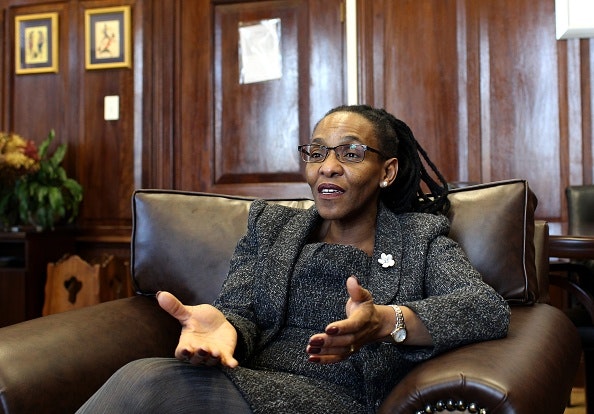
The only nominee for the position of South Africa’s Deputy Chief Justice, Justice Mandisa Maya, has once again put the spotlight on indigenous languages and the justice system. She is the Judge President of the Supreme Court of Appeal.
South Africa’s post-apartheid legal profession, through legislation and policy, adopted an English-only approach. English was further elevated when the heads of the courts adopted it as the only official language of record in 2017. But the country has 11 official languages, and the majority of citizens speak an African language as mother tongue. Only 9.6% of the population speak English as a mother tongue.
The other official languages are Afrikaans, isiNdebele, isiXhosa, Sesotho, Setswana, Sepedi, siSwati, Tshivenda, Xitsonga and isiZulu. They all have equal status.
The decision to use English only is a missed opportunity for promoting multilingualism. Giving African languages intellectual status would ensure that legal practitioners became proficient in them. Using and developing all the nation’s languages is vital for their growth and survival.
It is often wrongly thought that language is associated with “race”. That is not the case. Language acquisition is linked to a person’s environment. This is true for the two of us. We grew up in an isiXhosa environment and learnt the language at school and at university. It is not our mother tongue.
According to Section 174 of the constitution, “race” and gender must be taken into account when “appropriately qualified” judges are appointed. The primary purpose is to ensure the judiciary is transformed from the past era of racial discrimination to one that’s part of an inclusive, equal society.
Judges’ competence in official languages other than English is not considered.
Language and the judiciary
To our minds, the exclusion of proficiency in African languages runs counter to the country’s transformation agenda. No language should be seen as superior or inferior to any other. They should be seen as a rich resource which can ensure social justice.
Similar to the constitution, the Judicial Service Commission Act makes no mention of the language abilities of judicial officers. Yet they work in multilingual courtrooms.
The Judicial Service Commission advises the government on matters concerning the judiciary and the administration of justice. It interviews candidate judges and handles complaints against judges.
Some commissioners and candidates have recently highlighted the importance of accepting African languages for court proceedings and records.
Justice Maya shows the way
In her first interview for the position of Chief Justice in February 2022, Justice Maya was commended for writing judgments bilingually (in isiXhosa and English). This was described as “extraordinary”.
Maya reiterated the need to develop African languages for use in courtrooms. She suggested reviewing the law degree curriculum and enabling judges to write judgments in African languages. Maya noted that a new language policy for courts would require resources and commitment. She said she would encourage all judges to write judgments in their mother tongue.
In her most recent interview for the position of Deputy Chief Justice, Maya was grilled on the fact that she wrote a bilingual judgment in the case Afriforum v Unisa. It appeared as though commissioners were taking issue with the fact that the case, dealing with language rights of Afrikaans-speaking students, was written in isiXhosa (Maya’s mother tongue). One would expect commissioners to ask questions about Maya’s views on using African languages.
Maya said she needed the assistance of a legal translator when writing the judgment. This opens the possibility of employment for forensic linguistics and legal translation students and graduates. But the theme of transformation was not pursued at the interview.
Maya’s bold step of using isiXhosa as a language of record may chart a new course, one where African languages are finally recognised as being “official” in practice.
Writing judgments in African languages
Maya’s example was not the first in South Africa. It has happened in the past, primarily in the magistrates’ courts. This dates back to 1998 in the case of State v Matomela. The case was heard in isiXhosa and the magistrate wrote the judgment in isiXhosa. The magistrate argued that it was practical to proceed in isiXhosa, where all parties were proficient in the language.
But when a high court reviewed the judgement, the judge said the most practical and efficient way to proceed in future was to have one language of record: English.
In the 2004 case of State v Damoyi no interpreter was available for the accused, so the magistrate heard the case in isiXhosa. On review, the judge questioned this. The magistrate responded that isiXhosa was an official language, and that it was practical to proceed in the language to safeguard the accused’s right to a fair trial.
In the case of State v Gordon in 2018, the use of languages as part of transformation of the legal system was undermined and criticised. English was said to be the most beneficial and practical option.
Language in pursuit of justice
When forensic and legal linguists have argued for judgments to be written in African languages, and for cases to be conducted in African languages, they have been accused of shopping for judges on the basis of “race”. But, as we have argued, the link between “race” and language is not a given.
Read more: Why using just one language in South Africa’s courts is a problem
Judges should be allowed to play to their own linguistic strengths, thereby entrenching language and multilingualism in line with the constitution. The discussion should centre on how language can be used in courts of law in the pursuit of justice, rather than fixating on a particular language of record.


