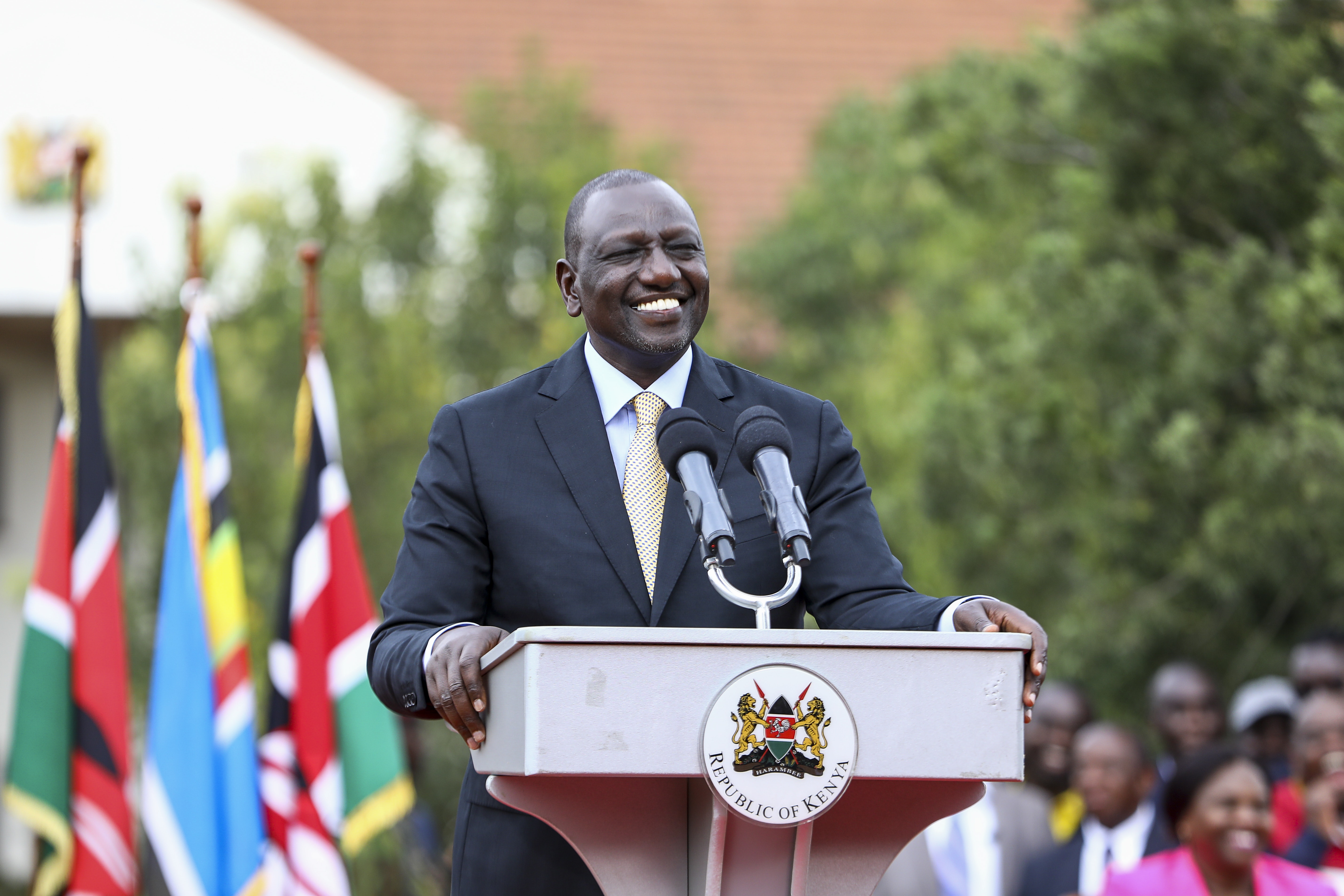
Kenya’s Supreme Court has confirmed William Ruto’s election as president in a unanimous ruling following the submission of eight petitions seeking to annul the result. The court dismissed all the petitions, including that submitted by the losing candidate, Raila Odinga. It found that some of the claims “were based on forged documents and ‘sensational information’.”
Odinga responded by saying that he had “respect for the opinion of the court”. But he “vehemently disagreed with the decision” and “would be communicating in the near future on our plans to continue our struggle for transparency, accountability and democracy”.
The court ruling followed weeks of uncertainty which began with a six-day wait for the presidential outcome after a close race. On 15 August four Independent Elections and Boundaries Commission commissioners disowned as “opaque” the results about to be announced. But the electoral commission chairman, Wafula Chebukati, went ahead and announced that William Ruto of Kenya Kwanza was the country’s president elect with 50.5% of the popular vote.
Raila Odinga of Azimio la Umoja got 48.8%. Governors, senators and members of parliament were initially fairly evenly split between the two alliances.
Azimio rejected the results and challenged Ruto’s election in the Supreme Court. It argued, among other things, that some of the polling station-level forms (specifically 34A forms) had been changed on the elections commission portal by hackers associated with Ruto; that Ruto had failed to secure 50% plus one vote and so did not secure a first round victory; and that the gubernatorial races in Kakamega and Mombasa had been postponed with the ulterior motive of reducing turnout in Odinga strongholds.
Many Kenyans feared the possibility of violence. But the campaigns and post-election period were relatively calm and peaceful. This was despite vigorously contested, close, disputed and at times tense polls.
Notable incidents include limited protests in Nairobi and Kisumu following the announcement of the results, and the tragic murder of a Nairobi electoral returning officer.
Based on research conducted around Kenyan elections since 2007, I would argue that the country is very different to that which stood on the “brink of a precipice” in 2008. Nevertheless the shadow of – and potential for – violence still lingers, and the road ahead remains a difficult one. Key institutions are in need of further reforms, the country remains divided, and the new president is faced with large economic challenges.
New reforms, old fears
But what explains the disjuncture between fears of violence and reality?
It can in part be explained by uncertainty. Particularly important in this regard is uncertainty about how the elections would unfold and whether certain parties would try to manipulate the elections. And, if so, what evidence would exist of the same? Also important is uncertainty about how key players would react to events, and how die-hard supporters might respond to their reactions.
However, this disjuncture can also be explained by the fact that much of the fear that I came across as I travelled around the Rift Valley and its borders in the months prior to the elections stemmed from memories of election-related violence and nervousness about a recurrence. This history includes the ethnic clashes of the 1990s and the post-election crisis of 2007/8 when over 1,000 people were killed and almost 700,000 displaced.
But a great deal has changed since then.
A new constitution was introduced in 2010. This devolved powers and resources to 47 new county governments, and prompted other reforms, including changes to the electoral system. These made the problems of multiple voting and interference with vote tallying reported in 2007 far less likely. They also made the process far more transparent.
These changes were in place for this poll. They were what lay behind unprecedented transparency in the record of votes at each of Kenya’s 46,299 polling stations – better known as form 34A. Various actors could check whether the forms on the electoral commission’s portal matched those seen by party agents and posted outside polling stations.
This paper trail provided vital evidence that proved central to the court’s upholding of Ruto’s election.
There was also far more confidence in the judiciary following judicial reforms and the Supreme Court’s annulment of the 2017 presidential election. The changes meant that, as in 2013 and 2017, the losing presidential candidate brought an electoral petition before the court.
In addition, the police are better trained and organised, and were more visible on the ground. And various monitoring, early warning and conflict resolution mechanisms have been established.
Just as importantly, the political atmosphere has changed.
Change in tone
In 2007, politicians mobilised quite openly along ethnic lines. The opposition Orange Democratic Movement, for example, cast its call for reform as a contest of 41 tribes against one.
In 2022, in contrast, both of the main alliances – Odinga’s Azimio la Umoja and Ruto’s Kenya Kwanza – mobilised across ethnic divides. The result is that most areas were divided in terms of support.
The rise of social media has also ensured that, while misinformation is rife, what is said in one area can quickly spread across the country. This has led to most politicians being much more careful about what they say.
Finally, the majority of Kenyans clearly do not want violence and – as reflected by relatively low voter turnout rates – are much more sceptical of politicians as a class and not greatly excited about either of the frontrunners. In this context – and in a very difficult economic environment in which people are struggling to make ends meet – it is clear from interviews that many simply want the economy to pick up and to get back to work.
More work to be done
While Kenya has changed, the road ahead is a difficult one.
Time will tell what Odinga’s plans will involve, and how the incumbent president, Uhuru Kenyatta, will respond to events. Kenyatta has said that he will execute the orders of the Supreme Court, but also invited Kenyans “to hold all institutions to account”.
This close and disputed election has gone hand-in-hand with much misinformation and followed a vigorous campaign period. It also followed concerns voiced about the electoral commission by the media, political parties and the police in the weeks prior to the poll, and reports of leaflets circulating online and offline, warning certain communities in parts of the Rift Valley to vote in a particular way.
The incoming government also inherits an economy characterised by a cost of living crisis and massive debt burden. And the president elect has made many promises to the Kenyan electorate, alliance partners, and those who agreed to accept party nomination results.
A series of defections to Kenya Kwanza has also weakened the political opposition, which has a vital role to play in holding the government to account.
Many of the country’s key institutions also suffered from a credibility crisis going into the polls and have been further tainted by the allegations of electoral malpractice raised. This includes the police and electoral commission.
The Supreme Court in its ruling was blunt in its assessment of the commission, saying that it suffered from a “serious malaise” and was in need of “far-reaching reforms”.
Finally, inter-communal relations remained poor in places going into the polls. This was true, for example, in parts of the Rift Valley where little has been done to address past grievances and injustices, or to provide accountability.
The fact that presidential power is still believed to bring benefits to particular areas ensured that the stakes were high. Unfortunately, the elections – and the allegations and counter-allegations made, and the “monsoon of misinformation” – will only leave the country further divided. Ruto’s pledge to “make Kenya a country of everybody” is thus welcome. It will be important for the opposition and other actors to hold him to that promise.


