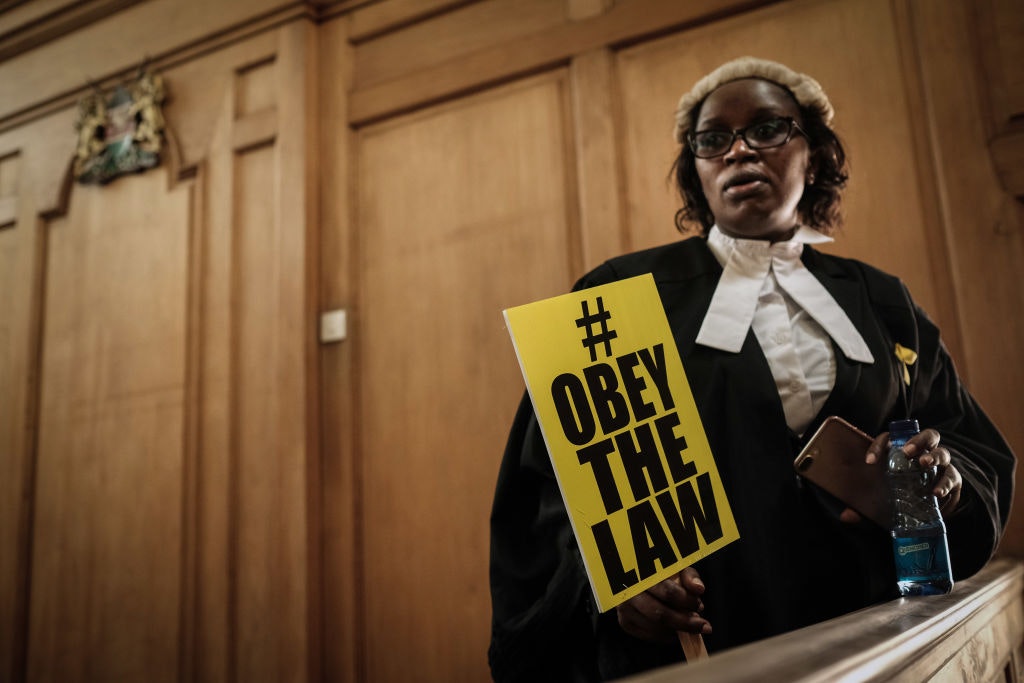
A failed attempt to overhaul Kenya’s progressive constitution less than a year before elections illustrates continuing struggles between the rule of law and the crude tribal instincts of Kenya’s political elite.
The bid to amend 74 clauses of the 2010 constitution was backed by President Uhuru Kenyatta and his allies. It was invalidated by Kenya’s High Court in May, 2021. The decision was later affirmed by a majority of the court of appeal, declaring the Constitutional Amendment Bill 2020 unconstitutional.
The courts ruled that Kenyatta could not purport to assume the role of an ordinary citizen to initiate constitutional amendments. The constitution provides for two avenues of amending it. These are a popular initiative by the citizenry or through a parliamentary initiative.
The appeal court further faulted the process and ruled that the proposed amendments had been pushed through using unlawful conduct. This included bribery, intimidation, coercion, and abuse of state agencies and security apparatus. In addition, the electoral body, tasked with overseeing the process, was not properly constituted.
The bill is better known as the Building Bridges Initiative. Among the retrogressive changes it contained were increased presidential powers and an expanded executive. Just as alarming was a plot by the incumbent to remove the separation of powers. This involved granting the president oversight over the judiciary. The amendments would also have blurred the line between the executive and parliament.
The proposed new positions of prime minister and two deputies were aimed, ostensibly, at redressing the historical regional inequities entrenched by personality politics. Kenyatta and his rival turned ally, Raila Odinga, past masters in ethno-regional political mobilisation, fantastically held that an expanded executive would neuter the dominance of Kenya’s politics and economy by ethno-regional cabals.
They claimed further, unconvincingly, that more executive seats, not social justice, were the answer to Kenya’s adversarial and often violent elections.
Kenya’s economic and political exclusion dates back to the colonial period. Jomo Kenyatta, Kenya’s first president, escalated rather than demobilised this politics. He did this through grand corruption, land grabs, ethnicisation of the state, crackdown on dissent, political assassinations and inequitable distribution of national resources. He excluded opponents and the communities from which they hailed.
This explains the country’s lingering per capita and regional economic disparities. And the fact that Kenya’s former presidents, their families and close allies rank among the wealthiest in the country .
It therefore beggars belief that a political elite pact would have addressed economic and political exclusion. After all, this is not the first time that Kenyans have witnessed power-sharing between political foes.
The political falling out
The Kenyatta-Odinga pact is a form of power sharing that has exacerbated societal divisions and elite fragmentation. It has done so by isolating Kenyatta’s deputy, William Ruto, and his supporters. Ruto’s support was decisive in Kenyatta’s rise to power.
Kenyatta and Ruto fell out shortly after winning a second five-year term following the 2017 elections. The acrimonious falling out has provided further evidence of the enduring personality driven politics of deceit and betrayal that has often driven Kenya to the precipice since independence. It mirrors the infamous falling out between Jomo Kenyatta and the man who fought hardest to clear his path as Kenya’s founding president – vice president, Jaramogi Oginga Odinga.
Fast forward to the 2021 for another episode of Kenya’s tragi-comical political drama starring the offspring of senior Kenyatta and Odinga. Odinga’s scion, Raila Odinga, who had previously accused Uhuru Kenyatta of rigging him out at the ballot, is now his de facto deputy. Apparently Kenyatta now prefers Odinga as his successor and has endorsed his fifth presidential bid.
Kenyatta is determined to stop Ruto from succeeding him. This is despite the fact that they were directly elected on a joint ticket. He reassigned Ruto’s responsibilities to a loyal cabinet minister. Ruto’s associates were also purged from leadership positions in parliament and replaced by Kenyatta-Odinga loyalists.
More recently, the elite security team assigned to Ruto was replaced with the regular police.
Nevertheless, Odinga, Kenyatta and Ruto are ideologically indistinguishable. They are reactionary, opportunistic, disdainful of institutions and adept at tribal mobilisation.
Even though the falling out between Kenyatta and Ruto is not surprising, their incessant public outbursts bode ill for Kenya’s stability. In the event that the results of the presidential elections in 2022 are fraudulent, Kenya could plunge into violence once again.
A game of musical chairs
The proposed changes to the constitution was a bold attempt to entrench in law deal-making among the political elite. These changes would have undermined competitive multiparty politics. They would also have elevated the ethnic barons, whose legitimacy stems from tribal mobilisation, and precariously tied the destiny of Kenya to their whims.
As I have argued before, it is credulous to expect Kenya’s incestuous plutocracy to safeguard and implement the constitution. This is because it has a vested interest in state dysfunction.
In a manner akin to feudalism, the ruling class reincarnates through political office and wealth inheritance. With political power, they have entrenched themselves economically. It is my view that this kleptocracy is the biggest stumbling block to competitive plural politics and Kenya’s transformation.
The Kenyan judiciary is not itself beyond reproach. It is still weighed down by corruption and bribery. And it delivers justice slowly. In addition, it suffers from a legacy of executive interference and appointments and promotions tainted by ethnicity.
But the courts have increasingly asserted themselves against an unruly executive. The annulment of the presidential elections in 2017 over fraud and the recent quashing of the constitutional changes affirm this. Through these landmark rulings, Kenya’s judiciary has distinguished itself as the guard rail of its democracy and rule of law.
Political script
The political script of Kenya’s post-colonial period repeats itself. The first-generation politicians shredded the independence constitution to suit their personal goals. This set forth social, economic, and political problems that the country is yet to shake off. These include corruption, inequalities and impunity. State and political violence and the brazen disregard of the rule of law are symptoms of this legacy.
The president is constitutionally a symbol of national unity. However, since independence, Kenya’s successive presidents have been incubators of divisiveness. They have acted as the fulcrum of tribalism propelled by impunity and grand corruption. All were steeped in insular politics and struggled to tower above the smallness of self-interest. Kenyatta is no different.


