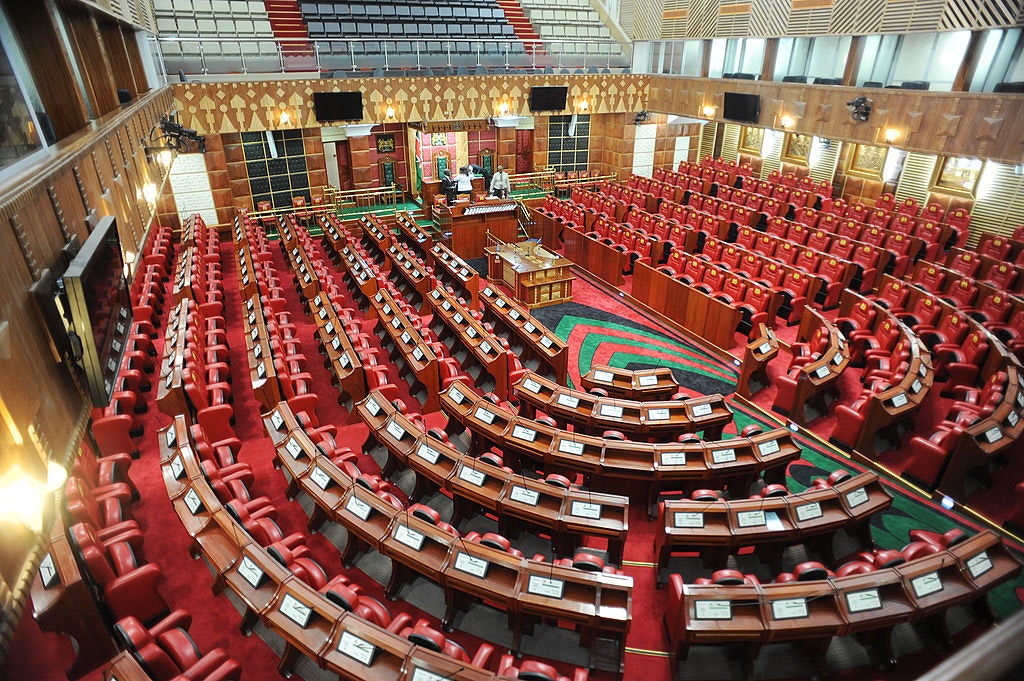
President Uhuru Kenyatta’s government has held a majority of elected seats in both the national assembly and the senate since the 2013 general election. This enabled his Jubilee coalition to drive its agenda largely unhindered over two five-year terms. This will clearly not be the case for Kenya’s incoming president as results for parliamentary seats and the senate show a near 50:50 split between the two main coalitions. Oscar Gakuo Mwangi sets out the roles of the two houses and what the absence of a clear majority will mean.
What are the national assembly’s powers?
Previous Kenyan constitutions centralised powers under an executive president. These were whittled down under the 2010 constitution, which provides for a clear separation of powers. Parliament is one of the three arms of government, along with the executive and the judiciary. Each arm has powers to check and balance the others.
Kenya’s 349-seat national assembly draws heavily from parliamentary traditions practised in the UK and most of its former colonies.
The first piece of business for the new parliament is to elect the Speaker, who maintains order, manages proceedings and governs the administration of business. This includes debating and passing proposed laws, and authorising national and county government revenue collection policies and spending by county governments.
Other functions and powers include allocating national revenue between the national and county governments; appropriating funds for national government and state organs’ expenditure; and overseeing national revenue and expenditure.
Parliament must also approve senior appointments made by the president. It has the power to initiate the impeachment of the president, the deputy president and other state officers. It can also amend or veto bills passed by the senate with a resolution supported by two-thirds of its members. It approves declarations of war and extensions of states of emergency.
The coalition or party that commands a majority has considerable influence in the appointments of the speaker, majority leaders and whips and committee members, and on policy and governance.
What are the senate’s powers?
The Kenyan senate is unique in several ways. It has no exclusive legislative function given that all bills are subject to approval by the national assembly. The constitution does not clearly stipulate which of the two houses is the upper house.
The senate primarily oversees the operations of county governments. It debates and approves bills concerning counties. It determines the allocation of national revenue among counties. The chamber’s powers include hearing and determining impeachment charges against errant county governors.
The lack of constitutional clarity provides an opportunity for the national assembly and the executive to sidestep the senate in certain county-related decision-making processes. This enhances tensions between the two chambers.
What are the power dynamics between the two chambers of parliament?
The national assembly and the senate have fought turf wars from time to time owing to constitutional ambiguities in their roles. The lack of clarity has negatively affected coordination and dispute mechanisms.
Bills concerning counties have to be considered in both houses. Those not concerning counties are the preserve of the national assembly. At times it’s not clear whether a bill concerns counties or not. In such cases, it is a constitutional requirement that both Speakers resolve the ambiguity before the bill is introduced to either house.
Between 2017 and 2019, the national assembly passed 23 laws without the participation of the senate. It unilaterally forwarded 15 others to the senate without complying with constitutional provisions. In October 2020, Kenya’s high court declared the 23 acts of parliament unconstitutional.
The power imbalance is also evident in the way bills are initiated. Laws considered by parliament are usually developed and sponsored by the executive and introduced in the national assembly. In contrast, bills initiated through the senate are usually private member bills prepared by senators.
The vetting of most presidential appointments is the preserve of the national assembly. A few require the approval of both houses, for example the appointment of the inspector general of police.
In the event of impeachment proceedings against the president or the deputy president, the process originates in the national assembly but the senate takes the final decision.
Both houses are also involved in decision-making when it comes to national crises. This includes approving the deployment of the Kenya Defence Forces in and outside the country, and approving the extension of the term of parliament when the country is at war.
In short, the party or coalition that has a majority in both houses can easily influence the legislative agenda.
What is the place of the opposition in parliament?
The role of the opposition is mainly located in parliamentary oversight committees. These committees allow opposition legislators to engage in effective oversight of government affairs, such as expenditure. The members are nominated from a party other than the parliamentary party forming the national government.
What happens when there’s no clear majority?
In a presidential system like Kenya’s, the incoming president would struggle to achieve his electoral promises or to respond to emerging needs or public demands without a clear majority. This can potentially result in a stalemate between the arms of government, which can disrupt the enactment of essential policies and contribute to public disappointment.
It is for this reason that President-elect William Ruto’s Kenya Kwanza Alliance is rushing to form post-election agreements with rival Azimio la Umoja coalition party’s members of parliament-elect. The registrar of political parties argues that such agreements are unconstitutional since the members of parliament-elect have not followed the required legal procedures for withdrawing from Azimio la Umoja.
The registrar nonetheless emphasises that it is within individual politicians’ constitutional right to associate with any party in parliament. The rush to jump ship underlines the fact that political pacts are more about the rewards of government than political ideologies or policies.


